
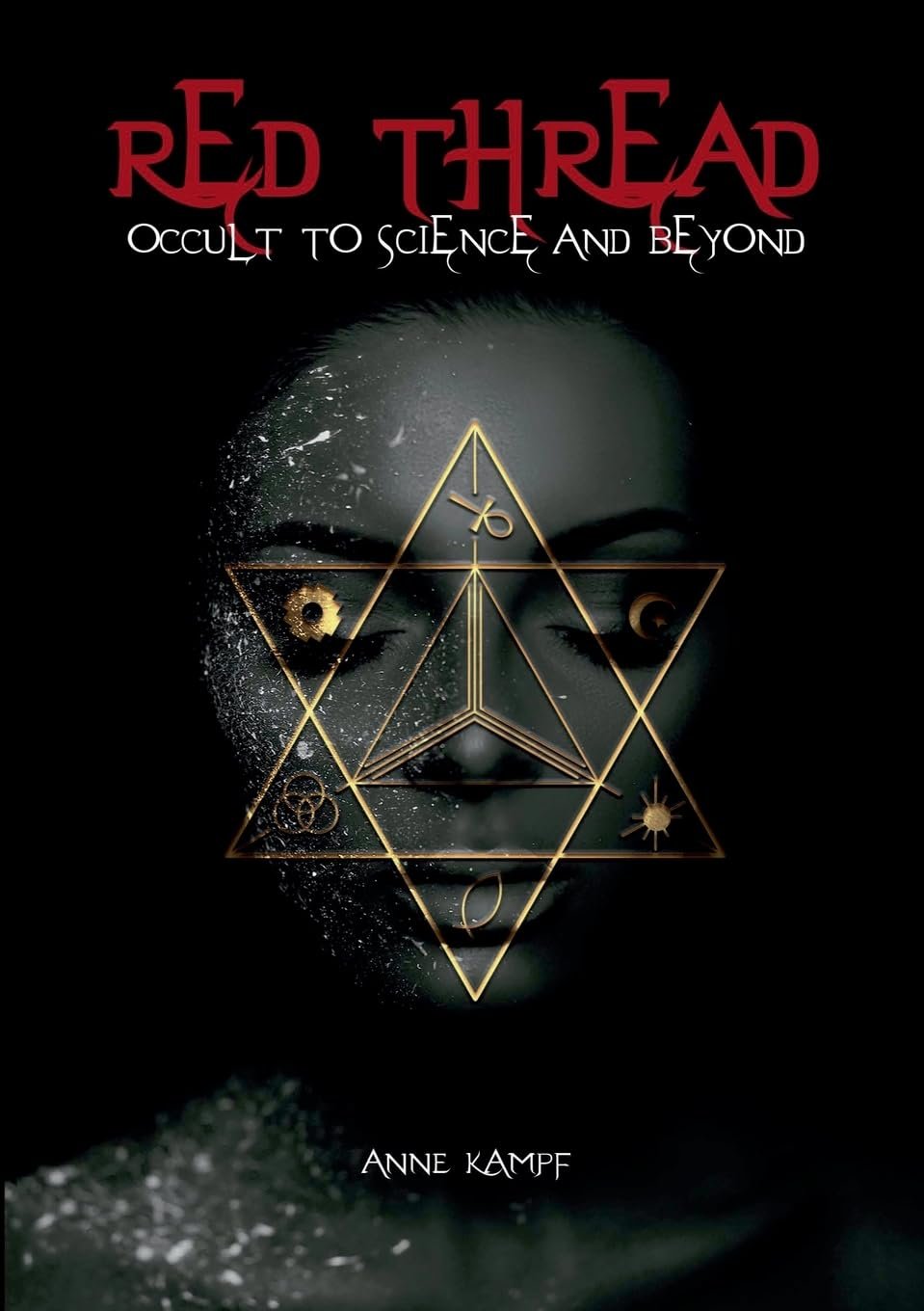
Red Thread: Occult to Science and Beyond
A curiosity-led study traces connections proposed between mythology, alchemy, esoteric traditions and modern science.
Books worth discovering. Authors worth knowing.
The distance between an ancient symbol and a modern laboratory raises questions about history—and evidence.
Publisher describes an exploration of connections among ancient mythology, alchemy, esoteric practices and the development of scientific ideas, by a physics-trained author interested in astrology and anthropology.
Following a question across centuries
Anne-Marie Kampf’s Red Thread: Occult to Science and Beyond invites readers to consider historical connections between traditions now often separated into categories: myth, astrology, alchemy, spiritual speculation, and the development of scientific thought. The publisher frames the book as a search for recurring patterns rather than a conventional laboratory textbook. That approach can appeal to readers interested in how ideas travel and change meaning over time. It also requires careful editorial distinctions. An intriguing historical connection is not proof that an esoteric practice produces reliable scientific knowledge. The value of examining the relationship may lie in tracing questions and cultural influences without collapsing different standards of evidence into one.
The title’s red thread is a suggestive image for intellectual continuity. Human beings have long tried to find order in natural events and personal experience, sometimes through mythic stories, sometimes through symbolic systems, and sometimes through systematic experimentation. Those projects can overlap historically while differing fundamentally in how their claims are assessed. A thoughtful feature can make that distinction visible. The book’s public summary emphasizes the connections Kampf sees; it does not supply sufficient chapter-by-chapter evidence for this article to adjudicate every historical claim or endorse the scientific accuracy of astrology, divination, or alchemical theories.
Alchemy as a complicated ancestor
Alchemy is a particularly interesting entry point because its history includes practical experimentation as well as philosophical and symbolic ambitions. Techniques, materials, and habits of observation developed within varied premodern contexts. Yet it would be misleading to describe modern chemistry simply as alchemy proven right. The histories are entangled, and the epistemic commitments differ. Kampf’s publisher explicitly cites alchemy in describing the route toward present-day science. The claim should be presented as the author’s narrative focus, leaving readers room to ask which continuities are well established and which are broader interpretive associations.
One useful way to read a book like this is to keep three questions distinct. What did people in a particular period believe? What did they actually do in workshops, studies, or communities? And which later developments can be linked through documented transmission of ideas or methods? The first question concerns culture and belief; the second concerns practice; the third requires historical evidence. A book connecting myth and science can be rewarding when it encourages all three. It becomes less reliable when similarity of symbols is treated as sufficient proof of a direct lineage. This is a framework for critical engagement, not a verdict on unverified chapters.
Mythology as a human vocabulary
Ancient myths can preserve narratives about creation, danger, transformation, and the position of human beings within a larger order. They are valuable cultural artifacts even when not read as literal scientific accounts. Kampf’s publisher names mythology as part of the book’s terrain, suggesting an interest in the meanings people have attached to natural forces and recurring patterns. This gives readers an opening to think about how a culture organizes uncertainty. Two societies might describe a similar celestial event in different stories; the similarities and differences can be historically instructive without proving either story functions as scientific explanation.
The strength of a cross-disciplinary approach is that it can prompt readers to encounter unfamiliar intellectual traditions with curiosity instead of contempt. It may also reveal that the history of knowledge was never organized in the clean departments found in a modern university. A past scholar might investigate stars, medicine, religious practice, and philosophy within a single world of inquiry. Modern readers should avoid projecting contemporary disciplinary labels backward too rigidly. But historical empathy does not require credulity: understanding why a belief mattered is different from confirming its factual claims.
The author’s mixed intellectual background
The publisher biography describes Kampf as physics-trained, employed in the energy industry, and interested in psychology, anthropology, astrology, and related traditions. That background helps explain why she might be drawn to connections between seemingly opposed domains. It does not, by itself, validate every argument in the book. Scientific training can inform rigorous curiosity, but a scientific credential is not a substitute for evidence when evaluating a claim about history or esoteric practice. Readers can appreciate the breadth of the inquiry while still asking what sources and reasoning support particular conclusions.
There is a useful human theme beneath that combination. A person may inhabit a technical profession and remain fascinated by stories, rituals, symbols, and the emotional life of communities. Modern intellectual identity need not be one-dimensional. Red Thread appears positioned for readers comfortable moving between history of ideas and reflective speculation. The audience should understand that a project about connections is not necessarily an empirical demonstration of supernatural effects. Keeping both possibilities clearly named respects the author’s interests and the reader’s ability to evaluate claims independently.
Reading across differences without erasing them
Comparative thinking is rewarding because it reveals patterns that isolated study can miss. It can also lead to overconfident conclusions. If two traditions employ a circle, star, or sequence of stages, their resemblance does not automatically mean one borrowed from the other. Similarly, contemporary technology may inherit some methods from historical experimentation without inheriting the philosophical worldview around those methods. A source-conscious reader can look for dates, citations, geographic pathways, and changes in terminology. These are not demands for a dry book; they are ways to preserve what makes a cross-cultural argument interesting rather than merely poetic.
Another useful distinction concerns metaphor. Saying that an idea is a thread between eras can be illuminating without implying a documented chain at every point. Kampf’s title encourages this kind of connective reading. The publication description makes broad gestures toward ancient origins and modern developments, but a book feature should not add specific historical episodes the sources do not name. Readers who love big questions may find the larger frame attractive. Readers who require a narrowly technical history with extensive primary-source debates should inspect the sample or contents before purchasing.
What the publication record verifies
The publisher identifies Red Thread as an English-language paperback published by Books on Demand in 2023. Germany’s national bibliographic notice confirms the title, author, date, and illustrated print format. Those details ground the edition without needing speculative claims about its entire argument. External commentary exists, but quotations from a review cannot replace direct evaluation of every chapter. This article therefore uses the official description to explain the book’s stated project and independent bibliographic data to verify its identity. It deliberately avoids treating enthusiasm about its subject as a substitute for a historical demonstration.
The result is a clearer purchase decision. The book is framed as exploratory nonfiction engaging spiritual and intellectual history, not as a professional chemistry curriculum. Someone hoping for a straightforward account of laboratory method may want a different text. Someone curious about why alchemy, myth, and astronomical symbolism still capture modern imaginations may find this interdisciplinary format inviting. The book’s interest lies in the attempt to place seemingly separate traditions in conversation while leaving the reader responsible for weighing the arguments offered.
Who should read Red Thread
Red Thread: Occult to Science and Beyond is a potential fit for reflective readers who enjoy the history of ideas, the cultural roles of mythology, and questions about how scientific and esoteric traditions have interacted. It may work well for reading groups willing to distinguish documented historical continuity from suggestive analogy. It is less suitable for anyone expecting experimentally validated astrology, medical claims, or an authoritative reference on modern physics. A productive reading posture is open-minded but evidence-conscious: welcome unusual comparisons, ask how they are supported, and recognize that historical influence and scientific truth are different questions. This approach allows curiosity without sacrificing critical judgment.
About Anne-Marie Kampf
Kampf’s publisher biography connects her interest in esotericism and mythology with a degree in physics and professional work in the energy sector. These facts help place her voice in an interdisciplinary conversation. The book’s title and description suggest a personal intellectual journey through overlapping questions, but this article does not claim access to private motivations or unretrieved chapters. Its recommendation is based on the verified theme: an ambitious effort to connect symbolic traditions with the long development of human attempts to understand the world.
About the book.
Cross-disciplinary history of ideas / esotericism and science. Publisher describes an exploration of connections among ancient mythology, alchemy, esoteric practices and the development of scientific ideas, by a physics-trained author interested in astrology and anthropology. Source-based feature, not a firsthand review.
Sponsored book feature. This article uses verified public descriptions and reasoned reading context; it does not claim a full firsthand reading. WordPress cover media fields await publisher automation.
Found a book worth opening?
Books worth discovering. Authors worth knowing.
Return to the Journal →