
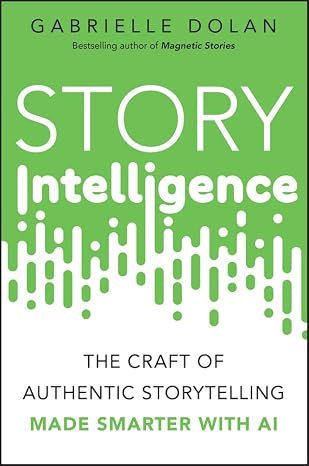
Story Intelligence
Gabrielle Dolan shows how to use AI to improve storytelling processes without surrendering human judgment or voice.
Books worth discovering. Authors worth knowing.
Better storytelling with AI begins not with a prompt, but with a human memory worth sharing.
D.
Human Stories in a World of Generated Words
Gabrielle Dolan’s Story Intelligence begins with a contemporary communications problem: tools can now produce fluent prose quickly, but fluent prose is not the same as a story that creates a meaningful connection. A presentation may sound polished while revealing almost nothing about the person delivering it. A company message may be grammatically perfect yet feel interchangeable with a thousand others. Dolan argues that lived experience remains an irreplaceable source of credibility even as artificial intelligence changes how people draft and refine communications.
The book’s proposition is not that AI must be excluded from storytelling. It is that the human storyteller must continue to choose the purpose, truth and emotional responsibility of the message. That distinction moves the debate beyond simple enthusiasm or fear. Instead of asking whether technology can write sentences, the reader is invited to ask which parts of communication require memory, judgment, accountability and an authentic relationship to the events being described.
What Story Intelligence Means
Dolan describes story intelligence as the ability to use stories deliberately to communicate clearly, connect emotionally and inspire action. In her framework, storytelling is not reserved for artists or entertainers. Leaders, educators, managers and professionals also rely on narrative when they explain a difficult choice, introduce a change or invite someone to trust a shared direction. A story creates a sequence of experiences through which a listener can understand why an issue matters to a real person.
That usefulness is not automatic. A vivid anecdote can still be irrelevant, manipulative or misleading. The intelligence part of the phrase suggests discernment: choosing an experience worth sharing, understanding the audience’s needs and being clear about the action or understanding a story should support. Dolan’s publisher materials emphasize practical techniques rather than a claim that every audience can be persuaded by the right narrative. The aim is to make communication less generic and more accountable to human experience.
Four Kinds of Story Worth Recognizing
The available sample identifies four story categories: personal, professional, public and parable. Each has a different relationship to the teller. A personal story draws on lived experience and can reveal values. A professional story can illuminate work decisions and lessons without pretending that one person’s experience is universal. A public story may use a widely recognizable event to create a shared reference. A parable invites reflection through an illustrative narrative rather than a literal account of what happened to the speaker.
These distinctions help a communicator select material ethically. A parable should not be misrepresented as a verified autobiography; a public event should not be claimed as private experience. Choosing the correct form also affects how much detail an audience needs. A brief workplace anecdote can clarify a policy when a long inspirational monologue would obscure it. Readers can use the categories as a way to ask not merely what story to tell but why that story belongs in a particular conversation.
AI as a Partner, Not the Owner
Dolan’s book openly discusses systems such as ChatGPT and Claude as tools for developing and refining stories. A model can help brainstorm possible angles, organize a draft, compare structures or identify where an explanation is confusing. Those applications can save time for someone who already knows what experience matters. The essential boundary is that the tool must not silently replace the storyteller’s memory or invent testimony that never occurred. Fluency does not make a fabricated scene authentic.
A useful practice is to begin with notes in one’s own words before requesting revisions. Ask AI to help clarify chronology, shorten repetition or offer alternative openings, but return to the original facts and restore any details that carry genuine meaning. Verify claims and obtain permission where other people’s private experiences are involved. The value of the technology then lies in reducing friction around craft while leaving authorship, disclosure and ethical responsibility where they belong: with the human communicator.
Trust Cannot Be Prompted into Existence
Trust depends on much more than a well-shaped story. Listeners notice consistency between words and conduct, particularly when leaders describe difficult decisions. A moving personal account may win attention, but it will not cancel an organization’s failure to act honestly. Dolan’s attention to authentic connection can be read as a reminder that stories are evidence of a relationship, not substitutes for one. An anecdote earns significance when people can recognize real choices and consequences behind it.
AI intensifies this issue because generated narratives can sound intimate without being grounded in an actual life. Listeners may be increasingly skeptical of perfectly calibrated emotional language. The response is not simply to make AI-assisted writing less polished. It is to preserve the truthfulness and specificity of real experience and to disclose the role of technology when that role matters. A communicator who does not own a story’s facts cannot borrow credibility from its tone alone.
Presentations and Meetings Need More Than Data
The book’s practical applications include speeches, pitches, team meetings and presentations. Data can tell an audience what changed, but a well-chosen story can help them understand how that change affected people. For example, a leader explaining a new process might share a genuine experience of a customer or colleague navigating the old one. The story gives scale to the number, provided it is accurate and does not become a substitute for evidence about wider outcomes.
Dolan’s framework may be especially helpful when a presentation is overloaded with abstractions. The writer can ask where a concrete experience would illuminate a concept, then decide which facts remain necessary for honesty. Emotion and reason need not compete. An ethical business story gives the audience something memorable while preserving the right to assess a proposal critically. Persuasion becomes more credible when a listener can see both the human consequence and the supporting information.
A Craft That Improves with Practice
The author’s public materials emphasize examples, sample prompts and practical methods. This positions storytelling as a craft rather than a mysterious natural gift. People may improve through collecting experiences, noticing turning points, testing a structure aloud and removing unnecessary explanation. A rough personal account often contains more distinctive detail than a polished generic statement; revision should bring that detail into focus rather than smooth it away.
Readers can try a modest exercise before reaching for AI: write down a moment when their own perspective changed, describe what happened without grand claims and identify the lesson they would now share. Then ask whether that story belongs in the intended conversation. Only after those choices are made does technical help become most useful. Such a sequence protects the difference between discovering meaning and merely manufacturing an appearance of significance.
Who Should Read Story Intelligence
The clearest audience includes professionals who must communicate ideas clearly, leaders trying to build credibility and writers who use AI but want to preserve personal voice. Teachers, consultants and nonprofit workers may also recognize the challenge of balancing persuasive clarity with truthful experience. The material is relevant wherever a message is meant to move beyond information delivery into understanding. Its business emphasis does not prevent wider application, but readers should adapt its techniques to the ethical expectations of their field.
The book’s enduring question is how human authorship can remain visible when machines make composition easier. Dolan answers by returning responsibility to the teller: choose a true experience, respect its context, understand the audience and use technological assistance without allowing it to dictate what happened. That is a practical and humane way to frame the future of communication. Better tools may accelerate the drafting process; only people can take responsibility for the stories they tell about their lives and one another.
About the book.
A guide to authentic storytelling for business communications, presenting personal, professional, public and parable stories alongside practical AI use.
Independent editorial book feature. Research-based original commentary from public author, publisher, retailer or bibliographic sources; not a firsthand complete-book review. A cover placeholder will be resolved by the publishing automation.
Found a book worth opening?
Books worth discovering. Authors worth knowing.
Return to the Journal →