
The Coffee Shop Masquerade
A mysterious mask watches Hong Kong coffee-shop customers conceal, reveal, and reconsider their lives.
Books worth discovering. Authors worth knowing.
A mysterious mask watches Hong Kong coffee-shop customers conceal, reveal, and reconsider their lives.
An interlinked literary novel about strangers, identity, longing and everyday encounters observed by a strange mask.
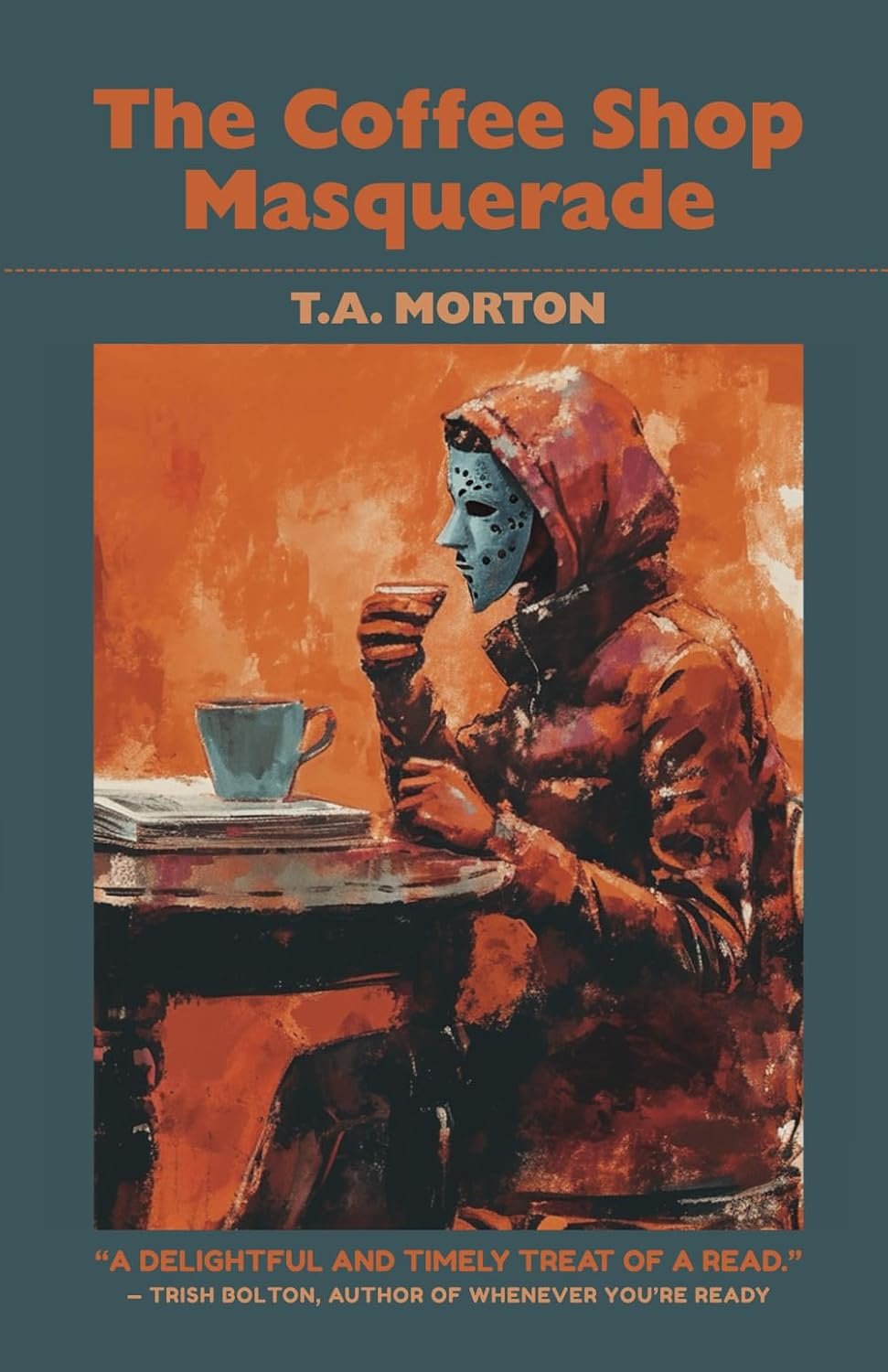
A coffee shop full of lives, and one watchful mask The Coffee Shop Masquerade by T.A. Morton starts with an unusual observer: a mysterious mask abandoned in a Hong Kong coffee shop. It cannot conduct the conversations that fill the room, yet it becomes the fixed point around which those conversations, memories, disappointments, and fleeting encounters accumulate. The publisher describes a novel interested in the question of who people are beneath the roles they present to the world. That premise makes the setting matter. A café is simultaneously public and private, a place where strangers share a room without necessarily sharing their lives, and where an ordinary day can contain a surprisingly complicated emotional history.
The mask has traveled before it reaches its shelf. A bookseller review describes its association with a family story in Italy, a descendant named Mario Risso, and the journey that eventually brings it to Hong Kong. An encounter involving a mysterious man called Monkey contributes to the mask’s unsettled aura. These elements invite curiosity about origins, but the novel’s central attraction appears to be the human lives observed along the way rather than a puzzle with a single mechanical solution. Morton uses an object with no ordinary social obligations to notice the people who are caught up in them.
Hong Kong as more than a picturesque backdrop Hong Kong provides the novel with a setting shaped by movement. People arrive seeking work, relationships, opportunity, escape, or a renewed sense of themselves. Others know the city differently because it is home rather than a temporary destination. The coffee shop creates a small meeting ground among these experiences. Its customers do not need to become lifelong friends for an encounter to leave an impression. That is an important distinction in a story about transient lives: meaning may arrive in moments that are real precisely because they cannot be made permanent.
The publisher’s description emphasizes choices, secrets, and unexpected bonds. Independent coverage points to an ensemble that includes locals and expatriates, with a different character often taking focus in successive chapters. Readers should therefore expect connected perspectives rather than a single straight-line romance or detective investigation. An ensemble can reveal how different people understand the same place and why one person may misunderstand another’s behavior. The result is a way of exploring urban life without pretending everyone who passes through the same doorway shares an identical cultural experience.
The faces people choose to show A mask makes an obvious metaphor for concealment, but it can also symbolize adaptation. A person speaks differently with a stranger than with a parent; a worker manages frustration in ways that a friend might recognize as unnatural; someone newly arrived in a city searches for the identity that will help them belong. Morton’s central object gives the novel a means of examining those shifts without treating every social role as an act of dishonesty. Sometimes a mask hides pain. Sometimes it lets a person move safely through a situation. The distinction leaves room for compassion rather than easy accusations of hypocrisy.
Characters described in public reviews demonstrate the breadth of this question. Jasmine, a barista, is drawn toward possibilities beyond the limits she knows. Grace faces pressures inside her marriage. Rob brings grief with him to Hong Kong. These summaries identify lines of concern, not the outcomes of their stories, and readers should be allowed to discover those without a feature inventing resolutions. The interesting link is that each person can be observed from outside while privately carrying another story altogether. A café offers a setting in which those visible and invisible selves coexist.
An object that complicates the ordinary The mask is also presented as more than conventional decoration. Morton’s own interview describes her fascination with benign everyday objects as narrators or witnesses. Here, she connects the mask with ideas associated with the Tao Te Ching: existence, observation, and the futility of forcing experience into a predetermined path. The object sometimes causes small moments of mischief, according to the author, but it does not have to become a horror-movie monster to change a scene’s meaning. A slight disturbance in a familiar café can make people notice things they previously ignored.
This is one reason the title’s word Masquerade works on several levels. There is the actual mask, the performances imposed by city life, and the uncertainty about how much of another person can ever be known. The story appears to invite patience with unanswered questions. Readers looking for a thriller in which every odd event resolves into a neatly documented conspiracy may want to adjust their expectations. The literary interest described by the publisher and author lies in ambiguity, observation, and how people decide what to reveal.
An interlinked structure and its possibilities Telling a novel through multiple lives can create a special kind of emotional rhythm. Instead of spending every chapter with one protagonist, the reader repeatedly enters another person’s worries and hopes. That can make small details matter enormously: a strained exchange, an awkward misunderstanding, a generous gesture, or an encounter that looks insignificant to everyone except its participants. Independent commentary on the book recognizes this vignette-like form and its interest in longing. The structural choice can encourage readers to see a crowd not as an anonymous mass but as individuals with different unfinished stories.
There is an inevitable trade-off. Readers who want one plot pursued without interruption may prefer a more conventional narrative. Those who like character-led literary fiction may enjoy the way one life illuminates another. A coffee shop is a practical device for sustaining that movement because people naturally enter, leave, and return. The mask remains while the cast changes, allowing it to link episodes without forcing everyone into one improbable chain of coincidence. Morton’s stated fascination with listening to conversations and their hidden meanings supports understanding this as a deliberate formal choice.
East, West, memory, and the limits of explanation Morton’s interview connects the mask’s imagined history with Chinese and Venetian traditions. The point is not to compress those traditions into one universal symbol, but to show how an object can acquire different meanings as it passes between places and people. The novel’s presence in Hong Kong also offers room to consider the misunderstandings that arise when language and cultural expectations do not align. Such experiences may be amusing, painful, or both, and they are familiar to people who have spent time trying to make a home far from their place of origin.
The Taoist influence should be understood as part of the author’s creative framing, not as a claim that the novel is a formal guide to Taoist philosophy. Fiction can introduce an idea by dramatizing uncertainty instead of defining terms like a textbook. Here the mask watches people make choices while knowing very little about what the future will bring. It becomes a reminder that our confident explanations of another person’s motivations are often incomplete. That uncertainty is a productive theme for a book about connection in a fast-moving city.
Who will enjoy this literary masquerade The Coffee Shop Masquerade is a strong prospect for readers of interlinked literary fiction, urban stories, ensemble casts, and novels that use a slightly uncanny premise to reveal everyday emotions. The documented Hong Kong setting, the mask’s unusual role, and the questions of longing and self-presentation make it something different from a standard café romance. It may also appeal to readers interested in the ways expatriate and local lives brush against each other without fully converging.
This introduction is grounded in the publisher description, an author interview, and bookseller and critical summaries. It is not presented as a firsthand review of the entire text, and it avoids giving the individual characters endings that the available descriptions do not establish. The book’s strongest invitation is simple but generous: behind every casual exchange may be a private life that deserves more attention. Readers who find that premise appealing can check the original book listing for format and edition information before choosing to enter Morton’s crowded, mysterious coffee shop.
About the book.
An interlinked literary novel about strangers, identity, longing and everyday encounters observed by a strange mask.
Independent MarketAnyBook editorial book feature. This is a research-based introduction, not a firsthand review, star rating, or guarantee. WordPress cover media are resolved by the publisher.
Found a book worth opening?
Books worth discovering. Authors worth knowing.
Return to the Journal →