
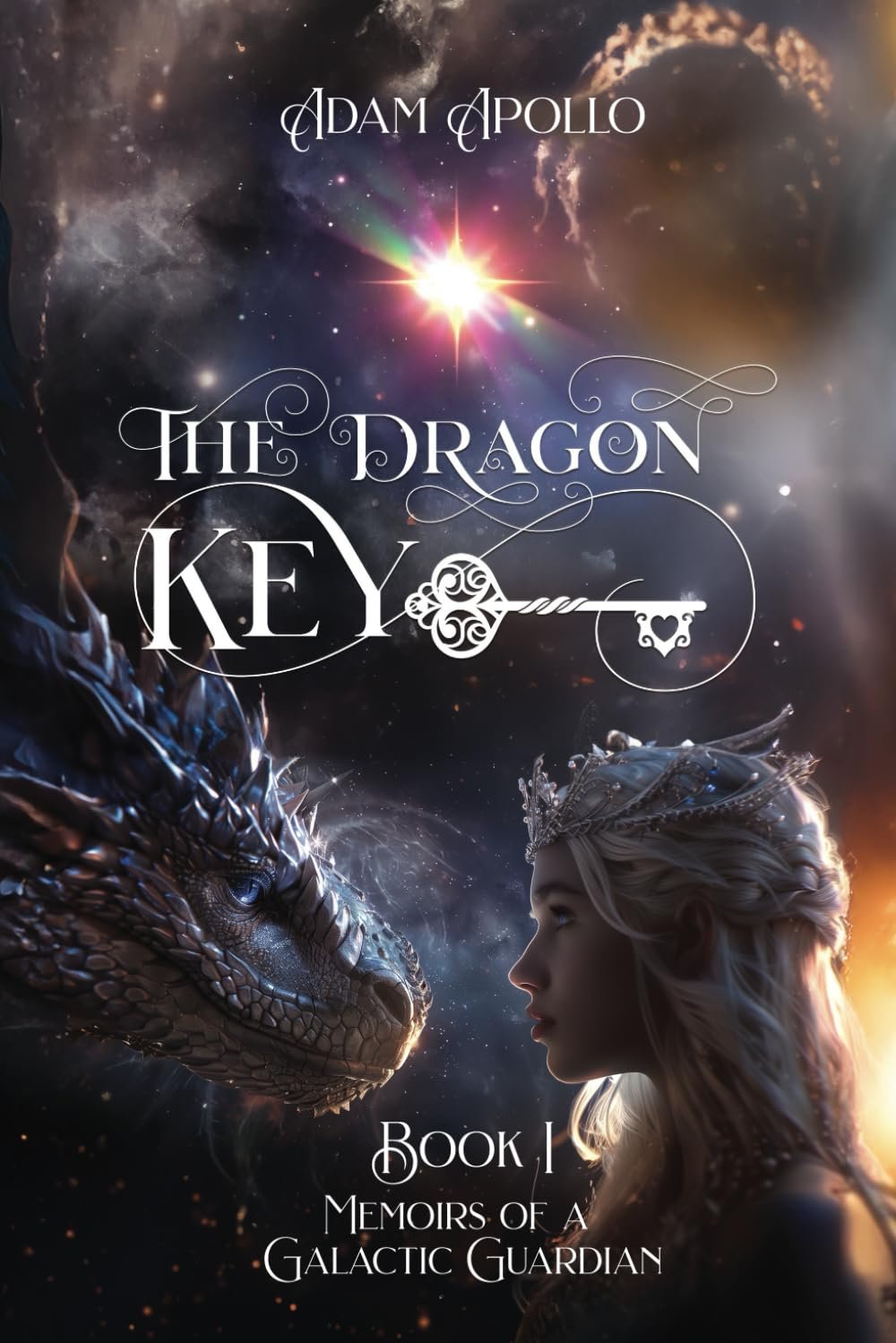
The Dragon Key: Memoirs of a Galactic Guardian
Adam Apollo frames a sweeping galactic saga through personal accounts of past-life memories and speculative spiritual history.
Books worth discovering. Authors worth knowing.
Adam Apollo’s vision moves from the Andromeda galaxy to the Orion Wars, treating cosmic history as a stage for identity and consciousness.
S.
A Personal Mythology on a Galactic Scale
Adam Apollo’s The Dragon Key: Memoirs of a Galactic Guardian presents an expansive vision of identity across worlds and lifetimes. The author’s own launch announcement describes an ancient dragon in Andromeda, a warrior called Shihaelei amid the Orion Wars and a continuing journey through different forms of existence. The book is explicitly framed through personal accounts of past-life memories and metaphysical interpretation. Those are the author’s claims and creative premises; they are not independently established records of extraterrestrial civilizations or historical events.
The title combines three different registers. A dragon belongs to myth, fantasy and symbolism; a key suggests revelation or access; a guardian implies a duty beyond private desire. Together they signal the kind of experience Apollo wants to offer: a story about discovering origin, responsibility and hidden connection. The subtitle calls the work memoirs, but in this context the word does not mean the ordinary documentation of a publicly verifiable career. The author is describing experiences he interprets as memories reaching beyond a single human lifetime.
Such an unusual approach requires the reader to understand the agreement being offered. One can appreciate a visionary narrative as an imaginative or spiritual work without accepting all of its assertions literally. The narrative may draw on the author’s felt experience while asking the audience to inhabit a cosmic worldview. A responsible feature makes that boundary clear. It can explore how the story is constructed and why its questions attract interest without presenting contested metaphysical claims as tested science.
Andromeda, Orion and an Expanding Sense of Self
The author’s announcement names Andromeda and the Orion Wars as significant environments. In astronomy, Andromeda and Orion also refer to real celestial objects or constellations, but those scientific meanings do not authenticate the civilizations portrayed in the book. Apollo’s account uses cosmic locations as settings within a personal, mythic narrative. The distinction is important because vocabulary borrowed from astronomy can sound evidentiary even when the story is operating through intuition, recollection and spiritual symbolism.
The movement between a dragon and a warrior also raises the possibility of identity as something larger than any one body or role. That is a well-established theme in speculative literature, where transformations allow a character to encounter new forms of power, fear and belonging. Here the author’s account gives that question a metaphysical dimension. What would continuity of self mean if memory were imagined to extend across radically different lives? How might responsibility survive a change in form? These are interpretive questions generated by the publicly stated premise, not hidden chapter summaries.
The Orion Wars provide an image of conflict on an extraordinary scale. War stories often depend on group loyalties, disputed histories and moral choices under pressure. A visionary work can use those patterns without reproducing the familiar technology of military science fiction. The author describes his project in terms of spiritual insight and galactic history, so the reader should not assume it is a conventional space-opera novel. Its announced interest is as much consciousness and remembrance as combat or conquest.
Memory, Meaning and the Limits of Verification
Apollo’s website presents the narrative as intertwined with recollections shared by others. That claim is central to how the project identifies itself, and it deserves accurate attribution. An account can be meaningful to the person who reports it even when its historical explanation remains unverified. Readers may approach such material with faith, skepticism or simple curiosity. The editorial task is not to force one response, but to make clear which statements come from the author and which are independently supported.
There is an important difference between memory as a personal experience and memory as evidence for an external event. People can have vivid experiences that shape their sense of identity; that fact alone does not establish the literal reality of ancient galactic warfare. Apollo’s work joins those experiences to a broader cosmic interpretation. Readers interested in visionary literature can explore the narrative’s meaning while recognizing that claims about past lives and civilizations beyond Earth do not meet the same standards as documented historical research.
The project’s own presentation emphasizes connection. Its websites invite readers to explore the author’s account, chapter-related conversations and media connected to the larger series. This creates a reading environment that extends beyond a printed volume. Multimedia material can give useful insight into how a creator understands the text, but it also belongs to the creator’s own interpretive framework. Someone researching the subject should continue to distinguish commentary by participants from independent corroboration.
The Work of Worldbuilding in Visionary Narrative
Regardless of one’s metaphysical position, the book can be approached through literary questions. How does a narrative help a reader recognize a personality that moves between forms? What recurring symbols link distant settings? How does a conflict in one era acquire emotional significance in another? The publicly described dragon, warrior and guardian roles invite such questions without requiring the feature to invent scenes or outcomes. The story’s breadth creates the possibility of pattern and recurrence, the same elements readers follow in many mythic cycles.
Dragons, in particular, have many meanings across literary and cultural traditions. They can represent danger, knowledge, power or transformation, depending on the telling. Apollo’s personal account places an ancient dragon in Andromeda, but the public material does not establish every attribute of that being. It would be inaccurate to import a specific European or Asian dragon tradition and claim it appears unchanged in the text. The more useful approach is to notice that the chosen image carries enormous symbolic potential and then allow the actual book to define it.
The word “guardian” is equally consequential. A guardian’s role is defined through a relationship to what is protected. That role can be noble, burdensome or morally conflicted. In this book’s publicly announced frame, the guardian’s responsibilities extend across cosmic landscapes and multiple states of being. A reader can consider what protection means on such a scale while leaving the specific plot for discovery. This emphasis on duty may help explain why the author uses a memoir-like language of remembered mission rather than presenting only an invented fantasy adventure.
Who Might Be Drawn to The Dragon Key?
Readers interested in metaphysical memoir, visionary fantasy, mythic worldbuilding and stories about consciousness have direct reasons to explore the book. Those seeking scientifically verified cosmology or historical evidence of extraterrestrial wars should know that the author presents a personal spiritual interpretation, not a conventional academic account. Readers wanting only a fast-paced military science-fiction plot should likewise recognize the project’s broader introspective emphasis. The genre boundary is unusual enough that setting expectations is a form of respect.
The author has spoken of creating a series rather than a single isolated book, and the linked edition is identified as volume one. That matters for readers curious about how far the announced mythology extends. A beginning volume can introduce a large imagined or remembered history while reserving later strands for subsequent installments. The safest description is therefore the one supplied by the creator: an opening entry exploring experiences across lifetimes, galaxies and conflicts. It does not warrant forecasting which later revelations the series will establish.
The Dragon Key offers a sweeping personal vision that connects mythic identities with spiritual questions about reality. Its interest lies in an unusual narrative frame and in the emotions that frame may allow the author to explore. Approached transparently—as visionary literature grounded in the writer’s own interpretation rather than independently verified cosmic history—it invites readers into a large story without confusing imaginative possibility, personal testimony and established fact.
About the book.
The author presents a visionary first book about an ancient dragon in Andromeda, a Shihaelei warrior amid Orion conflicts and interwoven past-life memories. The claims are the author’s personal and metaphysical accounts, not established history.
Sponsored book feature. Research-based commentary from named public sources, not a first-hand complete-book review. The cover placeholder will be resolved by the owner’s publishing automation.
Found a book worth opening?
Books worth discovering. Authors worth knowing.
Return to the Journal →