
The Gardens of Byzantium
A Persian woman’s search for refuge leads to a dangerous attachment across enemy lines in seventh-century Constantinople.
Books worth discovering. Authors worth knowing.
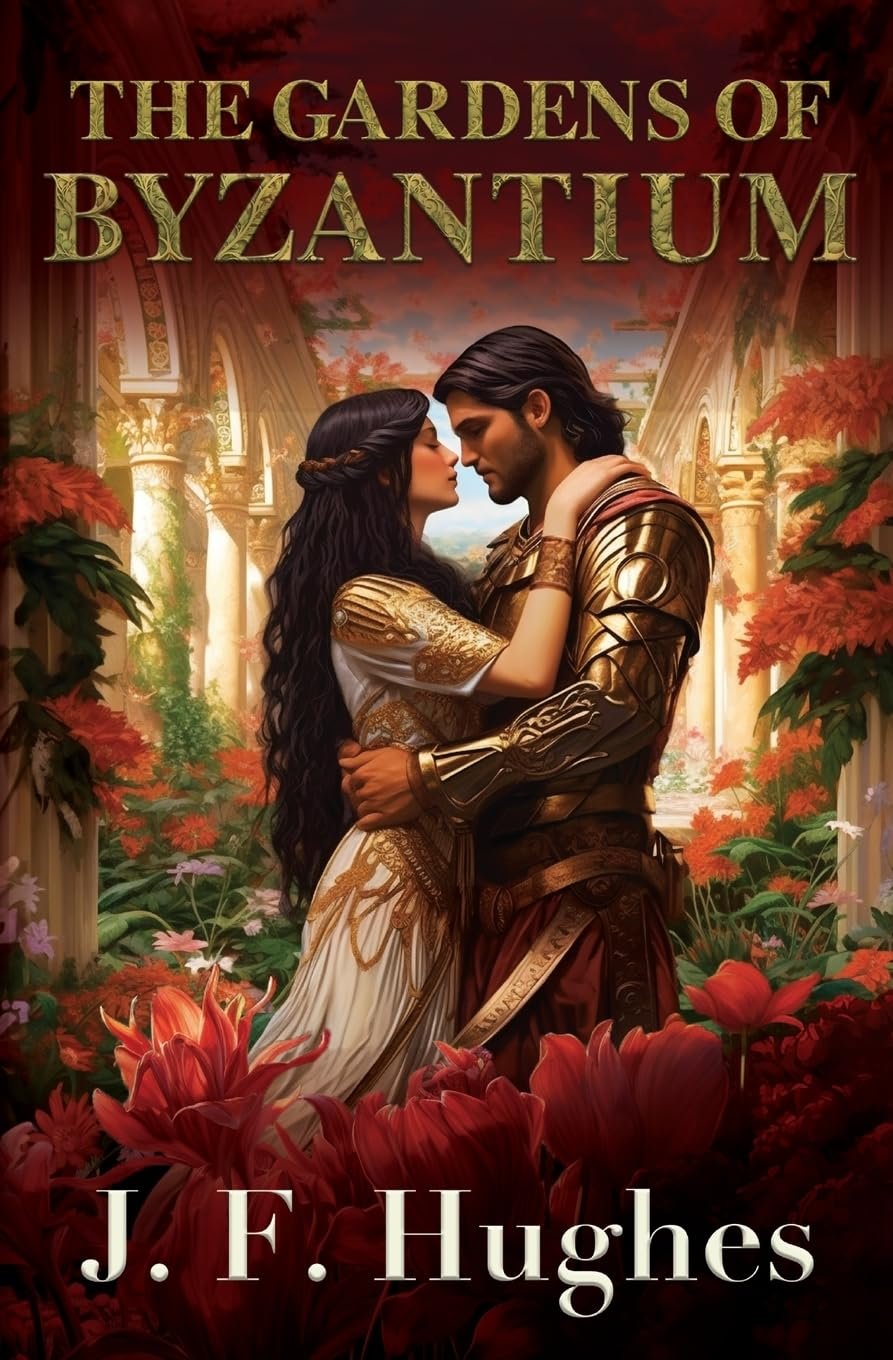
J.F. Hughes sets The Gardens of Byzantium amid the conflict between the Persian and Byzantine empires in 622 CE. Asana, the daughter of a Persian army officer, has spent much of her life moving from one distant garrison to another. Her separation from family eventually brings her into the hands of a Roman soldier and to a beautiful palace in Constantinople. The published premise places love and vulnerability inside a history shaped by war.
An editorial introduction to the book, its premise and the story surrounding it.
J.F. Hughes sets The Gardens of Byzantium amid the conflict between the Persian and Byzantine empires in 622 CE. Asana, the daughter of a Persian army officer, has spent much of her life moving from one distant garrison to another. Her separation from family eventually brings her into the hands of a Roman soldier and to a beautiful palace in Constantinople. The published premise places love and vulnerability inside a history shaped by war.
The following introduction examines the published premise and its context without claiming a first-hand reading of the complete book. It focuses on the book’s identified setting, themes and format, distinguishing public descriptions from interpretations that prospective readers can consider for themselves.
The historical landscape of 622
The novel’s setting is a period when the eastern Roman and Persian empires were engaged in a prolonged struggle. Political borders and military allegiances provide the framework for Asana’s story, but its emotional focus is the effect of that struggle on an individual life. The advertised synopsis does not require readers to know every campaign to understand why movement, uncertainty and loyalty matter to a young woman seeking a home.
Asana’s childhood among garrisons
Asana is introduced as the daughter of an officer in the Persian army, accustomed to being uprooted and taken to new places. Her experience of family life is therefore tied to military assignments and foreign surroundings. The recurring absence of permanence makes the idea of safety especially important. When her circumstances later change again, the disruption has meaning beyond a simple change of scenery.
Flight on a beloved horse
The official description says that Asana becomes separated from family and flees on horseback. The horse serves as a tangible link between a familiar life and the danger she encounters. Her movement toward an unknown destination shifts the focus from politics at the level of empires to the immediacy of an individual’s predicament. It also prepares the premise for a meeting that would have been unlikely under ordinary circumstances.
A mysterious Roman soldier
Asana encounters a Roman soldier who takes her into a palace in Constantinople. Their identities place them on opposing sides of the larger war. That fact gives the advertised romance an inherent tension: the possibility of personal tenderness exists within relations of political conflict and unequal power. Readers may wish to attend to how the novel frames refuge, control and choice rather than assuming that beautiful surroundings automatically mean safety.
Constantinople as a place of beauty and power
The great capital of the Byzantine Empire provides the contrasting setting of palace life. Its gardens and impressive architecture can suggest sanctuary, but a capital is also where political decisions and military anxieties converge. The book’s title draws attention to an enclosed space of cultivated beauty amid a dangerous world. The apparent shelter offered by that space is fragile when the surrounding war remains unresolved.
Love crossing enemy boundaries
Asana’s growing feelings for the Roman soldier create a personal bond at odds with imperial loyalties. Historical romance often gains force from the obstacles surrounding two people, and here those obstacles are connected to their different origins and the unsettled landscape around them. A relationship formed in wartime may offer a temporary sense of belonging while leaving fundamental questions of freedom and future security unanswered.
The return of military danger
The published synopsis indicates that news of a Persian army approaching Constantinople disturbs the fragile calm Asana has begun to feel. This is a stated element of the premise rather than an invented spoiler. The movement of armies reminds readers that political conflict has not paused for private happiness. The romance is therefore framed by uncertainty, with characters unable to separate their personal hopes from the direction of events.
The book’s declared tragic tone
The official description characterizes the story as reaching a tragic conclusion. Knowing that broad tonal direction helps potential readers choose appropriately without revealing particular final scenes. This is not advertised as a carefree love story with difficulties that evaporate. It belongs to a tradition of romantic historical fiction in which personal attachment may be tested by forces that the lovers cannot control.
The author’s interest in music and place
In an interview with The IndieView, Hughes said that reading about Constantinople’s Great Palace while listening to classical music helped inspire the novel. He also described selecting a musical playlist for its chapters. Those details offer an unusually concrete glimpse of how a historical setting and a musical atmosphere can develop together in the writer’s imagination.
Looking more closely at the themes
Historical romance often gives readers two simultaneous experiences. The larger period provides a world with rules, loyalties and dangers unlike their own. The central relationship offers an intimate perspective from which to feel the force of those restrictions. The Gardens of Byzantium announces both elements clearly: the warring empires supply an unmistakable conflict, while Asana’s need for refuge makes the consequences personal.
The garden image is especially suggestive against this setting. Gardens are spaces people shape and protect, sometimes associated with abundance and tranquility. But the novel’s premise places that cultivated refuge inside a capital threatened by war. The contrast helps explain why beauty alone cannot guarantee permanence. Asana’s experience is shaped by the possibility that an apparently peaceful life can be abruptly overturned by forces beyond her control.
Reading the work as fiction matters for another reason. The premise draws on a real period of history, but Asana’s private experiences and the romantic story are part of the author’s literary construction. Readers interested in the era may find the setting an invitation to learn more, while documentary claims about military events should be checked against historical research rather than inferred from the narrative alone.
Hughes’s comments about music indicate that atmosphere was important to his creative process. Sound can suggest pace, mood and emotional scale even when it is not literally heard on the page. The idea of a classical playlist alongside a historical romance provides an additional point of entry for readers drawn to place-driven fiction. It also distinguishes the authorial framing from a purely plot-oriented description.
Who may want to explore this book
Readers of historical romance who appreciate court settings, divided loyalties and the emotional uncertainty of wartime may be drawn to The Gardens of Byzantium. Its seventh-century Persian and Byzantine setting offers a distinctive alternative to more familiar medieval European backdrops. The published synopsis makes the tragic tone clear, so readers who insist on an uncomplicated happy ending should consider that before choosing it. The strongest appeal is the meeting of intimate longing and political conflict, with Constantinople providing the richly imagined setting.
About the book.
J.F. Hughes sets The Gardens of Byzantium amid the conflict between the Persian and Byzantine empires in 622 CE. Asana, the daughter of a Persian army officer, has spent much of her life moving from one distant garrison to another. Her separation from family eventually brings her into the hands of a Roman soldier and to a beautiful palace in Constantinople. The published premise places love and vulnerability inside a history shaped by war.
Sponsored Book Feature. MarketAnyBook’s queue identifies this article as sponsored. Based on published book information; not represented as a first-hand full-book review.
Found a book worth opening?
Books worth discovering. Authors worth knowing.
Return to the Journal →