
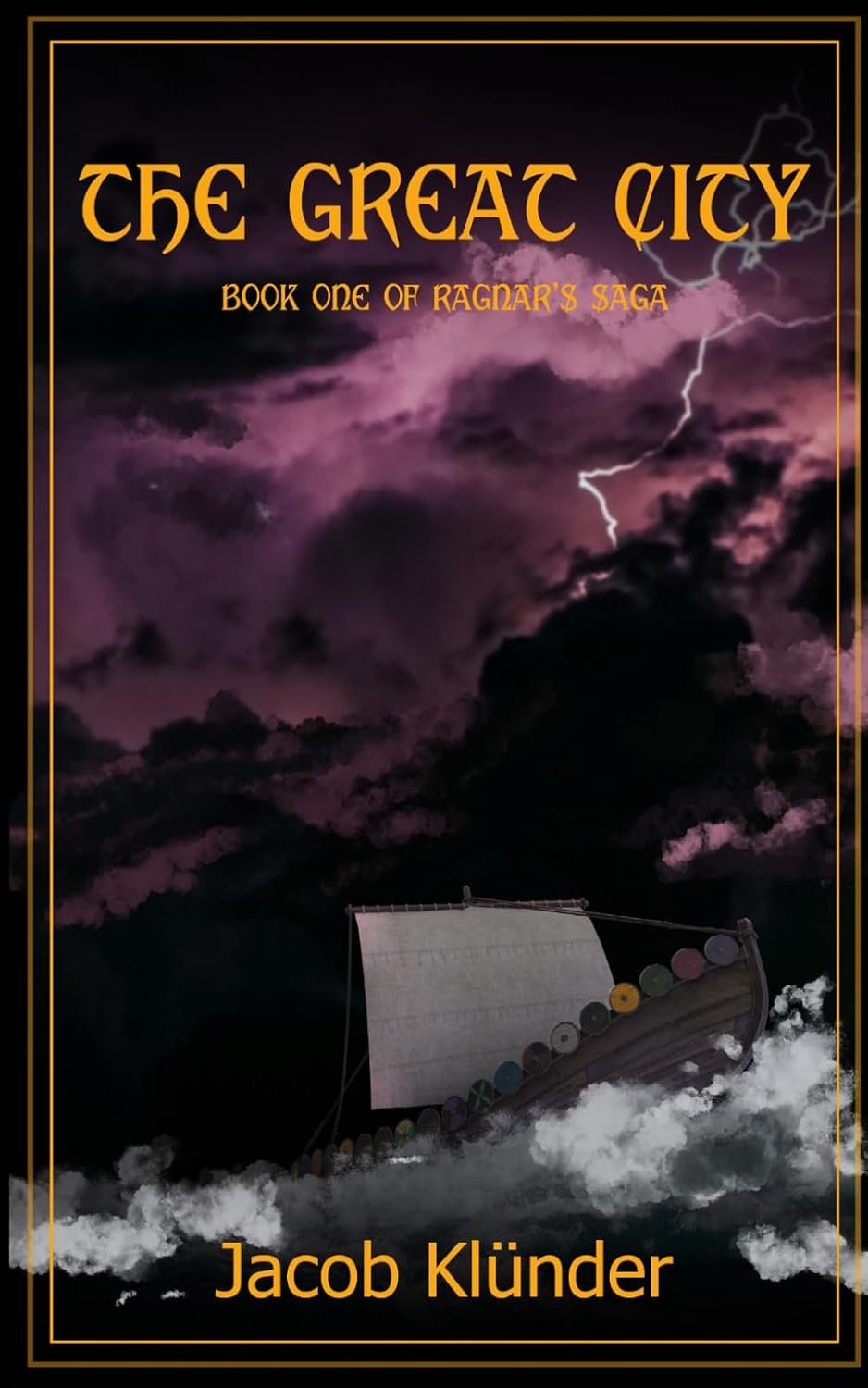
The Great City: Book One of Ragnar's Saga
The Great City announces itself as the first part of Ragnar's Saga, a title that invokes large settlements, political power and a personal journey shaped by legend. The named author is Jacob Bjørnø…
Books worth discovering. Authors worth knowing.
The Great City announces itself as the first part of Ragnar's Saga, a title that invokes large settlements, political power and a personal journey shaped by legend. The named author is Jacob Bjørnø Klünder and the queue credits Auralys Wium for illustrations. Those are the secure bibliographic facts. Public descriptions offering a reliable sequence of…
Considered reviews, grounded in the book’s documented promise.
The Great City announces itself as the first part of Ragnar's Saga, a title that invokes large settlements, political power and a personal journey shaped by legend. The named author is Jacob Bjørnø Klünder and the queue credits Auralys Wium for illustrations. Those are the secure bibliographic facts. Public descriptions offering a reliable sequence of characters and events were not established, so this review does not manufacture a Viking raid, a kingdom's downfall or a particular quest. The legitimate critical invitation lies in asking what a city means within a saga: a promise of belonging, an engine of authority, or a place an outsider longs to enter.
A city as a character
Epic fantasy often treats its capital as a symbol of power. But a city is first a dense network of dependencies: food, trade, authority, memory and ordinary relationships. A title that elevates the city creates an expectation that place will matter to the story beyond serving as a battleground. Readers may look for the felt difference between entering its gates and inhabiting its streets. This is a genre-context question, not a report that specific scenes appear in Klünder's book.
The promise of Ragnar
A saga named after Ragnar invites an individual trajectory across a longer sequence. The name carries Norse associations for many readers, though nothing in the available description proves the protagonist is a historical or mythological figure. The responsible reader should resist equating familiarity of name with familiarity of plot. What matters more is whether the series gives its central figure competing obligations and allows the political landscape to change through choices rather than predetermined destiny.
Illustration as another narrative voice
The credit to Auralys Wium suggests that images are a designed part of the edition rather than incidental decoration. Illustration can clarify geography, change pacing and reveal tonal details that prose leaves unsaid. It can also fix the reader's imagination in ways that a purely verbal epic keeps open. The artwork itself has not been inspected here, so no claim is made about style, technique or quality. An eventual full review should examine how image and text cooperate rather than treating the illustrator as a footnote.
A first volume's difficult bargain
An opening book has to convince readers that its world is worth entering without requiring knowledge of a sequel. Too much explanation can delay emotion; too little can make a strange world feel arbitrary. The series designation makes that balance central to evaluation. The most useful questions are whether immediate conflict has human scale and whether the conclusion gives meaningful local resolution even as larger mysteries remain. No public sample was available to establish that balance.
What cannot be inferred
It would be easy to fill a review of an ambiguously titled saga with helmets, longships, prophecies and battles. None of those details follows from the title alone. A professional review must insist on the difference between a genre expectation and a reported fact. The Great City remains a potentially interesting illustrated fantasy opening, but any more decisive appraisal requires the actual synopsis, illustrations and a substantial reading sample.
Who will value this book
For readers interested in illustrated fantasy sagas, Norse-inflected naming and long-form world-building, with the important reservation that the accessible record does not yet establish the plot or audience age. The review is a cautious discovery note and needs full-text source verification before publication.
Scope of this assessment
This is a research-based editorial review drawn from identified bibliographic, author and publisher sources. It considers the work’s documented premise and the critical questions it invites, without claiming a complete firsthand reading. No unverified scene, character action or ending is asserted.
About the book.
An evidence-bounded critical introduction to illustrated Norse-inspired saga fantasy. Published descriptions support the stated premise; interpretations are identified as editorial analysis, not confirmed plot details.
This review concerns a book marked sponsored in the current MarketAnyBook queue. Sponsorship is disclosed, and all observations remain research-based. No reliable full plot synopsis obtained. Critical claims are explicitly framed as questions and genre context. Illustrator artwork not inspected.
Found a book worth opening?
Books worth discovering. Authors worth knowing.
Return to the Journal →