
The Human Inside: Reditus
A spacefaring return for the amborgs, whose emergency recall meets a threat beyond Earth.
Books worth discovering. Authors worth knowing.
A spacefaring return for the amborgs, whose emergency recall meets a threat beyond Earth.
Research-based literary perspective on a verified edition.
In Y.T. Cheng’s The Human Inside: Reditus, the familiar action-adventure invitation to save the world gains a difficult complication: the heroes have already done something extraordinary once. Nearly ten years after the amborgs saved their country, their work has spread outward, with a continuing mission to protect people beyond the scene of that original victory. The published description introduces an Emergency Recall, an approaching threat from space and David 117’s effort to gather a scattered team. Those few established details suggest an unusually productive starting point for a sequel. What happens when a celebrated rescue becomes an ongoing responsibility, and what does being human mean when the people asked to respond are no longer simply ordinary human beings?
The problem with saving the world once
A first heroic mission often has a clean dramatic outline: a danger appears, unlikely allies unite and a decisive confrontation tests their courage. A return adventure must do something more demanding. It has to acknowledge that success changes the lives of the people who accomplished it. In this book’s available synopsis, the amborgs have not spent the intervening years standing still. They have taken their protective mission into the wider world. That continuity invites readers to think beyond the satisfying final scene of an earlier instalment. Protection is not a trophy; it is an activity that keeps presenting new circumstances.
That shift can deepen the question at the heart of a long-running superhero or science-fiction sequence. Is heroism a special talent, a decision made under pressure, or a commitment that survives the applause? The distinction matters because duty can become expensive. A person who once volunteered may discover that others now expect them always to answer. Without claiming to know the novel’s precise internal conflicts, the premise itself puts this tension within reach: the amborgs are needed again, and their previous achievement has not made the future safe.
An Emergency Recall with personal consequences
The Emergency Recall is one of the description’s most intriguing devices. On the surface it is an efficient story mechanism, bringing a dispersed cast together when an exceptional situation demands it. Yet the idea also carries an emotional charge. Recalling a group means asking its members to leave wherever their lives have taken them. Even when a mission is justified, a recall may interrupt commitments, relationships and the ordinary possibilities that people have cultivated since an earlier adventure. The public description does not specify those individual situations, so readers should resist treating them as confirmed plot points. As a structural possibility, however, the device creates room for the costs of cooperation to matter alongside its excitement.
Ensemble adventure is especially interesting when togetherness is not effortless. A team has to coordinate uneven experiences, different kinds of knowledge and perhaps different definitions of a successful outcome. Cheng’s premise places the amborgs in a world that has moved forward by almost a decade. Time itself becomes a source of narrative pressure: shared history can provide trust, but it can also tempt characters to assume the old solution will work in a changed environment. A compelling sequel lets the reader feel the weight of what is familiar while remaining alert to what has become newly uncertain.
From a national rescue to an off-world horizon
The published description clearly distinguishes an earlier domestic crisis from a new threat emerging from space. The enlargement is more than a matter of spectacle. A threat from beyond Earth challenges the scale on which readers imagine agency. At home, heroes may understand institutions, geography and the people they have sworn to protect. Away from that setting, familiar measurements of distance, risk and success can become unreliable. Science fiction uses such crossings to ask whether courage depends upon knowing the territory. It is easy to promise that one will act decisively; it is harder to act when the setting itself exceeds one’s understanding.
David 117 is identified as a leader preparing his friends for a mission whose odds look nearly impossible. That description offers an appealing space-opera tension between audacity and stewardship. An adventurous protagonist may regard low odds as an invitation, while a responsible leader must consider what failure would mean for everyone else. The book appears designed to satisfy an appetite for heightened danger, but its premise also allows a quieter question: how much uncertainty should an individual ask a team to carry in the name of protecting strangers?
Technology and the human measure
The word “amborgs” is central to the series description, and the title The Human Inside gives the editorial conversation a direction even before the story’s detailed mechanisms are known. It would be unwarranted to invent rules about their bodies, origins or technology from a title. Yet an adventure involving beings described as amborgs naturally sits near science fiction’s longstanding inquiry into personhood. When enhanced capability grows, does compassion grow with it? Who decides whether someone counts as fully human, and is technical strength an adequate measure of moral authority?
These are reading lenses rather than assertions about scenes that have not been examined. They are also part of what makes this sort of speculative fiction useful. By moving the familiar problem of responsibility into an unfamiliar technological future, the form can unsettle easy distinctions between the powerful and the vulnerable. A story may feature impossible machinery and still be concerned with recognizable choices: who is worth defending, how far care should extend, and what a team owes those who cannot protect themselves.
The special demands of a sequel
Reditus is presented as following The Human Inside: Adaugeo. A reader entering a series at this stage will probably notice references to an earlier mission, established relationships and the accumulated meaning of an Emergency Recall. For returning readers, the reward is continuity: the opportunity to ask whether characters have learned anything since the first crisis. For newcomers, the practical question is whether the pleasure of encountering the world at a moment of renewal outweighs the advantage of beginning at its origin. The retailer’s description openly frames this as a sequel, so starting with the earlier book may be a useful choice for those who want context.
A sequel should neither mechanically repeat its predecessor nor discard the reasons people cared about it. Cheng’s published premise makes that balance visible through changed stakes, an established team and a mission beyond the earlier horizon. Whether the novel ultimately achieves that balance is something readers can judge from the text itself. The available research supports the setup and its ambitions, not a verdict on pacing, prose or the success of individual scenes.
Questions to carry into the adventure
Watch for how the book defines success. Is protecting the planet an objective that can ever be completed, or does the obligation renew with each threat? Consider the relationship between David 117’s resolve and the agency of his fellow amborgs. Do collective risks require collective consent, and how might a group distinguish courage from a refusal to accept limitations? Notice, too, what the story makes of its nearly ten-year interval. Time can create maturity, exhaustion, distance or a stronger sense of purpose; what matters is how a work chooses to dramatize change. None of these questions presumes answers not established by the public description. They are prompts for attentive reading rather than hidden spoilers.
Who may want to read it
Readers who like ensemble science fiction, large-scale rescue missions and action-oriented speculation are the clearest audience for Reditus. The setup also has appeal for people who prefer heroes defined by responsibility rather than effortless invincibility. Fans of serial storytelling may particularly value the combination of an older victory and a newly assembled team, provided they are comfortable with a sequel that follows an earlier title. Readers primarily seeking intimate realism or a standalone novel with no prior context may wish to inspect a sample first. The verified information promises ambitious off-world stakes, not a specific balance of humour, romance, violence or technical exposition. Choosing by that honest distinction is better than treating every science-fiction adventure as interchangeable.
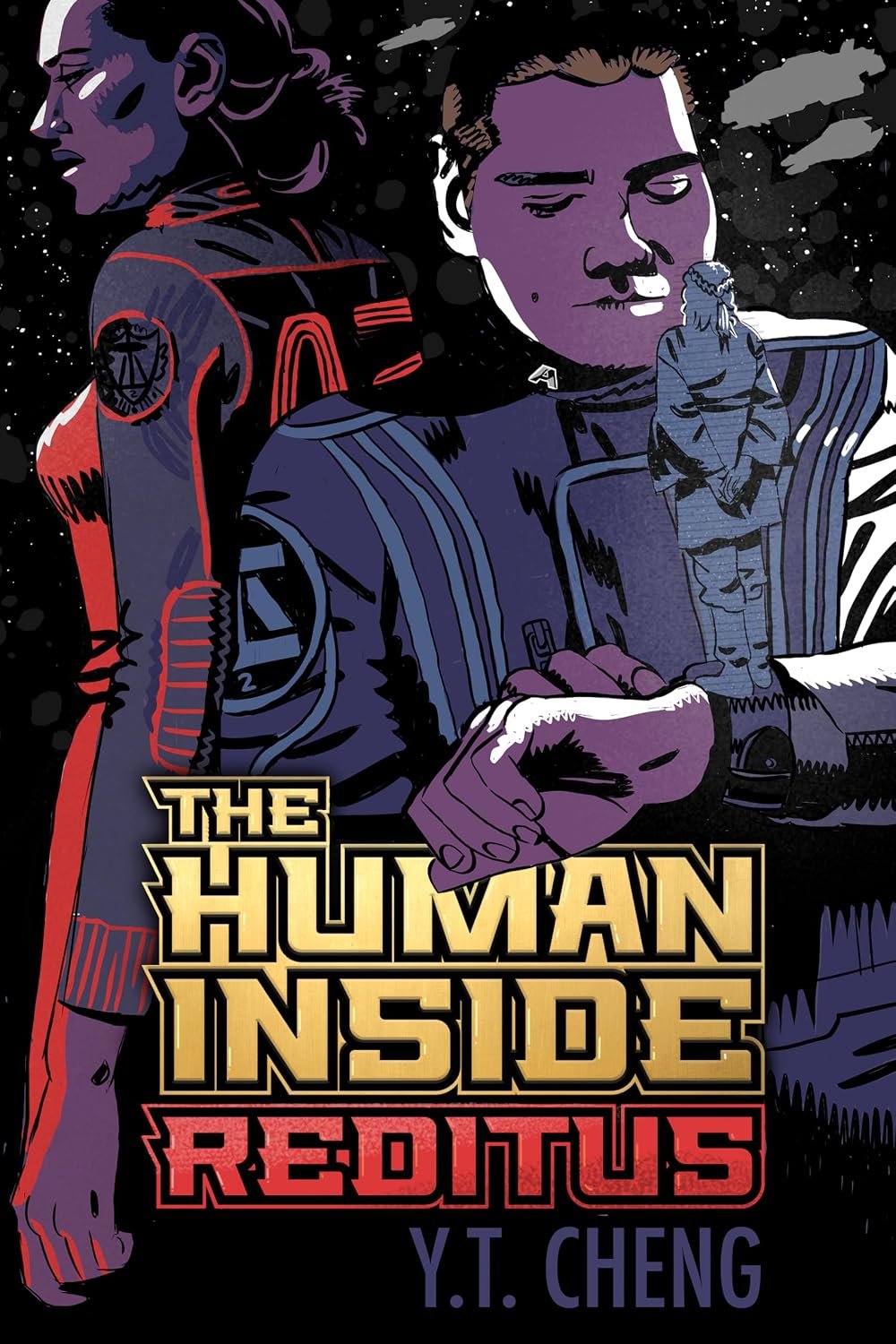
The published credits associate Y.T. Cheng with the novel, Michael Batista with illustration and Skyler Surber with editing. Their contributions belong to this edition’s identity, not merely to a line of metadata. Reditus can be approached as a test of how a long-running imagined world expands without losing its emotional reason for existing: the persistence of people willing to answer when the call arrives again.
About the book.
A spacefaring return for the amborgs, whose emergency recall meets a threat beyond Earth. The purchase link preserves the original listing in the queue.
This is an independent research-based editorial introduction, not a claim to firsthand reading or a personal review of the full book. Sources comprise publicly available publisher, retailer or bibliographic descriptions and the verified queue and cover; detailed interior content has not been independently examined.
Found a book worth opening?
Books worth discovering. Authors worth knowing.
Return to the Journal →