
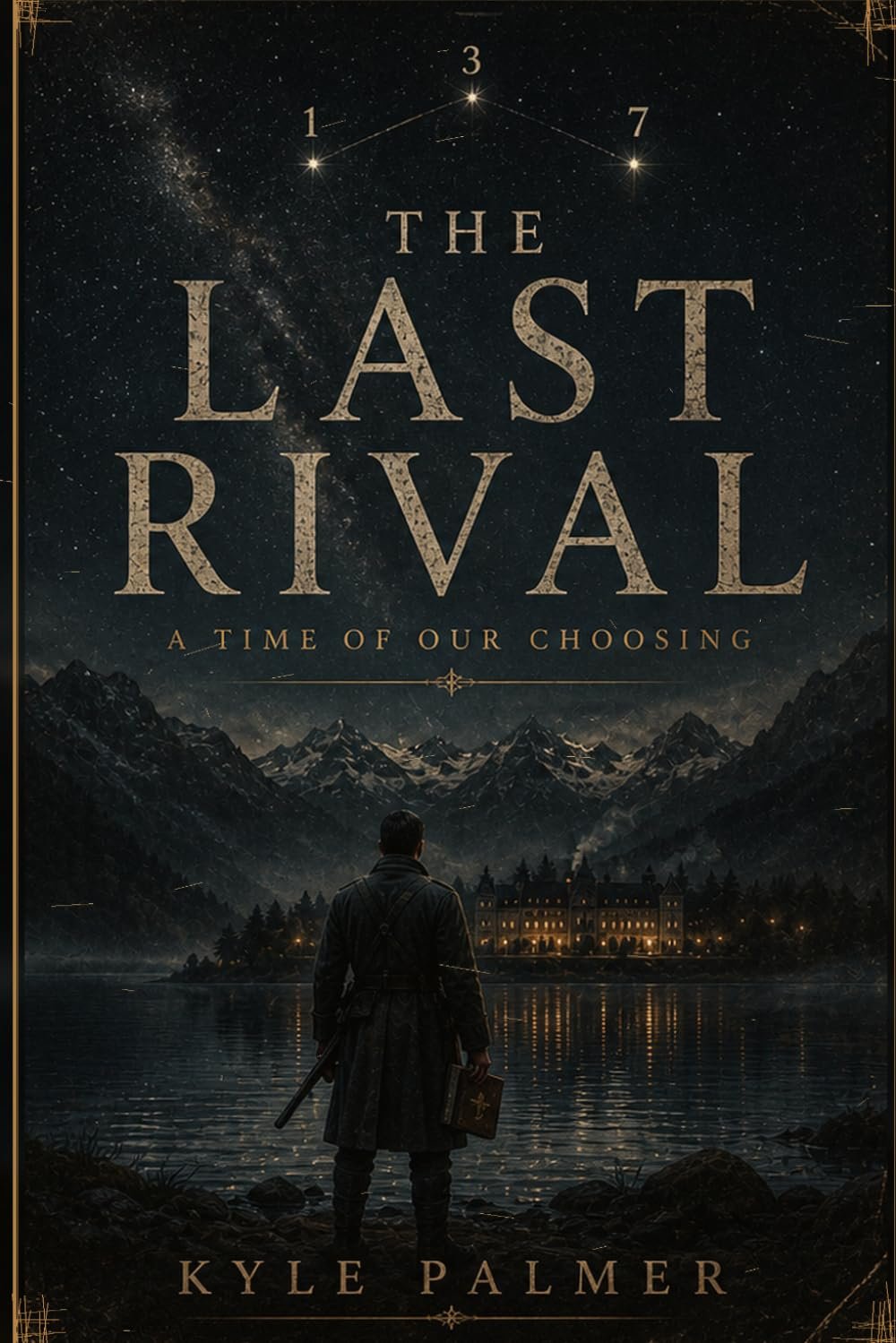
The Last Rival: A Time of our Choosing
An alternate-history historical thriller confronts the fragile peace and intelligence struggles after World War II.
Books worth discovering. Authors worth knowing.
War ends on paper long before its hardest moral decisions stop shaping the people who survived it.
A postwar novel involving Lewis Weinman, Jim Bolden, President Truman, and the emergence of covert conflict.
The uneasy opening after victory
The Last Rival: A Time of Our Choosing places its readers in the unusual space between victory and confidence. Kyle Palmer’s published synopsis opens on August 20, 1946, as Lewis Weinman, Jim Bolden, and their team gather near the Lincoln Memorial. World War II has ended, but the characters are not entering an uncomplicated period of relief. They are facing the consequences of wartime decisions and the early contours of a very different international conflict. The setting matters because it places public symbols of American unity next to private doubts about what the country should do next.
The novel is described as a historical and philosophical exploration rather than a straightforward account of troop movements. The tension lies in what victory permits and what it demands. After a world war, the capacity to act decisively may still be present, but the legitimacy of action becomes harder to assess. Readers interested in the birth of postwar intelligence strategy have an accessible point of entry without needing the article to invent an undocumented secret mission.
Lewis Weinman and Jim Bolden
The promotional account identifies Lewis Weinman and Jim Bolden as central figures wrestling with loyalty, duty, and the legacy of their earlier actions. This gives the story a human scale inside an enormous historical transition. Large international conflicts can be explained through conferences and dates, yet fiction often becomes most engaging when people must carry conflicting convictions into a room and decide whether cooperation is still possible. The two men’s relationship appears to provide that kind of pressure.
Their concerns are not described in enough detail to justify a scene-by-scene summary or a verdict on their motivations. Instead, the verified premise points toward shared burdens and difficult choices, including events in Argentina. The question the novel raises is how people who acted in one moral environment interpret their responsibilities in another. A decision once defended as necessary for wartime survival may look very different when the goal is to preserve a peace.
A meeting with President Truman
The public announcement places the group on a path toward a consequential meeting with President Harry Truman. That detail situates the characters near institutions of enormous power without requiring readers to accept the novel as a documentary record. Historical fiction can use real public figures to dramatize questions that formal histories often express more impersonally. Here the concerns are ideological difference, intelligence, and the political cost of protecting a new global order.
The presence of a real president creates a useful reading distinction. Truman was a historical figure, but the conversations, private motives, and particular meeting represented in a novel should be treated as fictionalized unless independently documented. Palmer’s premise invites an exploration of period pressures, not a substitute for archival scholarship. That boundary is especially important when fiction approaches consequential decisions in U.S. foreign policy.
Espionage before the familiar Cold War script
Most readers know the Cold War retrospectively as a period with recognizable alliances, institutions, and language. The characters of a story set in 1946 have no access to that hindsight. They must interpret emerging threats while their own side is still deciding which methods it is willing to employ. The announced novel refers to the CIA’s nascent role and ideological rifts, placing intelligence work within a changing institutional landscape.
The tension can therefore come from uncertainty rather than from a villain whose plans are already known. A covert organization may view secrecy as necessary, while those affected by secret choices might question accountability. A soldier trained for open conflict may find political ambiguity especially difficult to navigate. These are thematic possibilities supported by the book’s public framing, not assertions about specific operations or tactics in unread chapters.
Argentina and the long shadow of action
Promotional material identifies Argentina as another setting in which Weinman and Bolden confront past actions and uncertain futures. That geographic move widens the narrative beyond Washington and signals the global reach of the postwar reckoning. Readers familiar with the period will recognize that European conflict had consequences far outside Europe’s borders. Palmer appears to use an international setting to test what the protagonists believe about justice and necessity.
The exact purpose of their journey, any identities they encounter, and the outcome of their choices are not verified in the available book description. Avoiding those inventions makes the larger established idea clearer: distance from the battlefield does not grant moral distance from a war. People may travel, change roles, and enter new organizations while still confronting the commitments and compromises they made earlier.
Alternate history and historical responsibility
The Last Rival is cataloged as historical fiction and has been noted in an alternate-history awards context. That does not mean every depicted event is intended to diverge from the record in the same way. The most useful approach is to read the novel as a constructed world informed by documented history, with room for imagined meetings and decisions. It can be compelling precisely because the choices feel plausible against a recognizable historical background.
Alternate history can invite readers to ask not just what happened, but what people thought was possible at the time. In this case, questions of peace, intelligence, and rival ideologies are more substantial than a simple puzzle about a changed date. The premise directs attention toward decisions whose consequences are too large for any single participant to understand completely.
The novel also asks readers to remember that peacetime narratives are built after the fact. The people living through August 1946 had to interpret unfamiliar institutions and unstable alliances as they developed, not as chapters in a history they already knew. This perspective is an important difference between experiencing a political transition and studying it decades later. Fiction can inhabit that uncertainty by limiting characters to the knowledge available within their world. Palmer’s published premise gives the postwar moment enough specificity to make those unknowns central to the imagined choices before the team.
The attraction of morally complicated historical fiction
A reader seeking clean heroes and uncomplicated institutional certainty may find a book centered on ethical tension less comfortable than an adventure with obvious sides. That discomfort can be purposeful. A character who sincerely believes in duty may still disagree with allies about how it should be fulfilled. A new geopolitical system may reward tactics that challenge older assumptions about honorable conduct. Historical fiction can give these abstract problems emotional weight by binding them to identifiable people.
The novel’s promise rests on the collision of a dramatic period, two men carrying complicated experiences, and a country entering a new form of rivalry. This article draws its factual details from the publicly available announcement. It does not claim to know the ending, the precise structure of the espionage plot, or how successfully the finished manuscript balances character with historical atmosphere.
Who should explore this book?
The Last Rival: A Time of Our Choosing is worth exploring for readers interested in post-World War II historical novels that emphasize political uncertainty, covert strategy, and moral responsibility. Its identified characters, Lewis Weinman and Jim Bolden, provide a personal route into an era when wartime alliances were giving way to new rivalries. Readers who enjoy debates about duty, national power, and the costs of clandestine decisions may find the premise particularly appealing. This feature relies on publisher-supplied descriptions rather than a firsthand evaluation of the novel’s fictional conversations or conclusion.
About the book.
Set in the uncertain aftermath of World War II, the novel follows Lewis Weinman, Jim Bolden, and associates as geopolitical tensions and the ethics of covert action emerge during a fragile peace.
Independent MarketAnyBook editorial book feature. This article is an introduction grounded in public listings and is not a firsthand reading, rating, or guaranteed endorsement. Descriptions and interpretive commentary are distinguished; the separate Python publisher will resolve the public WordPress cover URL and media ID.
Found a book worth opening?
Books worth discovering. Authors worth knowing.
Return to the Journal →