
The Rise of the Iron Major (The fall series)
How a disciplined officer turns collapse into a ruthless new order.
Books worth discovering. Authors worth knowing.
Ellis Grayson’s The Rise of the Iron Major approaches the collapse of civilization from a disturbing direction.
An original critical assessment, grounded in verified public book descriptions.
Ellis Grayson’s The Rise of the Iron Major approaches the collapse of civilization from a disturbing direction.
The anatomy of a tyrant
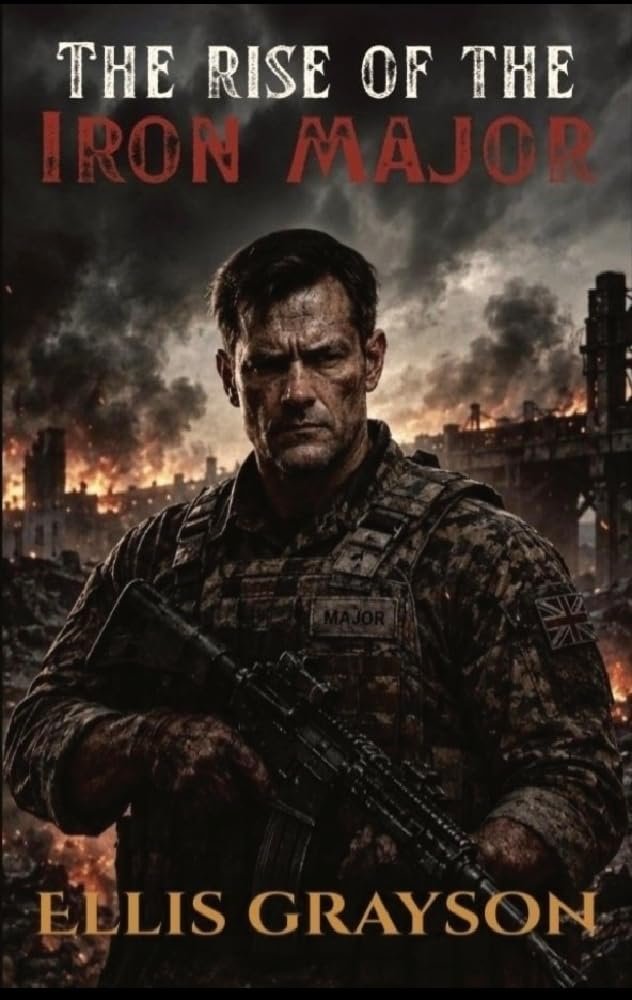
Ellis Grayson’s The Rise of the Iron Major approaches the collapse of civilization from a disturbing direction. Instead of centering the resilience of a small band of survivors, its stated subject is the emergence of Damien Blackridge, a major who uses the wreckage of post-apocalyptic Britain to build an authoritarian order. From Caerlaverock Castle, the former soldier converts training, command and efficiency into instruments of domination. The published description is explicit about tribute, subjugated communities and suppressed resistance. That makes the novel a villain-origin story rather than a straightforward survival adventure. It invites a question more troubling than whether one man can impose order: what happens when organization itself becomes an excuse for cruelty? The premise has genuine bite because disaster does not create a moral vacuum. It exposes the choices people make when institutions no longer restrain them.
Discipline is not an ethical code
Blackridge’s rise depends on a distinction often lost in action fiction. Being disciplined can make a person reliable, attentive and brave, but the same habits can make oppressive systems run more efficiently. Competence says nothing by itself about the legitimacy of a goal. Grayson’s advertised protagonist embodies that ambiguity, and the name “Iron Major” promises a form of identity forged by command. Readers should pay attention to whether the story examines the seduction of order from the inside or merely displays brutality as spectacle. Either approach can produce tension, but only one gives the origin narrative interpretive weight. The publicly available plot description establishes Blackridge’s actions and the danger he presents; it does not warrant a detailed judgment of the book’s psychology, prose or eventual moral reckoning.
The castle as a political idea
Caerlaverock Castle is more than a vivid piece of scenery in this setup. As an image of historical fortification, it makes a useful headquarters for a man recreating hierarchy after modern society has failed. Walls promise security, but they also announce who will remain outside. Tribute can be called taxation or extortion according to who has a voice in deciding it. A castle enables a new ruler to costume domination as tradition, even when the surrounding catastrophe should have made old political certainties suspect. These readings arise from the verifiable setting, not from imagined architectural passages. They show the unusual conceptual strength of placing a post-apocalyptic strongman in a building already saturated with the symbolism of power.
A figure from the past threatens the regime
According to the summary, a person from Blackridge’s military past returns and challenges his grip. The presence of such a figure matters because it potentially brings the general’s history into confrontation with the identity he has constructed after the Fall. Authority based on fear depends on appearing inevitable; a witness to earlier vulnerability or compromise can undo that performance. The suspense therefore may not reside solely in the next battle. It may also arise from the difference between the man his followers fear and the man another person remembers. That possibility makes the companion-novel structure interesting to readers familiar with Grayson’s wider Fall setting, while leaving newcomers a reasonably clear thematic entry point.
For readers who do not need a comforting hero
This is likely to suit enthusiasts of bleak post-apocalyptic fiction, military power struggles and portraits of authoritarian ascent. Its emphasis on a ruthless figure means it may frustrate readers who want an immediately sympathetic protagonist or a story of rebuilding through cooperation. The advertised violence and coercion call for ordinary content judgment. A serious review must also withhold a common shortcut: a strong premise about tyranny is not proof that the narrative makes tyranny intellectually complex. Whether Grayson avoids glamorizing cruelty, and whether the novel’s supporting figures resist becoming mere victims or obstacles, requires the complete text. Still, the outline is distinctive enough to merit attention as an exploration of what survives after the institutions that once claimed to define right and wrong have collapsed.
Fear is an expensive kind of order
A regime organized around tribute and obedience can appear stable while storing up future rebellion. Its leader must continually display force because the consent underlying ordinary civic life is absent. Blackridge’s rise is therefore not a simple accumulation of victories; it may also be the construction of a system that grows more brittle as it expands. The description’s reference to resistance and a resurfacing military connection offers grounds for examining that paradox. The romance of military decisiveness often depends on neat chains of command, but survival communities possess competing needs and sources of loyalty. A well-realized antagonist would be forced to confront those complexities rather than merely overwhelm them. This is where an origin story about a tyrant can offer more than spectacle: it can show how the habits that once seemed to create strength make a ruler incapable of living without enemies.
An antagonist’s interior is not an excuse
Villain-centered fiction invites readers into minds they would not wish to inhabit in life. That can sharpen understanding of power, resentment and the appeal of control. It can also make atrocities feel aesthetically thrilling merely because they are narrated close to a commanding figure. Grayson’s subject therefore requires a clear distinction between explanation and endorsement. Showing how a soldier becomes an authoritarian is different from suggesting that catastrophe validates his methods. The most rewarding reading will track the human costs of his decisions as carefully as his tactical competence. The published summary is unusually candid about the darkness of his rule, which makes the book’s stated ethical coordinates more legible. Whether its actual narrative perspective maintains that clarity is the question that should govern a final judgment.
The origin story’s final responsibility
There is a special satisfaction in tracing an antagonist backward from an established reputation, but the form carries an ethical challenge. If the character’s rise seems too smooth, the story risks presenting oppression as inevitable. If it is merely a sequence of brutal choices, the origins may explain too little. The most revealing moments would be those in which alternative decisions remain possible and Blackridge chooses against them. Such moments make character legible through agency, not destiny. The companion novel’s promise is therefore strongest when its subject is not simply the accumulation of power, but the narrowing of moral imagination that turns a commander into a tyrant.
About the book.
This review examines the documented premise and its critical implications; literary execution cannot be completely assessed without a full text.
Sponsored book review, identified according to the MarketAnyBook queue. Based on publicly accessible descriptions and bibliographic evidence; it is not a claim of full-book firsthand reading. Assessments of unverified interior craft are withheld.
Found a book worth opening?
Books worth discovering. Authors worth knowing.
Return to the Journal →