
The Saran Strategy
Aisha Saran’s empowerment guide for Black women links self-worth, personal reflection and the courage to shape a public identity.
Books worth discovering. Authors worth knowing.
Aisha Saran’s empowerment guide for Black women links self-worth, personal reflection and the courage to shape a public identity.
Original editorial introduction, grounded in the verified book edition and public descriptions.
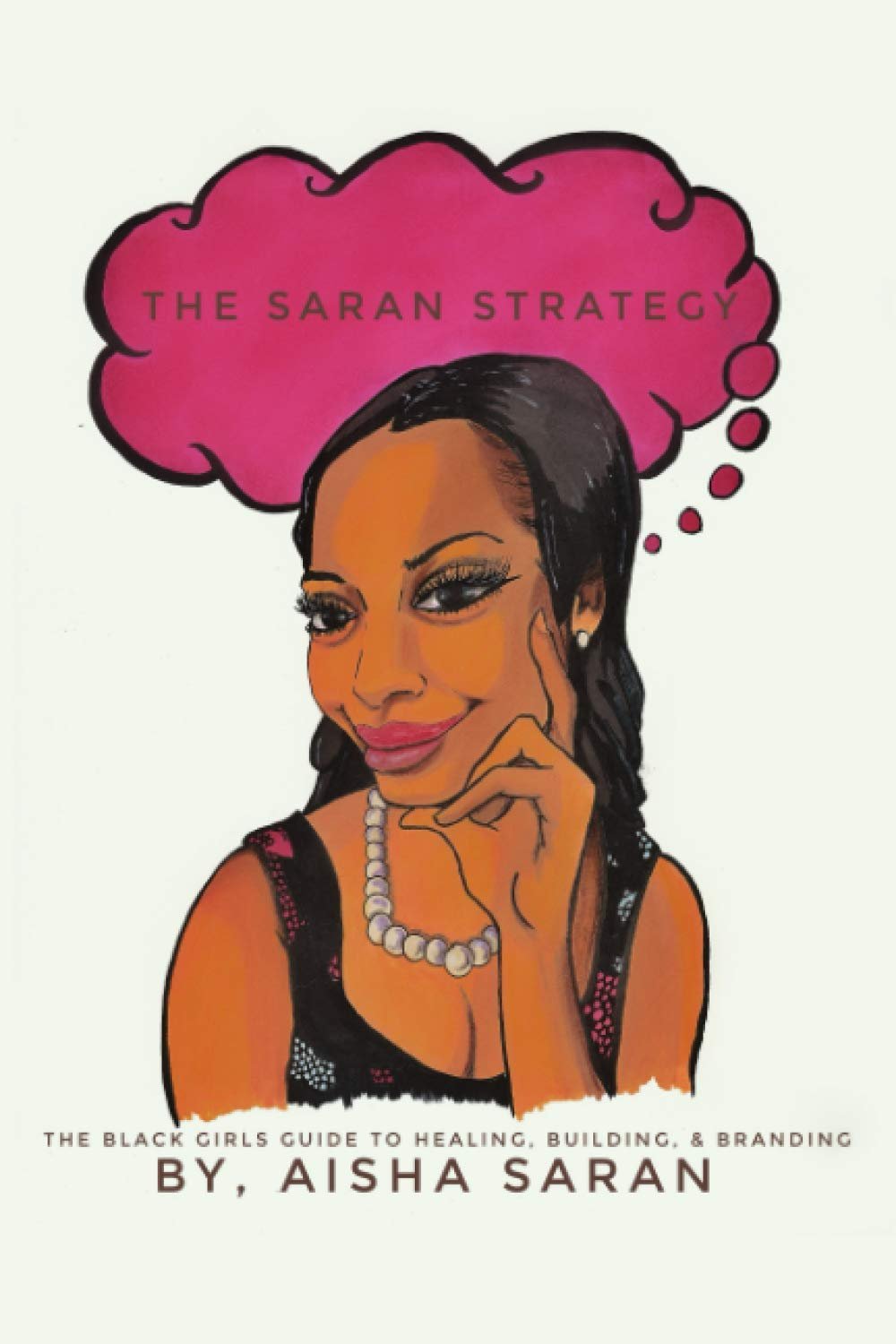
A strategy is usually described as a plan for reaching an external goal. Aisha Saran’s The Saran Strategy begins somewhere more personal: with the way a Black woman understands her own worth, identity and possibilities. Public descriptions identify the book as an empowerment guide that combines the author’s experiences, reflection and open-ended questions. A recorded author appearance gives its fuller framing as a guide to healing, building and branding. These three verbs suggest a sequence, but not a formula that could be followed mechanically. Healing asks what has damaged confidence; building asks what a person wants to create; branding asks how she chooses to represent her work and value to others. The distinctive invitation is to consider inner life and public presence as connected rather than competing projects.
An audience at the center rather than the margin
The published description speaks directly to Black women and the challenge of recognizing individuality and hidden strengths while moving through the world. That intended audience is not incidental. Too often, broadly marketed self-help writing treats one cultural experience as universal and invites everybody else to translate its advice. Here the naming of a particular audience helps define the questions the book can ask. It may give readers a place to see their experiences addressed without being made into examples for someone else. For readers outside the identified audience, the appropriate approach is curiosity and respect: the book offers a perspective to understand, not a claim that the experiences of Black women are interchangeable.
The source material connects self-esteem with the stories a person learns about herself in childhood, adolescence and early adulthood. Saran’s publisher-style description indicates that she includes personal experiences from those stages, but it does not offer enough detail to summarize a particular formative episode. The important editorial point is that identity changes in response to relationships, institutions and expectations. A personal-growth guide can make such forces visible without suggesting that individual confidence alone eliminates structural barriers. Readers can ask how Saran distinguishes the obstacles that belong to the surrounding world from the judgments people internalize about their own worth.
Healing as an honest starting point
The word healing appears in public presentations of Saran’s book, but it should not be reduced to a promise of quick emotional recovery. In a reflective guide, healing may mean naming painful expectations, challenging a rehearsed story about oneself or recognizing the support needed to make new choices. The book’s advertised use of open-ended questions is well suited to this work because questions create room for different lives and different answers. They do not prescribe a single destination. The source material does not establish any particular therapeutic method or clinical treatment in the book, and readers should not mistake its empowerment framework for individualized mental-health care.
An honest engagement with self-esteem also leaves space for uncertainty. Confidence is not always loud, permanent or visible. A person may know her value in one area and still struggle with insecurity in another. The desire to encourage should not turn into pressure to present strength every minute. That distinction is important for an audience regularly asked to be resilient in the face of unequal demands. A reflective reader can treat Saran’s affirmative premise as permission to examine difficult feelings, not as an instruction to deny them. The book’s value depends less on supplying a flawless self-image than on whether its prompts encourage real attention to the gap between inherited messages and personal priorities.
Building a life on chosen terms
The second movement in the book’s public framing, building, points outward from reflection. What is a person building when she decides that her value is not determined by someone else’s assumptions? It may be a project, a career, a network of relationships or simply a more coherent sense of purpose. The published description emphasizes individuality and the realization of personal potential. It does not provide a verified business plan, income system or stepwise career method. That distinction matters because the word strategy can create expectations of precise techniques. Readers should approach this work as empowerment-oriented nonfiction whose publicly documented method includes storytelling and questions, rather than a guaranteed route to commercial or professional success.
Saran’s stated concern with Black girls and women also invites an intergenerational reading. An adult reflecting on youthful experiences may notice advice she now wishes she had received sooner. A younger reader may find language for expectations that feel difficult to name. These are possible ways of using the book, not claims about a specific chapter. The core question is how knowledge gained through experience can become encouragement without denying the different circumstances faced by another person. What worked for a writer need not work identically for every reader. Yet a first-person account can be valuable because it makes a complicated process imaginable.
Branding without becoming a product
Branding is perhaps the most surprising word in the fuller description of The Saran Strategy. In business language it can refer to consistent public identity and messaging. Placed beside healing, it prompts a more delicate concern: how can a person communicate her value without allowing external attention to dictate who she must be? A strong personal brand might make professional ambitions more visible, but the pressure to be marketable can also flatten complexity. The book’s advertised emphasis on worth and purpose provides a useful counterweight to that pressure. A reader can bring the question of authenticity into any discussion about image, opportunity or public recognition.
This is particularly relevant in spaces where people are asked to tell compelling personal stories to obtain attention. It is reasonable to ask who benefits from that exposure, how much of a private life should become public and whether being recognized means the same thing as being understood. Public sources do not establish how deeply Saran addresses such tensions; they arise naturally from the stated intersection of healing and branding. A careful editorial spotlight can make these reading questions explicit without putting invented advice into the author’s mouth. The point is to preserve the room between a book’s documented themes and the reader’s independent evaluation of them.
Personal narrative as evidence of possibility
Anecdotes have their own strengths and limitations. Saran’s announced use of stories from her life can make her concerns concrete and approachable. A personal account shows that a perspective has been lived, but it cannot prove that a strategy works universally. Readers can value such examples while asking whether the author explains which lessons depend on her circumstances. The most productive response to personal-growth nonfiction is often neither total acceptance nor cynical dismissal. It is a process of selection: which question unsettles an old assumption, which idea invites meaningful action, and which recommendation requires more evidence or a different setting?
The book’s relatively brief length, as indicated by a retailer listing, may also influence expectations. A concise guide can be stimulating without being exhaustive. The reader may find it useful to keep a notebook and spend longer considering an open-ended question than the page itself takes to read. Reflection cannot always be rushed. Whether the book uses worksheets or a recurring framework is not established by the available sources, so this is a suggested reading practice rather than a description of its layout. It respects the very feature the public description confirms: questions that invite readers to bring their own lives into the encounter.
Who might enjoy this book
The Saran Strategy is most directly intended for Black women and girls seeking encouragement around self-worth, individuality, personal direction and public expression. It may appeal to readers who prefer an accessible, personally framed empowerment guide over academic theory, and to mentors who want prompts for supportive conversations without assuming every answer in advance. Readers interested in the relationship between inner confidence and outward ambitions may find the healing-building-branding combination distinctive. Those seeking evidence-based clinical intervention, a detailed corporate marketing manual or guaranteed financial outcomes should look elsewhere; the public sources present this as reflective guidance, not professional treatment or a commercial formula. Non-target readers can approach the work as an opportunity to listen carefully to a named perspective rather than presume it speaks for everyone.
A strategy that begins with authorship
The Saran Strategy’s clearest promise is that a woman can revisit the stories told about her and take a more active role in writing her own. The language of healing, building and branding joins private reflection to public possibility, while the advertised anecdotes and questions leave room for the reader’s circumstances. Nothing in the accessible description supports invented claims about specific exercises, dramatic life events or guaranteed transformation. What it does support is an invitation to consider who gets to define value, which inherited labels deserve to be challenged, and how ambition can remain connected to self-respect. Those questions give a short empowerment book a serious and potentially lasting conversation to begin.
About the book.
Aisha Saran’s empowerment guide for Black women links self-worth, personal reflection and the courage to shape a public identity. Public bibliographic details have been distinguished from editorial interpretation.
Independent editorial feature: this is a source-based introduction, not a firsthand review of the complete book. Bibliographic descriptions and author or publisher statements are interpreted with clear source limits. The original purchase URL remains unchanged; WordPress cover media is added later by the owner’s publisher. Spiritual testimony is described as contributor perspective rather than verified metaphysical or health fact.
Found a book worth opening?
Books worth discovering. Authors worth knowing.
Return to the Journal →