
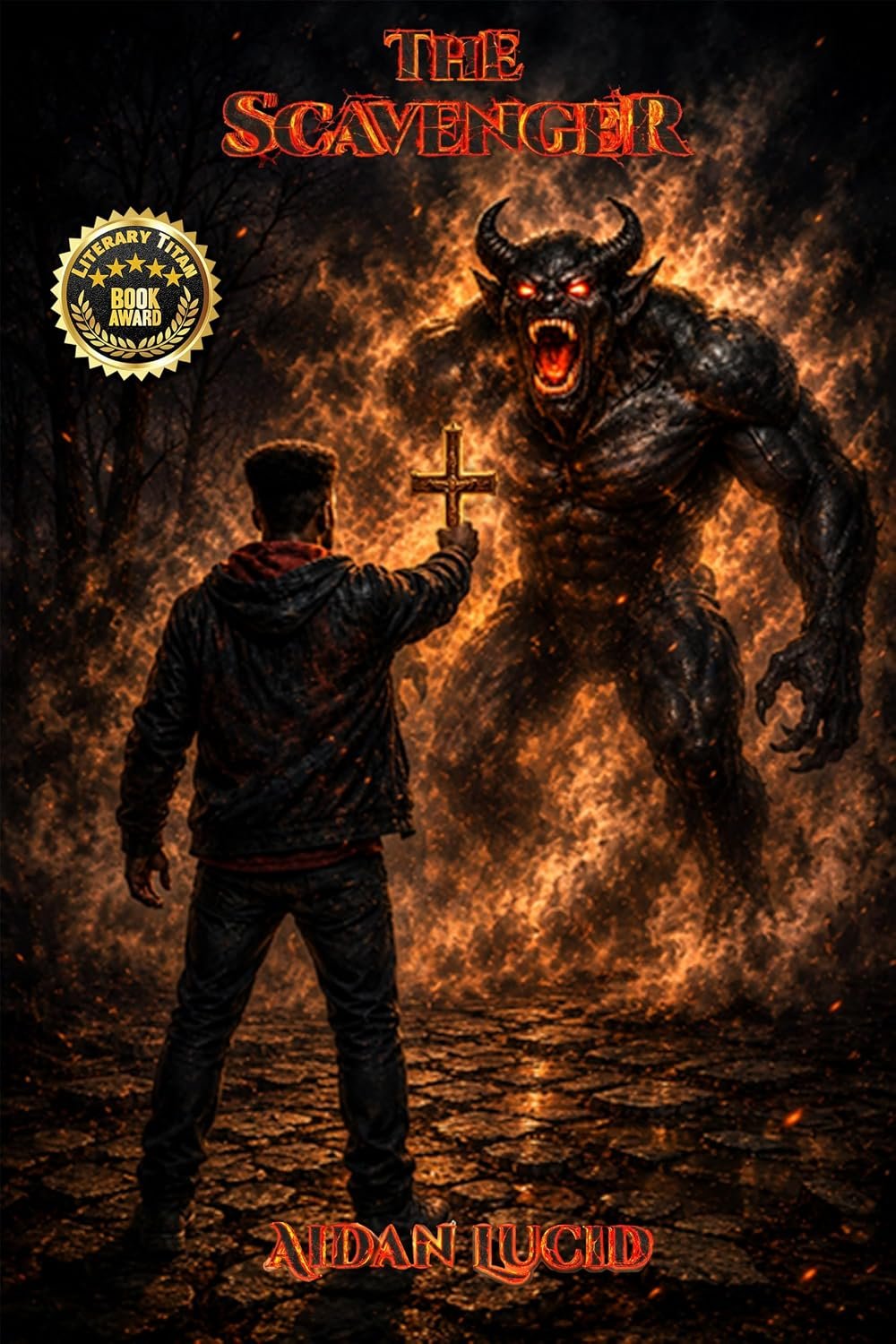
The Scavenger
Three troubled teenagers find an ancient wishing well in Hopps Town and discover the terrible consequences of wanting change.
Books worth discovering. Authors worth knowing.
Jared, Jessica and Adrian have different reasons to crave escape. A wishing well appears to answer—but the price is concealed.
S.
Three Teenagers and a Wish That Cannot Stay Harmless
In Aidan Lucid’s The Scavenger, the most dangerous moment begins with something almost innocent: three teenagers make wishes. Jared, Jessica and Adrian each carry a private burden, and one cold night they encounter an ancient wishing well. The possibility that their desires might be granted feels like escape from circumstances they cannot easily control. But the published description warns that the apparent answers arrive with a hidden price. Lucid builds supernatural horror from an everyday human impulse: the desire for a different life, immediately and without further suffering.
The characters’ troubles are not interchangeable. Jared faces bullying and pressure because he is gay. Adrian struggles under his father’s expectations while concealing a crush. Jessica lives with the fear and instability caused by an abusive alcoholic parent. These are elements explicitly identified in the bookseller synopsis. Their difference gives the well a sinister flexibility. What each teenager wants may arise from a separate wound, yet all three encounter the same temptation to bypass ordinary limits. The premise allows a frightening question: what if an apparently generous solution cannot understand the harm it might cause?
Lucid has spoken in an interview about writing characters affected by prejudice, family abuse and bullying, and about the importance of accepting personal difference. His remarks clarify the human purpose beneath the supernatural setup. The story is not simply concerned with what ancient force inhabits a town. It is also interested in why young people become vulnerable to promises of rescue when the people around them fail to listen. The horror can therefore be read as an enlargement of existing pressures rather than an unrelated interruption from the otherworldly.
Hopps Town and the Unease of Ordinary Places
The book is the first entry in the Hopps Town Quadrilogy, and its small-town environment plays a familiar but effective role in horror. Streets, schools and homes are supposed to form the predictable geography of adolescence. When something unnatural appears within that setting, the threat feels close because it shares space with daily life. The ancient well is a particularly resonant object: it is old, rooted in the landscape and seemingly able to provide what people ask for. The gap between its benevolent appearance and dangerous consequences drives the advertised tension.
The setting also gives social behavior an important function. A teenager whose classmates mock him cannot necessarily leave that world at the end of the day. A household may be emotionally unsafe even when it appears ordinary from outside. The supernatural device gains force against such backgrounds because the wish-makers have reasons to be desperate. A reader does not need to approve of every decision to understand how an opportunity that promises instant change might seem irresistible. Lucid’s premise places fear beside longing instead of treating horror as a contest between simply good people and inexplicable evil.
The public synopsis does not disclose the full identity or mechanics of the force the wishes awaken, and a feature should not invent them. The stronger introduction is to preserve the uncertainty. Once the wishes seem to materialize, the teenagers discover that the transaction was not what it appeared. That movement from hope to dread is an established engine of cautionary horror. It asks whether getting exactly what we request may be dangerous when we do not understand who or what is granting it.
Why the Scavenger’s Price Matters
Wish stories often involve an exchange: a desire is fulfilled, but a condition has been omitted or misunderstood. The moral stakes become more complicated when the person asking is not merely greedy. Jared, Jessica and Adrian are dealing with pain they did not simply choose. Their wishes emerge from legitimate needs for safety, acceptance or relief. If the consequence is terrible, the narrative can provoke sympathy as well as fear. The reader is invited to distinguish between blaming vulnerable people for wanting change and recognizing the danger of a promise that conceals its cost.
Adolescence is an especially apt stage for this dilemma. Young people are beginning to make decisions about identity and independence but remain subject to adult power. A supernatural shortcut may seem like the one source of control available to them. The novel’s premise exaggerates that imbalance into a literal force capable of altering reality. It offers readers a way to consider the temptation of sudden solutions without pretending that real-world abuse or discrimination can be solved by a single act of will.
Jared’s experience of anti-gay hostility brings a separate ethical issue into focus. Horror should not treat difference itself as monstrous. Lucid’s author interview explicitly endorses the idea that people deserve acceptance for their distinct qualities. That statement is worth preserving because the genre often transforms social fear into creatures, curses and hidden powers. The relevant danger in Jared’s published background is prejudice and bullying, not his identity. A fair feature keeps that distinction clear even while discussing the novel’s darker imagery.
The Meaning of a Second Edition
The selected book is explicitly marked as the second edition, part of the Hopps Town Quadrilogy. Public bibliographic records date it to 2024 and identify a previous edition. That matters for accuracy because readers may encounter reviews or descriptions associated with different versions. A feature can identify the shared premise confidently while avoiding unsupported claims that particular dialogue, scenes or endings changed in the revision. The author and retailer descriptions provide enough to discuss the story’s central dilemma; they do not establish a line-by-line comparison between editions.
Readers following a sequence also benefit from knowing this is the beginning. Series introductions must establish a community, emotional attachments and a central threat while leaving room for later consequences. Lucid’s published interview describes plans to expand Hopps Town beyond the initially envisioned books. Those plans offer context for the project, but a reader should not assume that every announced direction appears in this first installment. The second-edition subtitle and official series numbering are the reliable details to use when choosing a starting point.
The distinction between synopsis and complete reading is particularly important in horror, where a concealed mechanism can be the point of suspense. There is little value in manufacturing details about the creature or the final fate of the teenagers. It is enough to establish the well, the wishes and the unsettling response, then allow the reader to discover how Lucid structures the terror. The advertised warning about a deadly price supplies a strong hook without requiring a plot summary that spoils the experience.
For Readers Who Like Horror with Human Stakes
The Scavenger should interest readers of young-adult supernatural horror, cursed-object stories and fiction that connects the uncanny to familiar social pain. The publisher description makes the emotional material clear: prejudice, bullying, parental pressure and abuse form part of the teenagers’ world. Readers sensitive to those subjects should be aware of them before choosing the book. It would be misleading to frame the story as a carefree wish-fulfillment adventure merely because its supernatural premise begins with desires.
There is an additional appeal in the grouping of three very different teenagers. Horror involving companions can generate tension through conflicting needs and limited trust, while also making solidarity possible. The available synopsis confirms their shared encounter with the well; it does not dictate how every relationship develops afterward. What readers can expect is an intersection of individual vulnerability and collective danger, with the supernatural force magnifying what is already at stake.
Aidan Lucid’s The Scavenger converts the wish for a better life into a question about price and power. Its documented premise is memorable because the characters have good reasons to want change and little reason to trust a mysterious solution. The result is a promising opening for a horror sequence rooted in identity, social pressure and the terrifying possibility that the easiest answer may be the worst one.
About the book.
In Hopps Town, Jared experiences anti-gay bullying, Adrian hides a crush under paternal pressure, and Jessica lives with an abusive alcoholic mother. Their encounter with a wishing well leads to dangerous supernatural consequences. This is an explicitly revised second edition.
Editorial book feature, not paid sponsorship. Research-based commentary from named public sources, not a first-hand complete-book review. The cover placeholder will be resolved by the owner’s publishing automation.
Found a book worth opening?
Books worth discovering. Authors worth knowing.
Return to the Journal →