
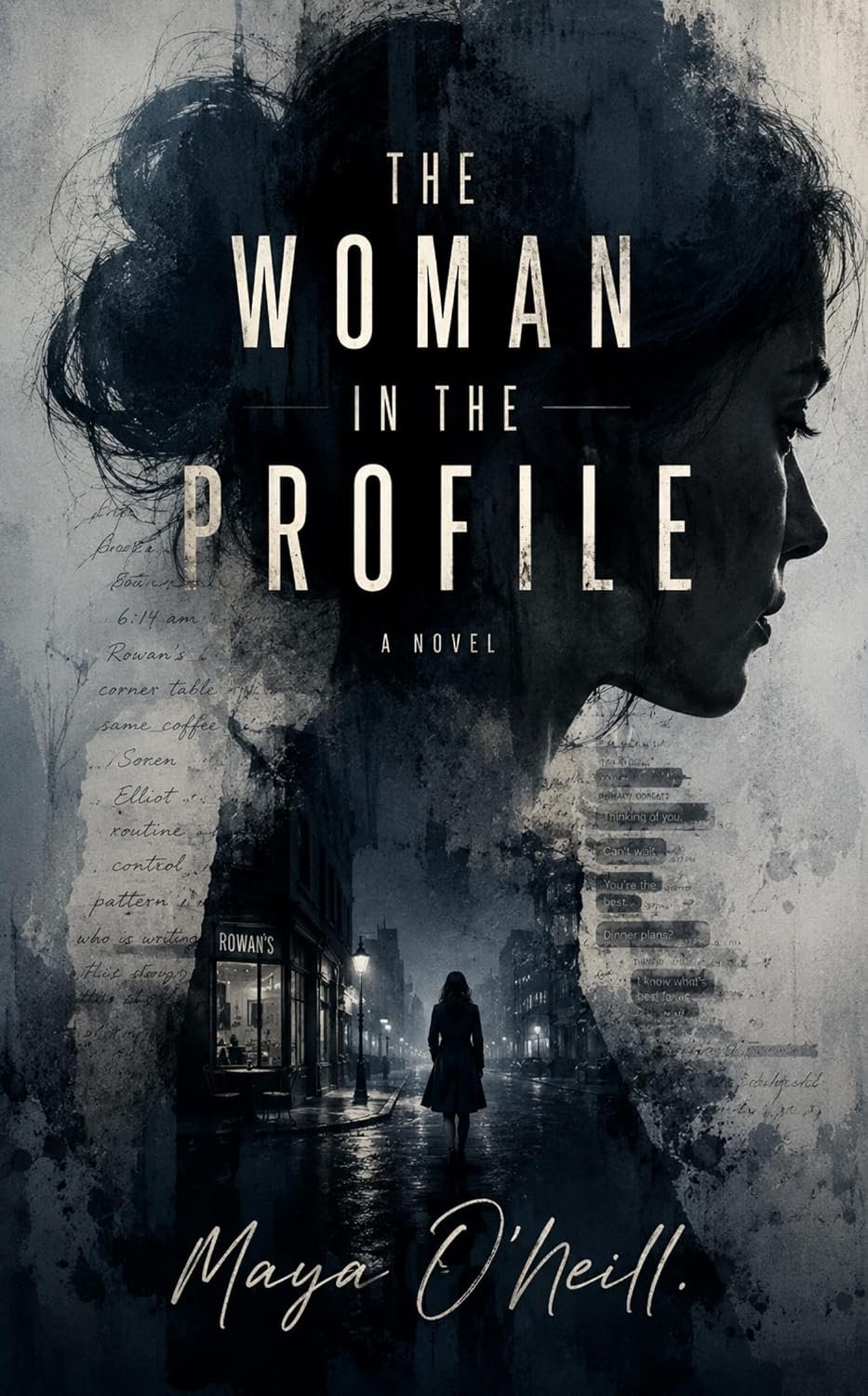
The Woman in the Profile
The Woman in the Profile announces a thriller built around obsession, evidence and a protagonist skilled at reading other people while failing to recognize something about herself. Maya O'Neill's…
Books worth discovering. Authors worth knowing.
The Woman in the Profile announces a thriller built around obsession, evidence and a protagonist skilled at reading other people while failing to recognize something about herself. Maya O'Neill's title and subtitle identify the governing irony with unusual clarity: professional or analytical mastery does not guarantee personal self-knowledge. The book…
Considered reviews, grounded in the book’s documented promise.
The Woman in the Profile announces a thriller built around obsession, evidence and a protagonist skilled at reading other people while failing to recognize something about herself. Maya O'Neill's title and subtitle identify the governing irony with unusual clarity: professional or analytical mastery does not guarantee personal self-knowledge. The book has an identifiable psychological-suspense proposition, but trustworthy detailed synopses are limited. The responsible critical approach is therefore to examine what the premise offers without inventing an investigation, culprit or final reversal.
The watcher who cannot see herself
Thrillers frequently give their central investigator or observer a gift for noticing details. The more unsettling possibility is that expertise becomes a defense against introspection. A person may be brilliantly attentive to patterns in other lives because examining her own desire would be harder. That is the tension suggested by the subtitle. For the book to earn it, the protagonist's blind spot would need to shape decisions and relationships rather than function only as a surprise withheld until the final pages. The listing does not establish how this happens.
Evidence is not the same as understanding
Modern crime fiction is full of traces: profiles, records, conversations that can be replayed and information that seems more permanent than memory. Yet an abundance of evidence does not create a correct interpretation by itself. The title’s vocabulary encourages a distinction between what can be documented and what a person wishes the documentation to mean. Obsession can narrow attention while making the observer feel unusually rational. That conceptual conflict could give the novel significant psychological interest if it is dramatized rather than announced.
The ethics of looking closely
Profiling another person can be protective, intrusive or controlling, depending on context and consent. A protagonist who builds explanations of other people's behavior may risk treating them as puzzles rather than agents. That is an apt moral question for an obsession novel. The subtitle points toward an asymmetry of knowledge: the one who categorizes everyone else is not adequately categorized by herself. A full review should ask whether the narrative understands the potential cruelty of such observation or romanticizes it as intelligence.
Suspense requires a changing hypothesis
The strongest psychological mysteries do not simply withhold information. They allow the reader to revise a theory as each disclosed detail alters the emotional stakes. The apparent meaning of a gesture changes when a relationship is better understood. An obsession plot, in particular, needs to reveal the observer's motives gradually enough that suspense remains tied to character rather than an arbitrary last-minute trick. None of this is an assessment of pages not examined here; it is the standard this unusually explicit premise invites.
A book with an unfinished evidentiary trail
The author's public listing confirms the title and association with psychological fiction, but comprehensive publisher copy, accessible excerpts and reliable independent discussion were not established for the exact queued edition. A literary reviewer should be cautious about overconfidence. The intrigue lies in the contrast between external evidence and inward blindness; the execution can only be judged after a complete or substantial reading.
Who will value this book
Readers interested in psychological suspense about perception, obsession and unreliable self-knowledge may find the premise appealing. This is a limited-source editorial review; there is insufficient verified detail for named supporting characters, a firm plot summary, craft verdict or ending discussion.
Scope of this assessment
This is a research-based editorial review drawn from identified bibliographic, author and publisher sources. It considers the work’s documented premise and the critical questions it invites, without claiming a complete firsthand reading. No unverified scene, character action or ending is asserted.
About the book.
An evidence-bounded critical introduction to psychological suspense and crime fiction. Published descriptions support the stated premise; interpretations are identified as editorial analysis, not confirmed plot details.
This is an unsponsored, research-based editorial review, not a claim to firsthand reading of the complete book. Detailed official synopsis and sample text not verified; avoid inventing character names, evidence, culprit or twist.
Found a book worth opening?
Books worth discovering. Authors worth knowing.
Return to the Journal →