
The Quantum Gate: 1
A fallen physicist and his estranged daughter follow clues toward the legendary Hall of Records beneath Egypt.
Books worth discovering. Authors worth knowing.
A fallen physicist and his estranged daughter follow clues toward the legendary Hall of Records beneath Egypt.
The author-confirmed premise blends esoteric traditions with fictional scientific mystery; it is not a factual science claim.
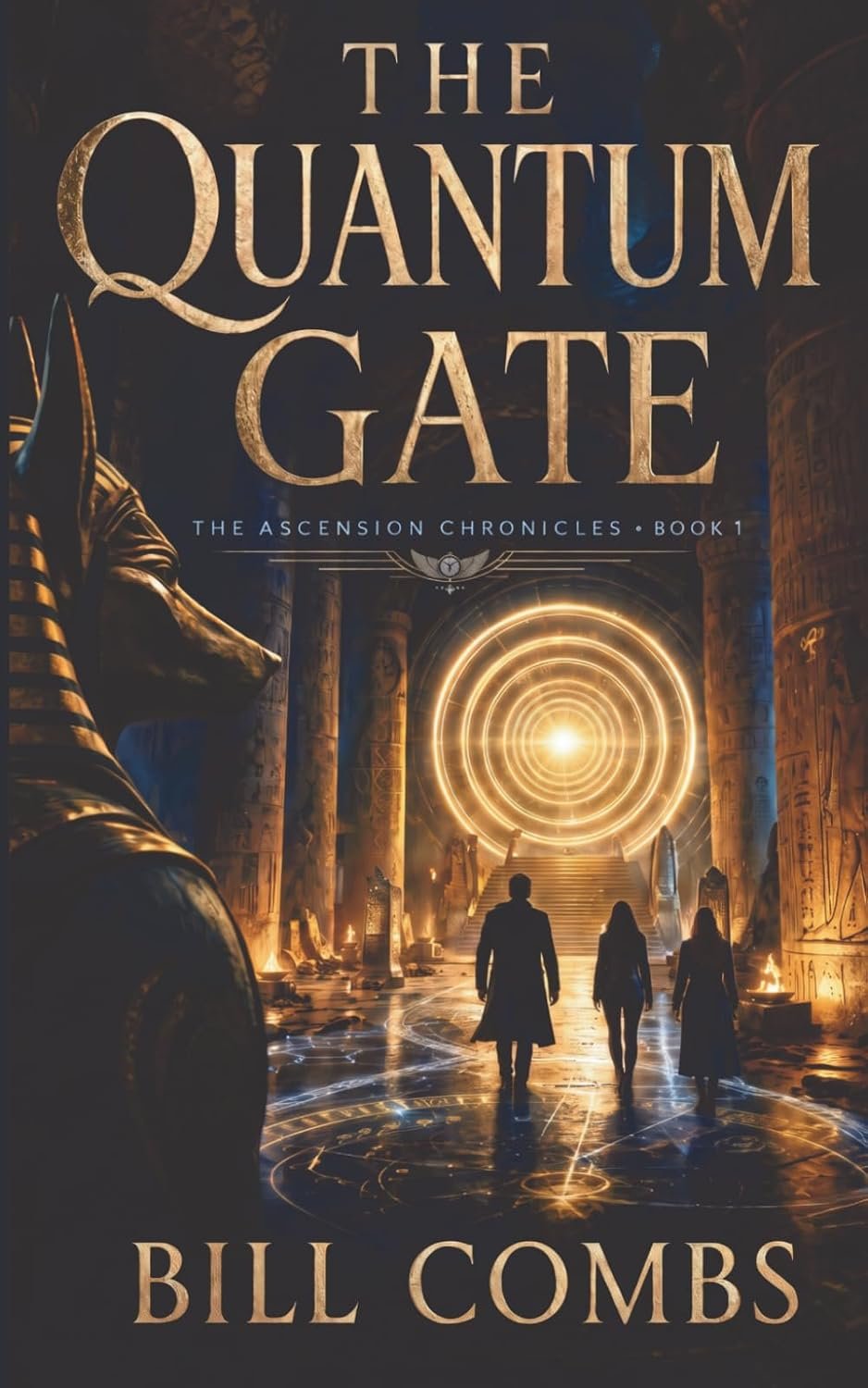
An impossible doorway beneath an ancient landscape
Bill Combs’s The Quantum Gate begins from a premise at the meeting point of adventure thriller and metaphysical speculation: a disgraced physicist receives a strange summons and follows it toward a hidden mystery in Egypt. According to the author’s website and bookseller descriptions, Dr. Ethan Cross is carrying both professional disgrace and private grief when a mysterious compass connected to a deceased friend draws him toward the legendary Hall of Records. The object at the center of the quest promises something larger than a recovered archaeological fact. The Hall is imagined as a repository of knowledge that could challenge humanity’s understanding of consciousness and its origins. This is fiction that uses scientific language to intensify questions of wonder, not a nonfiction claim that such a repository has been found.
The opening character choice matters. A scientist who has lost confidence in his standing may be unusually vulnerable to a discovery promising to overturn accepted limits. Ethan is not a fearless explorer starting from a comfortable life; the publisher’s premise positions him as someone who has already experienced damage to his sense of purpose. His daughter Sofi, described as an astrophysicist and a skeptic, brings an additional set of tensions. Father and daughter have become estranged, and the mystery forces an encounter between their different ways of understanding the world. That relationship gives the adventure a personal dimension beyond deciphering clues.
A thriller with both external and internal stakes
The official material describes adversaries determined to keep the Hall’s secret out of reach. A clandestine organization known as the Collective appears in a publisher listing; the author’s own description emphasizes secret societies, ancient traditions and hidden knowledge. Those elements place the book within the tradition of conspiracy-driven quest fiction. Codes and relics can move the action forward, while the protagonists’ disagreements keep revelation from becoming a purely mechanical reward. The question isn’t only whether Ethan will discover the Hall, but what he will accept, sacrifice or reconsider once he arrives.
The most interesting conspiracy stories understand that withholding information is a form of power. A guardian may believe concealment protects the world; a seeker may see the same act as domination. Neither claim settles the issue without examining consequences. Combs’s promotional descriptions present guardianship, choice and the dangers of discovery as central concerns. Readers can therefore expect a struggle over interpretation as well as access. It would be easy to invent a map of successive challenges or betrayals from these ingredients, but the available source material does not justify that. The safer, richer focus is the tension it has actually established.
Science as a way of asking questions
The title pairs “quantum” with “gate,” inviting an image of the physical world opening into extraordinary possibilities. The author’s own essay describes childhood fascination with Edgar Cayce, Atlantis, reincarnation and spiritual traditions as influences on the novel. That is useful context for a reader. It establishes that the book intentionally draws from metaphysical and esoteric ideas; it does not establish their scientific truth. Quantum physics is a rigorous field with empirical methods, whereas the story’s language of universal consciousness and ancient hidden teachings belongs to speculative fiction and spiritual imagination. Readers can enjoy the hybrid without confusing its genre conventions with scientific findings.
A useful reading question is what happens when a protagonist trained to demand evidence confronts experiences that do not fit his expectations. Skepticism can be portrayed as a virtue, a limitation, or both depending on the situation. In real life, extraordinary claims still require extraordinary scrutiny. In a novel, the protagonist can be placed in a world whose rules are different from ours. The Quantum Gate appears designed to use that fictional permission to explore doubt and transformation. Its adventure grows from the gap between what the characters think can happen and what its imagined world permits.
Egypt, Atlantis and the imagination of lost knowledge
Ancient settings have a long history in adventure literature. They offer symbolic depth, physical danger and a sense that the visible world may conceal another layer. The Hall of Records is situated beneath Egyptian sands in the promotional account, while the author’s essay invokes the legend of Atlantis. These references tap into durable speculative traditions; they also call for critical cultural care. Real Egyptian history is complex and well studied. Mythic links between Egypt and vanished civilizations are popular storytelling material but should not be presented as established archaeological discoveries. The distinction strengthens, rather than weakens, an informed enjoyment of the novel.
Readers who enjoy secret-history fiction often appreciate puzzles that connect distant traditions into a single hidden design. Such structures can be thrilling because they turn the reader into a companion investigator. But an ethical editorial approach makes clear that fictional conspiracies are not verified explanations of real societies. One may admire how the author stages a revelation while still questioning the appropriateness of borrowing living cultural or religious traditions as plot devices. The pleasure of the mystery and the responsibility of interpretation can coexist.
A father and daughter in different intellectual worlds
The relationship between Ethan and Sofi may be the book’s strongest human hook. Both are associated with science, yet the premise differentiates their experiences and emotional positions. Sofi’s skepticism is not merely a prop for Ethan’s awakening; it potentially gives their journey friction and credibility. A search for shared understanding can become inseparable from a search for lost trust. Whether or how their estrangement changes is for the novel to reveal. The verified premise is enough to point toward the value of placing a family relationship inside a high-concept thriller.
One way to read the quest is as a contest between isolation and connection. A disgraced scholar has reasons to withdraw; an estranged daughter has reasons not to accept every invitation. Yet the search for answers depends on people relying on one another. Such a structure can make a spectacular revelation feel consequential. A book about the fate of humanity may become memorable through smaller choices: whether characters listen, whether they can acknowledge harm, and whether curiosity leaves room for care. These are thematic possibilities grounded in the relationship established by the author, not spoilers.
The metaphysical thriller as a reading experience
Combs states that he wanted an adventure rather than a sermon disguised as fiction. That declared intention is revealing. Metaphysical concepts can weigh down a story when characters exist only to explain them. Adventure, by contrast, requires uncertainty, motion and consequence. The question for a prospective reader is whether they enjoy a narrative where clues prompt philosophical thought rather than deliver a simple practical answer. The available synopsis advertises secret orders, dangerous discoveries, ancient riddles and personal transformation. It points toward a reading experience built around movement between external mystery and inner upheaval.
This combination has a different appeal from conventional hard science fiction. Readers hoping for detailed experimental plausibility may find the metaphysical emphasis outside their expectations. Readers drawn to esoteric quest fiction can approach the same material as a stimulating set of imaginative questions. The book’s first-in-series status is also relevant: the author identifies it as the opening novel in The Ascension Chronicles. That positions the story as both a self-contained entry point to a particular mystery and the start of a larger conceptual world, without requiring invented claims about later installments.
Who should read The Quantum Gate?
Consider this novel if you enjoy secret-society thrillers, ancient-world mysteries, family relationships tested under pressure and fiction that openly explores consciousness and spiritual ideas. It is particularly suited to readers comfortable moving between suspense and speculation. Those seeking a science textbook or a factual account of Atlantis, the Hall of Records or quantum consciousness should look elsewhere. Fiction and empirical research ask different questions. The book can be enjoyed as imaginative adventure while its metaphysical vocabulary remains recognized as part of the invented world.
Bill Combs describes a longstanding interest in ancient mysteries and spiritual philosophy on his author website. He also explains how a friend’s encouragement helped turn a private idea into a novel. That origin story provides an authentic frame for the book’s ambitions. The strongest reason to try The Quantum Gate is the collision between two journeys: the search for a door under the sands and the need for its seekers to reckon with what they have carried there.
About the book.
Metaphysical thriller; speculative science fiction. The author-confirmed premise blends esoteric traditions with fictional scientific mystery; it is not a factual science claim.
Sponsored book feature. Research-based commentary; not a claim of firsthand complete-book reading. The content discusses fictional or advertised premises without treating them as scientific or clinical proof. The WordPress cover will be resolved by the owner’s automation.
Found a book worth opening?
Books worth discovering. Authors worth knowing.
Return to the Journal →