
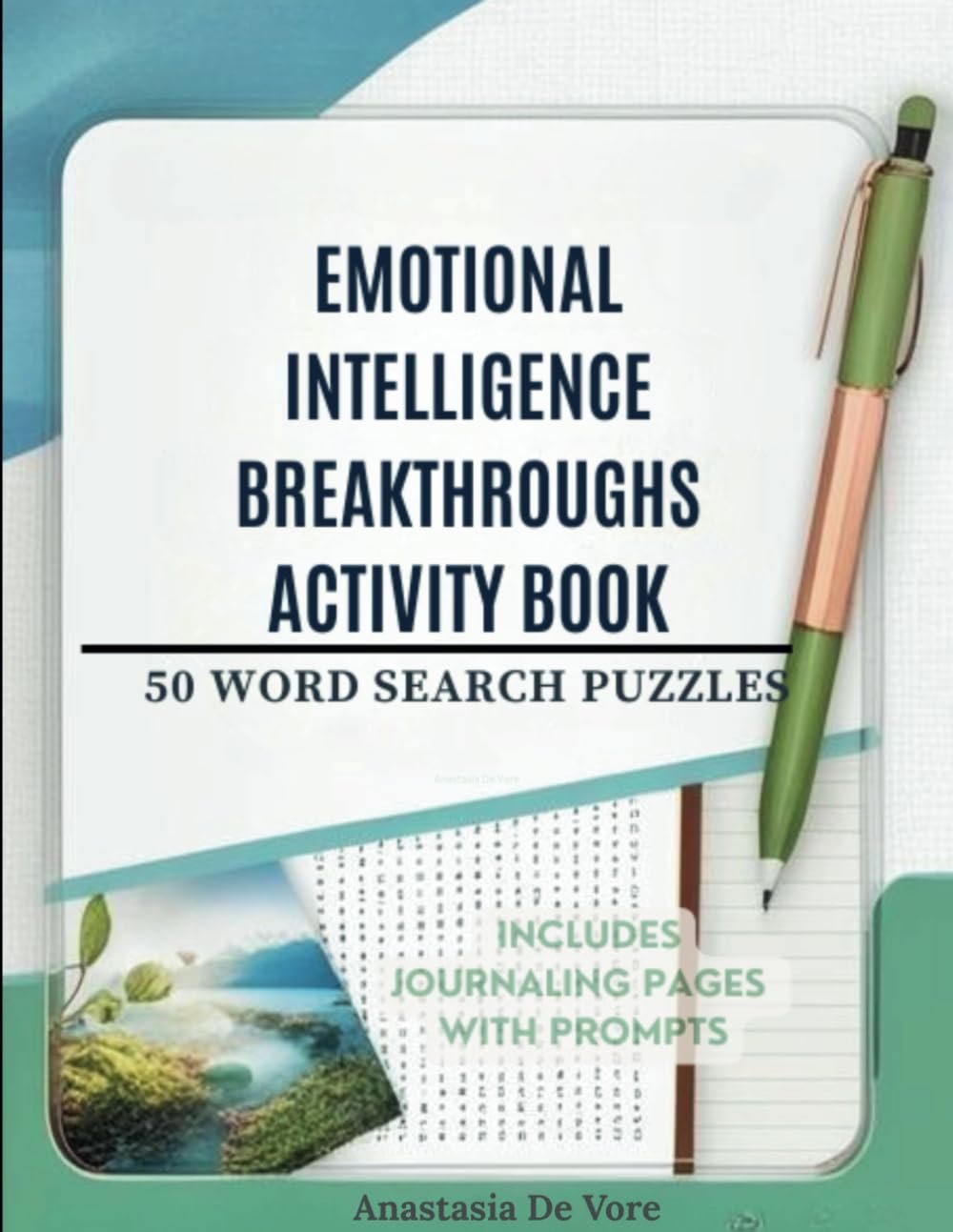
Emotional Intelligence Breakthroughs Activity Book
An activity-led companion for readers interested in practicing emotional awareness, reflection and resilience.
Books worth discovering. Authors worth knowing.
An activity-led companion for readers interested in practicing emotional awareness, reflection and resilience.
Activity-book context is supported by the author’s account; the specific internal exercise list was not independently verified.
Emotional intelligence as something to practice
The title Emotional Intelligence Breakthroughs Activity Book announces its intended use more clearly than a broad inspirational slogan could. Credited to Anastasia De Vore, it is presented as a companion in the author’s emotional-intelligence publishing work: an activity-oriented resource meant to make reflection manageable. The author’s public account describes it as enjoyable and life-enhancing, suggesting that even one activity per week can give readers a structured occasion to consider emotional awareness and resilience. That is an author’s recommendation, not independently verified evidence that a particular schedule produces reliable outcomes. The book is best approached as a prompted practice resource, with the details of its exercises learned from the text rather than inferred from the cover.
Emotional intelligence is often invoked as a desirable personal trait without explaining what a person would actually do differently. An activity-book format offers one potential answer. It puts a pause between knowing a term such as empathy and noticing a real moment when it might matter. Readers may be encouraged to reflect on feelings, communication or responses to stress, although this feature does not claim that a particular worksheet appears inside the publication. The reason the format is promising is its structure: a reader must participate, decide what to notice and perhaps revisit an answer over time.
A workbook is not a promise of instant transformation
The author’s broader book, Emotional Intelligence Breakthroughs, is described as addressing stress, resilience and relationship skills. That provides useful context for the activity title, but it does not make the two publications interchangeable. A conceptual guide may discuss principles and frameworks; an activity book needs to translate ideas into tasks that feel accessible. People learn differently, and a reflective question that helps one reader may leave another cold. Sensible expectations therefore matter. The success of an activity resource depends on a person’s willingness, situation and interpretation, not on a guaranteed transformation advertised by a headline.
This is particularly relevant to emotional regulation. Noticing that someone feels anger, sadness or pressure is an important starting point, but noticing does not instantly resolve the conditions behind a feeling. A workplace conflict, for example, may involve unequal authority as well as communication style. A strained relationship may involve misunderstandings, but also genuine differences of values or safety. Emotional intelligence can be framed as greater attention to one’s own behavior and to other people’s perspectives; it should not be used to require anyone to tolerate harmful circumstances.
The value of small, repeatable attention
De Vore’s public description of a weekly activity makes a practical editorial point: a resource may be easier to use when engagement is limited and realistic. Many personal-development books inspire readers for a short period and then become overwhelming through sheer volume of tasks. The promise of a manageable activity invites an alternative. Even a brief reflection can prompt a person to notice how they reacted to an interruption, listened during a disagreement or interpreted someone else’s silence. These are examples of everyday contexts in which emotional awareness matters, not accounts of exercises verified to appear on specific pages.
A repeatable practice also leaves room for change over time. Someone’s first response to a prompt may be defensive; a later response may recognize a pattern previously invisible. What matters is not producing the “correct” introspection but remaining willing to test assumptions. That kind of self-observation can become richer when paired with feedback from trusted people. A workbook is private by default, but its usefulness may extend to conversations in which both parties have room to question what they thought happened.
From self-understanding to relationships
Emotional intelligence is sometimes marketed as a route to better relationships. The phrase can be meaningful, provided the two people involved remain equally real. One can practice recognizing another person’s perspective while still drawing boundaries and expressing disagreement. An activity-oriented book can support this kind of reflection by helping readers distinguish intention from impact, urgency from importance and empathy from agreement. This feature uses those distinctions as editorial context, not as a verified index of De Vore’s exercises.
In professional settings, emotional language may be used to smooth difficult conversations. It can also be misused to frame justified objections as failures of composure. Readers should evaluate any guidance against the actual context and power structures in their lives. A practical activity book works best as a tool for increasing agency and understanding, not as a rulebook for suppressing discomfort. This critical lens can help a reader use a personal-development resource thoughtfully without discarding its potentially helpful prompts.
Stress, resilience and realistic limits
De Vore’s broader publication discusses reducing stress and building resilience, and those themes help explain the activity book’s audience. Yet emotion, stress and resilience are not interchangeable. A person might show considerable resilience while still needing rest, medical support, financial security or help from others. Practical reflection should be treated as one possible component of well-being rather than a substitute for professional assessment. Anyone dealing with severe distress or unsafe circumstances deserves more support than a workbook alone can provide.
The positive use of a guided activity is modest but worthwhile: it gives people a place to articulate a feeling they might otherwise ignore. Writing down a reaction can clarify whether it was triggered by fatigue, fear, disappointment or confusion. A later conversation may become easier once someone has named what they want to say. Again, these examples illustrate why an activity format can be helpful; they do not imply that the book includes a specific clinical method or validated therapeutic intervention.
Choosing a pace that belongs to the reader
The author describes the companion book as intended to be approachable rather than overwhelming. That distinction matters for readers who have little spare time or who dislike the pressure of rigid self-help schedules. Someone may prefer a weekly check-in; another might return to an exercise when a real situation makes it relevant. A low-pressure approach treats reflection as an invitation rather than another measure by which a person can fail. Books that encourage personal growth should be especially careful not to create a new form of perfectionism around self-awareness.
Activities also differ from passive reading because the person using them provides part of the content. An answer written today may be more revealing on rereading months later than it was in the moment. The value may emerge through comparison and context rather than from an immediate breakthrough. That is an interpretive advantage of activity-based formats generally. Before promising a specific feature such as journaling templates, scoring systems or numbered exercises, a responsible feature would need to inspect the exact edition; those features are not established here.
Who should try this activity book?
Emotional Intelligence Breakthroughs Activity Book is likely to interest adults who enjoy prompts, guided self-reflection and practical frameworks for paying closer attention to communication and emotional habits. It may suit people who prefer small exercises to long theoretical chapters. A reader seeking a comprehensive scientific account of emotional intelligence or treatment for a mental-health condition should choose different resources in addition to, or instead of, this one. The material is promoted as personal development, not clinical care. The exact activities and their suitability are best judged from the published book itself.
Anastasia De Vore publicly identifies this activity title as related to her longer Emotional Intelligence Breakthroughs guide. That connection is meaningful bibliographic context, while the queue’s exact title and purchase link remain the authority for this edition. A balanced feature need not promise dramatic change: it can present the book as a potentially useful occasion to notice, reflect and practice in a way that respects each reader’s circumstances.
About the book.
Personal development activity book; emotional intelligence. Activity-book context is supported by the author’s account; the specific internal exercise list was not independently verified.
Sponsored book feature. Research-based commentary; not a claim of firsthand complete-book reading. The content discusses fictional or advertised premises without treating them as scientific or clinical proof. The WordPress cover will be resolved by the owner’s automation.
Found a book worth opening?
Books worth discovering. Authors worth knowing.
Return to the Journal →