
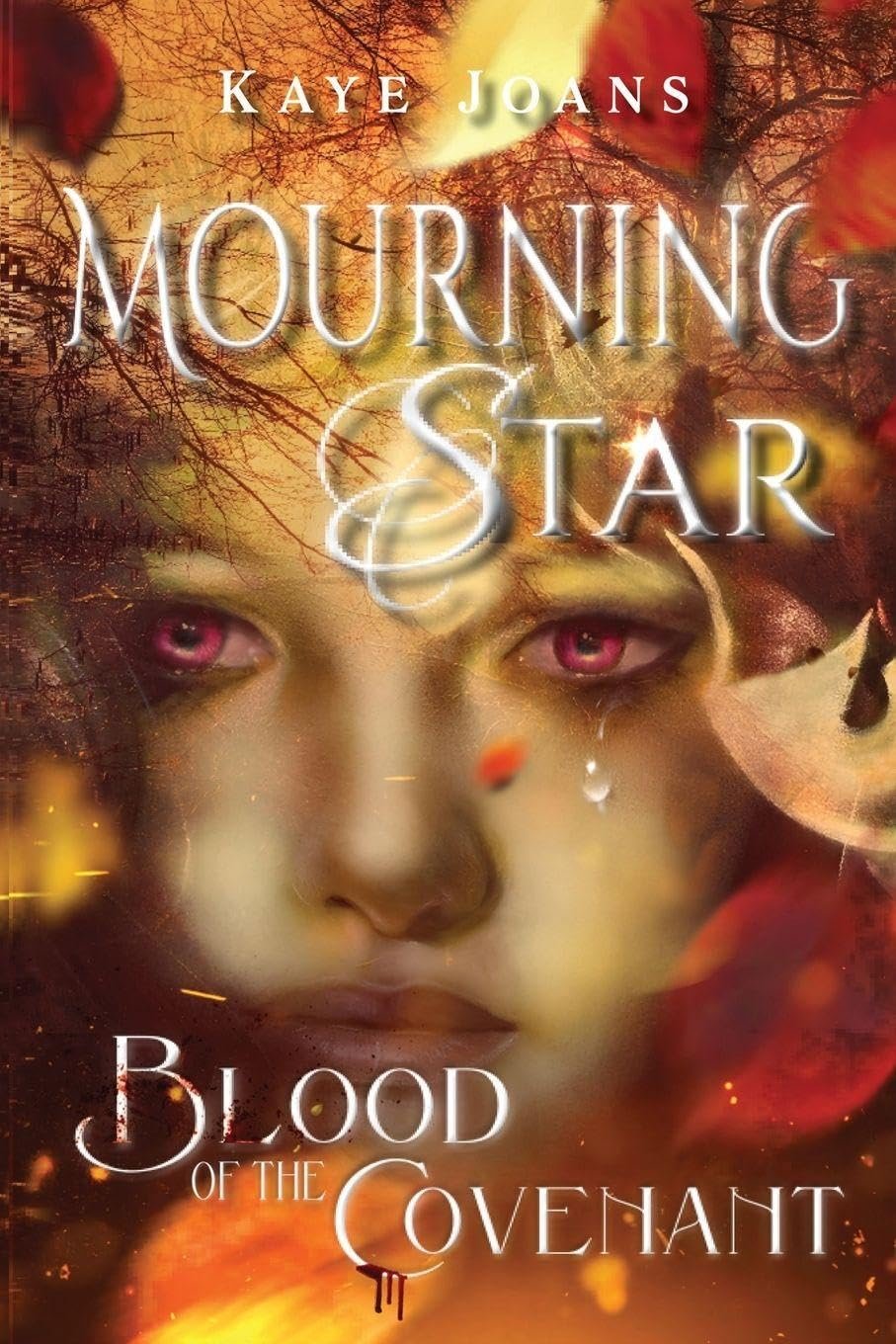
Mourningstar: Blood of the Covenant
Thirteen thousand years after being abandoned, once-powerful daemon Agony Mouringstar returns to the beings who left him behind.
Books worth discovering. Authors worth knowing.
Thirteen thousand years after being abandoned, once-powerful daemon Agony Mouringstar returns to the beings who left him behind.
Kaye Joans opens the public description of Mourningstar: Blood of the Covenant with an unusual reversal of power.
A Daemon Who Has Survived Too Long
Kaye Joans opens the public description of Mourningstar: Blood of the Covenant with an unusual reversal of power. Agony Mouringstar was once a daemon of extraordinary strength, yet he is now barely alive. He lives in a world where daemons and other supernatural beings have hidden among humans since before human existence, and his own story stretches across an almost incomprehensible span. Thirteen thousand years after being abandoned, Agony follows a siren song to the deceptively peaceful town of Montague Heights. There he encounters the very beings who left him behind. That is not merely an invitation to a battle between supernatural factions. It is a premise about whether someone who has endured a very old injury can find a way to trust again. The story places vast mythic time beside an intensely recognizable emotional situation: the people a person most needs may be the same people whose earlier actions caused profound hurt.
Montague Heights and the Unease of Homecoming
The book’s description calls Montague Heights a picturesque town, language that makes its welcome seem almost too orderly for the events it contains. Readers of urban paranormal fantasy are familiar with the pleasure of a normal-looking location masking a hidden population. Here the contrast is sharper because the place also contains Agony’s unresolved past. The town becomes both possible refuge and site of confrontation. Joans’s blurb does not name every resident, map supernatural hierarchies or explain how the siren song works. A responsible feature should not invent those elements to make the world seem easier to classify. What the account does establish is that Agony’s arrival reconnects him to beings who once rejected or abandoned him. A quiet street or handsome building is therefore not emotionally neutral. It might signify safety to a newcomer, but for Agony it could carry a reminder of what happened before. That tension gives the setting symbolic weight even without knowing each story event.
The Weight of Thirteen Thousand Years
The enormous interval between Agony’s abandonment and return changes the usual scale of a family dispute. Human arguments can survive generations through stories, inherited silence and institutions, but Joans gives the estrangement a mythological duration. That does not mean the reader should treat supernatural age as automatically conferring wisdom or moral superiority. The more compelling possibility is the opposite: even a being capable of enduring millennia may remain deeply vulnerable in the presence of rejection. The description juxtaposes an ancient, once-powerful identity with a damaged present self. Such a contrast invites questions about what time can heal and what it cannot. Is survival evidence of recovery, or only evidence that a wounded individual has managed to continue? The book’s public premise does not answer that question, and the answer likely depends on encounters readers should discover for themselves. Time supplies an extraordinary frame, but emotional recovery remains difficult and personal.
When Power Is No Longer Protection
Calling Agony a formerly powerful daemon establishes a past that no longer matches his circumstances. Fantasy heroes frequently begin weak and accumulate extraordinary abilities; this synopsis suggests a more complicated direction in which power has already been possessed and lost. Readers can ask what remains when supernatural capacity, former reputation and a sense of invulnerability are stripped away. Does identity depend on remembered greatness, or can a person become someone different? Joans’s setup makes it possible to read the search for self-understanding as a separate task from any possible recovery of strength. The book is also described as an encounter with beings who desperately want Agony to grow, a formulation that invites scrutiny. Growth can be offered as a gift, but it can also feel like an unfair demand when imposed by those who caused the original wound. A wounded protagonist’s right to decide the pace and terms of reconciliation may matter as much as the dramatic magic around him.
Those Who Left Him Behind
The central relationship appears deliberately complicated: the beings who abandoned Agony long ago are now the ones seeking his growth. A simple revenge plot would treat the confrontation as a chance to punish wrongdoers; a simple reconciliation story would ask him to forget what happened. The published description suggests a different path, concerned with finding peace, recovering identity and deciding whether a shared future is possible. Neither absolution nor retaliation is established as the novel’s final answer. That uncertainty protects the moral stakes. Readers can consider how changed circumstances alter responsibility without erasing past harm. The premise also raises the problem of trust. An apology, if one comes, does not instantly repair a relationship; demonstrations of patience and accountability matter more than declarations. In a paranormal setting, those issues can be explored through beings whose lifespans are radically unlike ours, while still retaining the emotional seriousness of betrayal and attachment.
The Promise and Difficulty of Family
One of the clearest phrases in public synopses describes the possibility that Agony might allow himself the blessing of a family. The wording matters because it presents family not merely as an inherited fact but as a relationship someone may choose to accept or refuse. In found-family fiction, mutual care can develop outside conventional blood ties. Mourningstar’s subtitle, Blood of the Covenant, adds another suggestive contrast between biological relation and commitments people decide to honor. This is an interpretive reading of the title, not confirmation of a particular magical ritual or plot mechanism. The description says that things are lost and found and hearts are broken and repaired, indicating emotional movement without disclosing the final arrangement. For readers who enjoy character-led fantasy, the chance of belonging may create stronger suspense than a battle for dominion. The question is whether a wounded figure can embrace connection without surrendering the memory of what made him wary.
Supernatural Scope, Intimate Stakes
Retailer and ebook records classify Mourningstar as fantasy and identify a substantial work published by Killer Publications in 2024, with some print listings approaching six hundred pages. A novel of that scale may have room for many supernatural relationships, but those outside the detailed public synopsis should not be guessed at. The verified description already shows what distinguishes this book from a generic monster adventure. It is not content simply to introduce daemons hiding among humans; it centers a daemon whose former strength cannot protect him from questions of abandonment and self-worth. Kaye Joans is also credited in public bibliographies with the title Whatever Happened to Vida Boheme?, though that credit alone tells us nothing definite about connections between the works. The value of this overview is to identify the actual premise and the likely appeal of its emotional frame without pretending to know every hidden-history revelation or action sequence.
For Readers Drawn to Wounded Immortals
Mourningstar: Blood of the Covenant may appeal to fans of urban fantasy, immortal protagonists, complicated supernatural kinship and stories where identity is rebuilt after estrangement. Agony’s journey offers an unusual combination: extraordinary historical time, sharply personal pain and a setting that appears welcoming while concealing the source of his old wounds. The book’s description does not support calling it a romance, promising a specific ending or identifying hidden villains, so those expectations should not be presented as facts. Its strongest documented promise is a test of whether an ancient survivor can find peace and accept a new form of belonging. Readers who prefer fantasy with emotional consequences may find that more attractive than spectacle alone. This sponsored feature draws on the publicly available synopsis and bookseller bibliographic data; it does not represent a firsthand complete-text review and leaves the author’s surprises to the reading experience itself.
About the book.
Urban paranormal fantasy and supernatural found-family drama. Thirteen thousand years after being abandoned, once-powerful daemon Agony Mouringstar returns to the beings who left him behind.
Sponsored book feature. Independent research-based commentary based on publicly available book details; not a claim of first-hand full-text review. The designated cover placeholder will be resolved by the owner’s publishing automation.
Found a book worth opening?
Books worth discovering. Authors worth knowing.
Return to the Journal →