
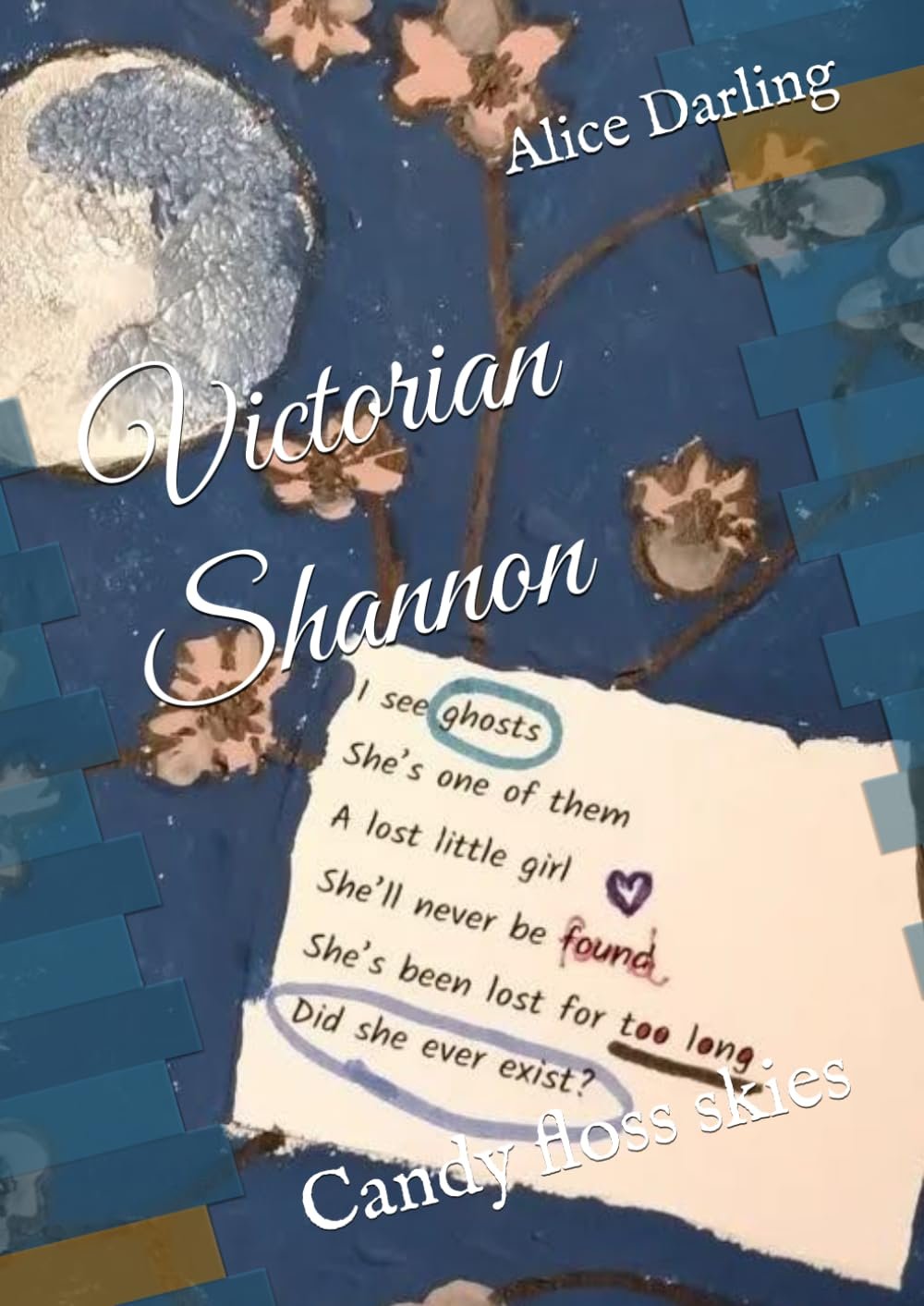
Victorian Shannon: Candy floss skies
In Alice Darling’s imaginative multiverse, griffins, perilous forests, haunted manors and lost souls coexist across shifting dimensions.
Books worth discovering. Authors worth knowing.
In Alice Darling’s imaginative multiverse, griffins, perilous forests, haunted manors and lost souls coexist across shifting dimensions.
Victorian Shannon: Candy floss skies by Alice Darling presents a multiverse in which familiar reality is only one among many dimensions.
Enter a World Beside Our Own
Victorian Shannon: Candy floss skies by Alice Darling presents a multiverse in which familiar reality is only one among many dimensions. Its bookseller description is unusually generous with worldbuilding: vast forests, shimmering astral pathways, peculiar towns, haunted structures and regions where lost souls travel. Rather than reduce the book to a single invented plotline, a responsible feature can begin with the setting the author has actually put forward. The world called Mystery Shore contains a dangerous but breathtaking woodland. Planets and stars seem to swirl along the path, giant jellyfish float through the landscape and trees grow taller the farther travelers venture. Beauty and danger arrive together. That combination challenges the assumption that fantasy worlds should be safe simply because they are enchanting. The images promise awe, but they also establish a rule of travel: wandering without understanding the place can be costly. The landscape is therefore more than background scenery; it is a source of dramatic uncertainty.
Griffins Guard the Paths
One of the description’s most distinctive elements is the role of griffins searching for those who become lost. Their multicolored eyes and striking feathers offer a vivid contrast with the hazards under the forest canopy. They appear as protectors, yet their help has limits. A creature is said to lure children from the path, and even the griffins cannot watch everyone or guarantee a way home. This tension makes the guardian creatures more compelling than simple magical rescuers. They represent care that cannot eliminate all risk. The old griffins introduce another unsettling possibility: their milky eyes can reveal glimpses of a person’s future. Such foresight can seem attractive to a traveler anxious about danger, but a fragment of what is coming may be as confusing as ignorance. The source description leaves the consequences of such visions unexplained. Readers can approach the encounters as occasions for curiosity without assuming that every magical rule will become a tidy solution.
Elora’s Cliffs and an Unsettled Town
The multiverse description also leads travelers into more inhabited places. A town holds narrow cobbled streets, colorful huts, shops and a square where merchants gather. Elora, by contrast, rises around fierce cliffs and a vast chasm threaded with bridges. Some inhabitants live in caves that resemble honeycombs, and an abandoned manor stands over a deeper void. The specificity of these locations matters. A fantasy world feels more convincing when its population must negotiate terrain, settlement and commerce rather than exist only as ornaments. Bridges imply connections and dangers of crossing; cliffs make geography part of decision-making; a deserted manor invites questions about the people who once lived there. None of those observations verifies a particular episode or character’s visit to every site. They are an editorial way to notice how Darling’s public world-description combines whimsical visuals with structures that could affect the story’s action. The reader is invited into a landscape with a history that remains partly concealed.
Echo Valley and Voices in the Air
Echo Valley is described as lush and green, with streams, colorful houses, strawberries and lavender. The beauty of the place is accompanied by a different kind of uncertainty: voices or whispers that are not simply imaginary, according to the book’s own fictional rules. This is a useful example of the contrast at work across the multiverse. Sensory delight does not promise normality. A person accustomed to judging reality by sight or hearing may struggle when the environment itself changes what counts as an ordinary experience. Such scenes can encourage a fantasy reader to pay attention to the difference between perception and interpretation. What appears threatening may be part of an unfamiliar system; what appears comforting may conceal a genuine warning. The source does not provide a precise explanation of the voices or their effects, and no invented mechanism is needed. Their presence already helps define the novel’s interest in the boundaries of ordinary knowledge.
Nightmare Valley and the Persistence of the Dead
Darling’s description identifies Nightmare Valley as a particularly frightening dimension inhabited by demons and the dead. It presents a supernatural distinction between souls that move onward and those that remain, while also allowing exceptions. The uncertainty in those rules makes the setting more disturbing than a neatly charted afterlife. A place where the dead appear is already uncanny; a place where movement may depend on moral judgment complicates questions of guilt, justice and fate. The premise does not authorize a feature to specify exactly who receives punishment or how the system is governed. What it establishes is that death does not necessarily end a person’s relationship with the world. That possibility gives haunting a new dimension: a ghost may carry history while a living traveler encounters consequences extending beyond ordinary time. Readers drawn to gothic fantasy may recognize the familiar pleasures of a haunted region, reshaped by the novel’s more elaborate dimensional geography.
A House in More Than One Place
The bookseller synopsis explains that some houses exist in several places at once, and that sufficiently skilled magic-users may see between dimensions. Its haunted manor offers a more disturbing form of crossing: while time traveling, a person can find themselves inside the mind or body of someone long dead. This is a striking idea because it blurs two kinds of boundary at once. The visitor crosses from one time to another and loses the stable separation between self and other. A haunting is no longer merely seeing an apparition; it can mean experiencing another existence from within. The publisher-facing description suggests the terror of an unfamiliar consciousness, not the resolution of any specific ghost mystery. The broader implication is enough for a thoughtful preview. Magic grants access, but access can be invasive and dangerous. The more the story unsettles identity, the more readers may wonder whether returning home guarantees returning unchanged.
Magic, Murder and Unreliable Reality
The public synopsis includes a killer in our own world motivated by revenge, a figure who possesses magic but often chooses ordinary physical violence instead. The presence of this murderer prevents the fantasy from becoming a tour of beautiful alternate landscapes alone. The narrative promises a meeting between enchantment and human cruelty, although the specific relationship between the killer and the named dimensions is not fully explained. It would be irresponsible to assign victims, motives beyond the stated desire for vengeance, or an ending without direct evidence. The existing facts create tension on their own. Power does not necessarily make someone more imaginative or more humane, and the decision to use violence can be personal even in a universe crowded with extraordinary forces. When multiple worlds interweave and appearances cannot always be trusted, an ordinary moral question becomes difficult to answer: who can be relied on when both perception and location are unstable?
Reading for Wonder and Unease
Victorian Shannon: Candy floss skies may interest readers who enjoy portal fantasy, intricately described settings, eerie ghost stories and worlds where beauty has a threatening edge. Its public description is especially rich in atmosphere; it is less explicit about a single named protagonist’s progression. That limitation should shape expectations. A feature can describe Mystery Shore, the griffins, Elora, Echo Valley, Nightmare Valley and the haunted house without pretending to know every narrative transition between them. Alice Darling’s work appears invested in the astonishing possibilities that arise when different realities occupy the same space. The central pleasure may lie in exploring those possibilities while wondering whether any map or identity remains trustworthy. Readers seeking conventional linear adventure should consult a complete sample before deciding; readers drawn to strange landscapes and layered hauntings have much to investigate. This research-based overview reports the book’s published setting and themes without claiming a firsthand reading of all its chapters.
About the book.
Portal fantasy, haunted houses and dark alternate-world adventure. In Alice Darling’s imaginative multiverse, griffins, perilous forests, haunted manors and lost souls coexist across shifting dimensions.
Editorial book feature, not paid sponsorship. Independent research-based commentary based on publicly available book details; not a claim of first-hand full-text review. The designated cover placeholder will be resolved by the owner’s publishing automation.
Found a book worth opening?
Books worth discovering. Authors worth knowing.
Return to the Journal →