
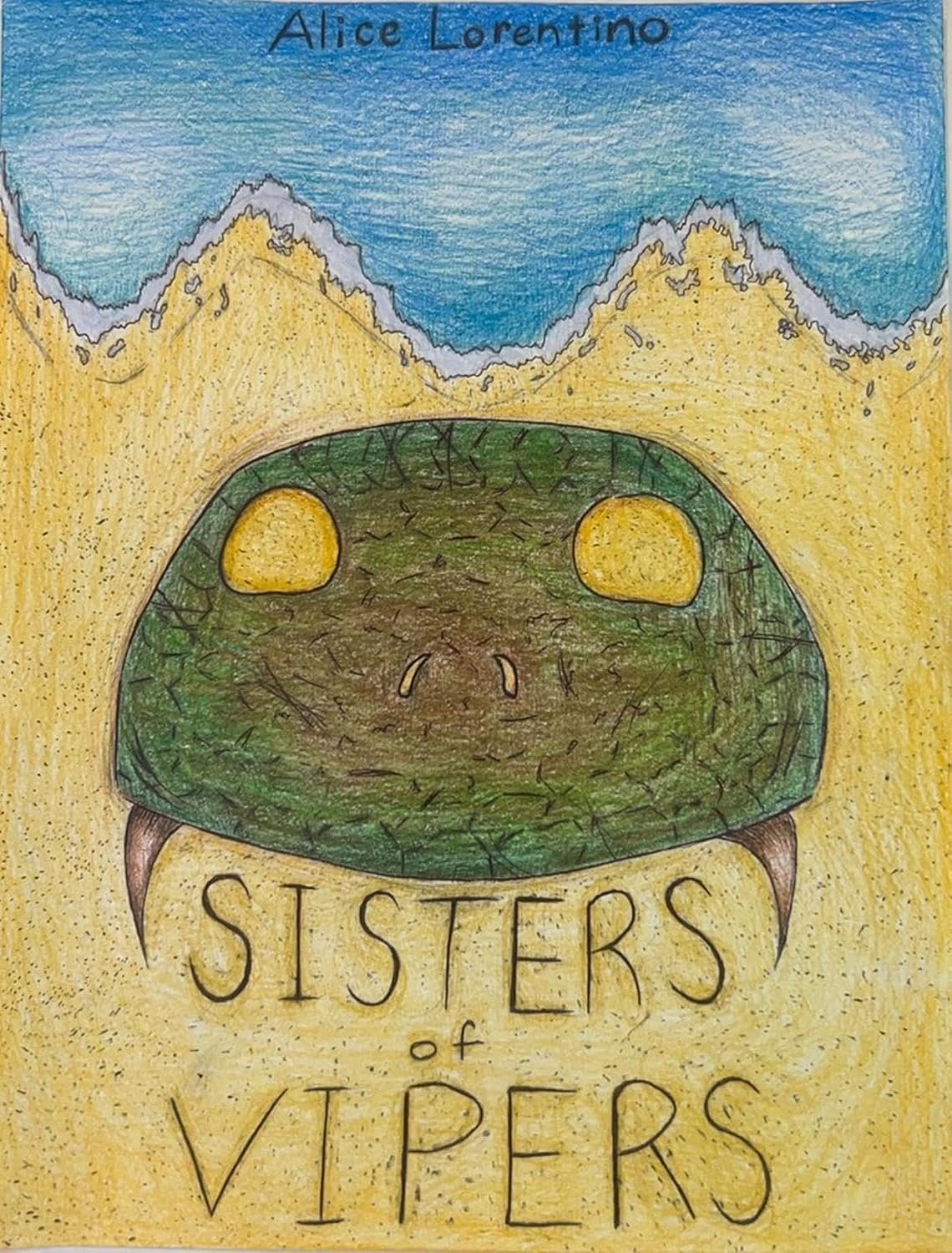
Sisters of Vipers
On Alapora, the privileged Holy Ones control demon magic—until two young women challenge who is allowed to wield power.
Books worth discovering. Authors worth knowing.
On Alapora, the privileged Holy Ones control demon magic—until two young women challenge who is allowed to wield power.
A.
Who Gets to Own Magic?
On the island of Alapora, magic is not simply a skill or mysterious force. In Alice Lorentino’s *Sisters of Vipers*, it is bound to social rank. Public descriptions explain that powerful priests and priestesses called the Holy Ones enjoy sanctioned access to the magic of demons, while ordinary people operate under restrictions. Yet secrecy has not eliminated demand. Demons and humans gather in the Masked Market, where magical transactions take place beyond the official system. The result is an instantly legible fantasy conflict: those who control an extraordinary resource claim the authority to define who may use it, and those excluded must decide whether to obey, negotiate or resist.
The book’s premise places two young women in that system. Zomoc, an eager student of a powerful priestess, goes to the market to investigate. There she meets Mola, and the encounter begins a chain of revelations that undermines her assumptions about herself and the island. Published descriptions then point toward a movement the pair helps build over several years to challenge the Holy Ones. This is not merely a story of acquiring stronger spells. It links personal discovery to political awakening. A character starts by asking what happens in a forbidden place and finds reason to reconsider the legitimacy of the entire order she has known.
The Masked Market as a Meeting Place
A secret market is a rich fantasy invention because it concentrates the contradictions of the setting in one location. Authorities declare a practice unsafe or illicit, but their declaration does not make the desire for that practice disappear. Buyers and sellers gather where oversight weakens. They create their own rules, bargains and dangers. In Alapora’s Masked Market, the mingling of humans and demons is especially significant because the Holy Ones’ power depends in part on who is allowed to mediate that relationship. The market challenges the idea that officially protected elites are the only people capable of interacting with extraordinary forces.
Zomoc’s decision to investigate this place therefore has more than the thrill of trespass. It invites a question about knowledge. What does a student understand about her society if all of her lessons have been filtered through an institution that benefits from controlling information? The public synopsis says her meeting with Mola changes what she believes about her home. We should not invent the precise revelation, but its direction is meaningful. Fantasy often makes the acquisition of knowledge a form of power. Here, understanding the hidden social world may be as consequential as learning a forbidden incantation.
Friendship and the Shape of Rebellion
The title *Sisters of Vipers* suggests solidarity complicated by danger, and the confirmed Zomoc–Mola partnership gives that impression a human center. The synopsis describes the two women devoting years to a movement that seeks to use magic against the Holy Ones. A rebellion developed across years is different from a single impulsive confrontation. It implies endurance, repeated choices and the difficulty of persuading other people to risk something. Success cannot be reduced to one moment of bravery; the protagonists have to keep deciding what they believe, whom they trust and how much they are willing to lose.
The friendship is also important because it links two kinds of experience. Zomoc begins as a student attached to an established power, while Mola enters the story through the world that institution has taught Zomoc to investigate. Their encounter creates the possibility of seeing a social system from more than one position. Such a dynamic can help an epic fantasy avoid flattening revolution into an abstract clash of armies. Change begins with people learning each other’s histories. It becomes political when those histories demonstrate that an injustice once treated as natural is actually maintained through decisions.
The Ethics of Dangerous Power
Demon magic is inherently ambiguous in the book’s setup. The Holy Ones claim a unique ability to use it safely, but their monopoly also benefits them. That does not mean the danger is imaginary. A reader can reasonably ask whether an oppressive institution could still have accurate knowledge about certain risks. The most interesting conflicts often arise when two statements may both be true: the existing authority is unjust, and the force it restricts can be genuinely perilous. A rebel movement then has to confront the ethical question that regimes often avoid. Who should decide acceptable risk, and who bears the consequences when power changes hands?
The premise also resists an easy separation between people and monsters. Humans deal with demons; demons participate in an underground economy. Such arrangements create possibilities beyond a conventional good-human, evil-creature division. Public sources do not specify every species, motivation or relationship, so there is no need to invent them. The confirmed mingling itself establishes a more complex moral landscape. It suggests that what the powerful label dangerous may sometimes reflect a mixture of real threat, prejudice and an effort to protect privilege. That ambiguity is fertile ground for fantasy that wants its politics to matter.
An Epic Measured in Years
Bookseller descriptions trace the central movement across a period of approximately three years. That span is useful for readers deciding whether the story matches their appetite. The scope suggests an unfolding campaign rather than a short isolated mission. Plans can fail; loyalties can be tested; characters can learn how much easier it is to reject injustice than to design a more humane alternative. At the same time, a large political framework needs intimate stakes to remain engaging. Zomoc’s uncertainty about her identity and Mola’s connection to the forbidden market provide an identifiable starting point from which a larger struggle can grow.
Lorentino is credited as the author and publisher in several retailer and ebook records, which place the work in the epic-fantasy category. Page counts differ across listed formats, so an article should avoid treating a single length as universal. More important for an introduction is the consistent story description: Alapora, the Holy Ones, the Masked Market, Zomoc and Mola. Those elements establish a coherent fantasy world without supplying unwarranted details about a final battle or the fate of specific characters. For readers who enjoy systems of magic tied to questions of class and authority, that verified outline provides a substantial basis for interest.
What It Means to Change a World
Revolution stories often begin with certainty and become more complicated as their protagonists learn what true change requires. *Sisters of Vipers* presents an opening that seems designed to support that shift. The characters encounter a forbidden world, discover that trusted assumptions may be false and move from investigation toward resistance. The danger is not merely an enemy with superior powers. It is a social arrangement that tells people what possibilities belong to them. Challenging it could mean changing the rules of magic, the meaning of legitimacy and the futures available to those born outside privilege.
A reader cannot know from a synopsis whether the movement succeeds or what it costs. That uncertainty is worth preserving. The strongest reason to approach Lorentino’s novel is its interplay of private discovery and public consequence. An inquisitive student meets someone who changes the questions she is prepared to ask; together, they begin attempting to change the world around them. *Sisters of Vipers* promises a fantasy in which empowerment is not simply becoming exceptional within the old system. It is asking whether the system deserves to stand at all.
About the book.
On Alapora, priests and priestesses called the Holy Ones claim safe access to demon magic, while forbidden exchange flourishes at the Masked Market. Student Zomoc meets Mola, and they develop a resistance over several years.
Editorial book feature, not paid sponsorship. Independent research-based commentary using publicly available descriptions and author material, not a claim of first-hand full-text review. The cover placeholder will be resolved by the owner’s publishing automation.
Found a book worth opening?
Books worth discovering. Authors worth knowing.
Return to the Journal →