
Secrets at Sunset
A grieving journalist and a former soldier search for a rhino-poaching informant while their secrets complicate an emerging romance in South Africa.
Books worth discovering. Authors worth knowing.
A grieving journalist and a former soldier search for a rhino-poaching informant while their secrets complicate an emerging romance in South Africa.
V.
An Orphaned Rhino and a Journalist’s Grief
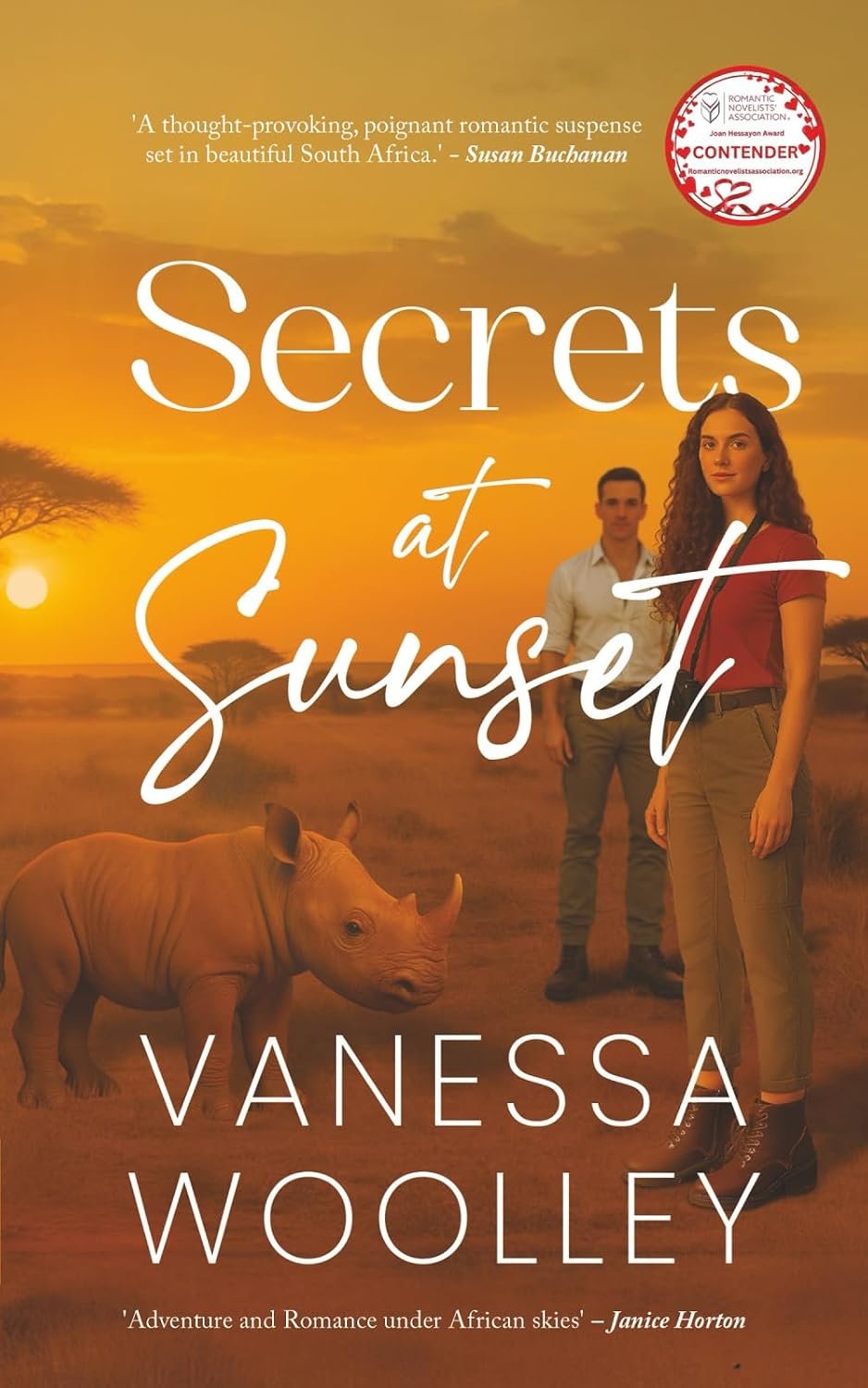
Vanessa Woolley’s Secrets at Sunset opens its public synopsis in South Africa, where journalist Kate Harper has arrived to investigate wildlife poaching. Kate is also mourning the deaths of her parents in a road accident. The timing makes her professional assignment intensely personal: she is trying to report on vulnerability, rescue and loss while carrying a loss of her own. When an orphaned rhino calf is airlifted to safety, the incident connects her to Ryan Brown, the former soldier responsible for saving it. The rescued animal is not merely picturesque scenery. It gives the mystery an immediate emotional and ethical center.
The book is described by its publisher and the Romantic Novelists’ Association as romantic suspense. That hybrid form matters because the relationship and criminal investigation are not simply alternating attractions. Both involve trust. Kate wants to know what is happening to wildlife and why, while Ryan must decide which colleagues and new acquaintances he can rely on. Their developing connection introduces one more relationship in which partial knowledge can be dangerous. The reader is invited into a story where personal recovery and public wrongdoing meet against the striking landscape of the African bush.
Ryan Brown and the Informer
Ryan has dedicated his life after military service to protecting animals. In the official synopsis, a rhino is killed on his watch, forcing him to acknowledge that someone inside his team may be supplying information to poachers. That is a strong suspense premise: the danger does not come solely from unseen criminals outside the protective organization. It may be moving through the very group established to prevent harm. If Ryan cannot trust his own side, ordinary coordination becomes a source of risk. Every shared plan may reach the people he is trying to stop.
The published description also references trouble in Ryan’s military past. It does not reveal the whole account, and a feature should not invent a traumatic incident or a hidden crime to explain his hesitation. What the information does establish is that his present vigilance is shaped by unresolved history. His relationship with Kate therefore develops while he is already under pressure. A protector can become so accustomed to threats that intimacy itself feels unsafe. The romance has an understandable psychological obstacle even before the plot’s explicit secrets emerge.
Kate’s Assignment and the Limits of Objectivity
Kate arrives as a journalist seeking information about poaching. Her profession makes investigation more natural than it would be for an accidental visitor. Reporters are trained to follow evidence and ask inconvenient questions; those skills can place her close to people who would rather stay invisible. Yet the official synopsis also reveals that her trip has a secret personal purpose. That detail complicates her position. Is she reporting only for her audience, or has something she needs for herself become inseparable from the story? The description promises a tension it wisely leaves unresolved.
A reporter’s hidden motive can be an effective fictional device because it asks readers to reconsider earlier questions and choices. What appears neutral may be emotionally charged. What appears impulsive may have been planned. The author makes Kate sympathetic through grief, but sympathy does not eliminate the need for scrutiny. Readers may care about her healing and still wonder whether she is making a dangerous choice. This keeps her from becoming simply the love interest of the person protecting wildlife. She has her own unfinished search.
The Poaching Story Is Not Just Background
Wildlife crime is a serious real-world concern, and Woolley builds her suspense around a fictional syndicate and an informer. A literary feature should distinguish the novel’s particular fictional investigation from verified reporting on actual conservation operations. The description establishes that Kate and Ryan pursue poachers and come closer to a trafficking ring. It does not authorize statements about real named reserves, specific criminal organizations or conservation statistics. The story’s ethical stakes can still be discussed responsibly: animal protection depends on information, trust and the willingness of individuals to intervene under difficult conditions.
The orphaned calf symbolizes what is at risk without requiring the reader to master a technical conservation report. Its vulnerability gives Kate a direct emotional connection to the place. Ryan’s commitment to protection similarly becomes visible through action rather than a declaration of values. These features make the environmental context meaningful to the romance. Kate is drawn to Ryan partly through witnessing what he cares about; he encounters her during a moment when his own work has become dangerous. Their attraction is bound to their responsibilities, not detached from them.
Two Histories That Threaten the Present
The book’s summary identifies Kate’s private reasons for visiting South Africa and Ryan’s troubled military past as obstacles to their connection. Romance readers may recognize the broad structure: each character wants trust while withholding information they fear could change the other’s judgment. Suspense raises the cost of that withholding. A secret that would already hurt a personal relationship may also threaten an investigation or put someone in danger. The narrative is therefore designed to turn revelation into both an emotional and a practical event.
The public description hints that Kate makes a shocking discovery connected to blood ties and new beginnings. Giving away an imagined explanation would only diminish the intended uncertainty, so this feature avoids it. Instead, the reader can consider why the language of blood ties belongs in a story about animal rescue and human attachment. Family can mean obligation, grief, identity and unresolved questions. Kate’s loss of her parents gives that theme particular force. Her choices may be about deciding which connections to preserve and which to redefine.
A Writer With a Conservation Interest
Woolley’s author information describes a background in healthcare management, English literature studies and long-standing newspaper-column writing. The Romantic Novelists’ Association lists Secrets at Sunset as a July 2025 release from Kingsley Publishers, and the Society of Authors identifies Woolley as a contemporary women’s-fiction writer. The publisher’s listing also emphasizes her conservation interest and support for efforts to protect rhinos. Those details do not make the invented plot a documentary, but they help explain why the story’s environmental subject is more than an arbitrary backdrop.
The publication history deserves precision. Different bibliographic sites show later editions, while the queue’s ISBN matches the Kingsley listing from 2025. The difference should not be mistaken for two unrelated stories. Readers considering a particular format can use the linked source listing to confirm the edition they are buying. As with any research-based feature, the plot descriptions here rely on public publisher and association synopses, not on an unverified claim to have read the entire novel.
Adventure, Romance and the Price of Silence
Secrets at Sunset is for readers who enjoy emotionally motivated romantic suspense, conservation themes, morally challenging investigation and relationships shaped by secrets. Its central appeal is the way the same issue—trust—operates at several levels. Ryan must trust colleagues while searching for an informer. Kate must trust her professional instincts while withholding private motives. Both must decide whether a relationship can survive knowledge that has been delayed. The suspense is likely to feel strongest when those questions become impossible to separate.
The beautiful setting promises escape, but the story is not presented as effortless holiday romance. Its protagonists carry grief and painful histories into a dangerous investigation. The orphaned rhino calf makes the stakes concrete: some lives depend on timely action rather than on romance unfolding at its own pace. Woolley’s premise offers readers both the pleasures of an atmospheric love story and the urgency of people who cannot simply turn away when they find something wrong.
About the book.
Journalist Kate Harper investigates poaching in South Africa, where an orphaned rhino calf brings her to former soldier Ryan Brown; they confront a trafficking ring and personal secrets.
Editorial book feature, not paid sponsorship. Independent research-based commentary using publicly available descriptions and author material, not a claim of first-hand full-text review. The cover placeholder will be resolved by the owner’s publishing automation.
Found a book worth opening?
Books worth discovering. Authors worth knowing.
Return to the Journal →