
Rethinking Resilience
Tissa Richards reframes resilience as an intentional, repeatable leadership practice rather than crisis-time endurance.
Books worth discovering. Authors worth knowing.
Leadership resilience is often praised after something breaks. Tissa Richards wants readers to cultivate it before the break.
S.
Resilience Before the Crisis
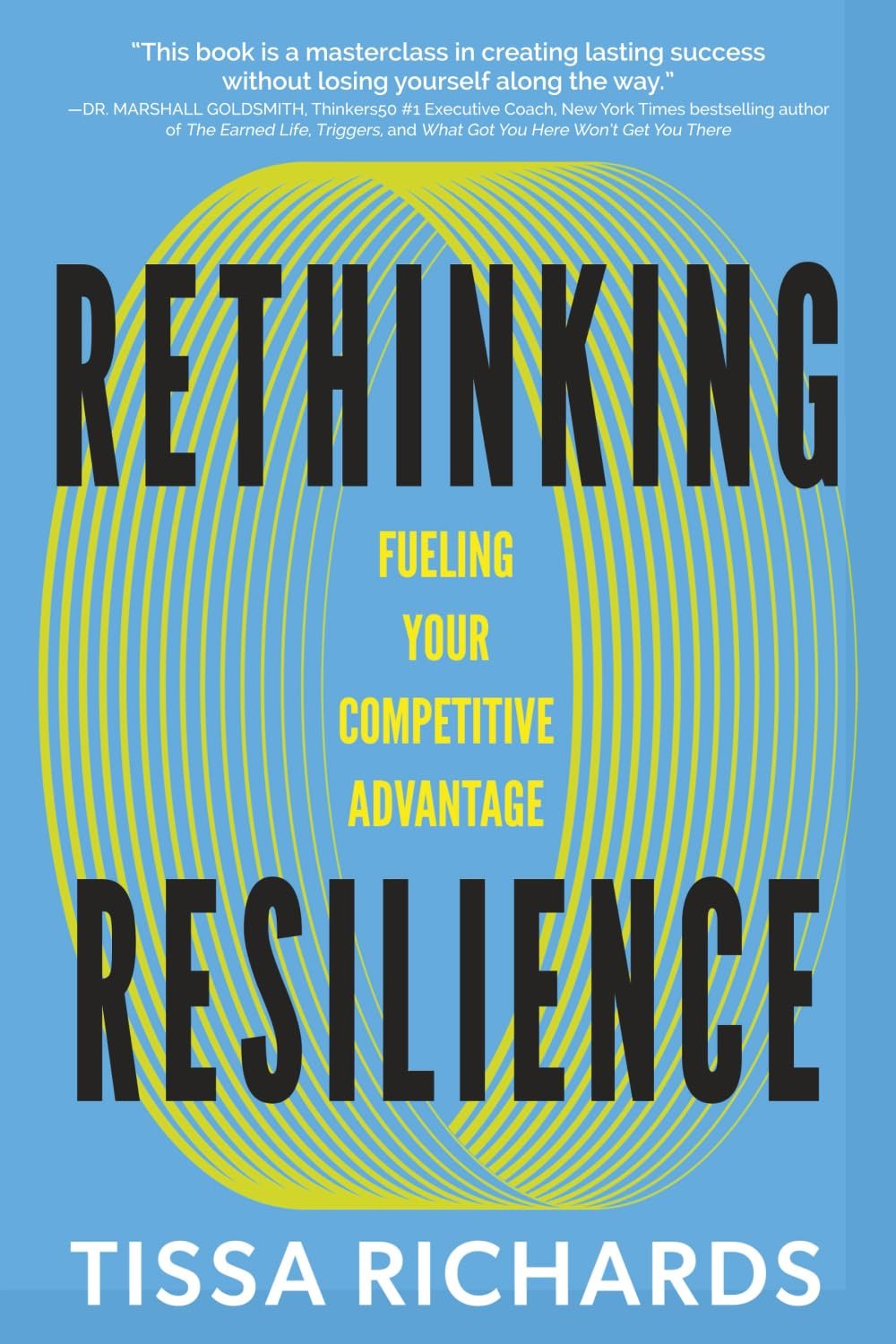
Tissa Richards challenges a familiar business slogan in Rethinking Resilience: Fueling Your Competitive Advantage. Leaders are frequently praised for bouncing back after disruption, as though resilience is visible only in the aftermath of a setback. Richards instead describes resilience as a skill set that can be built deliberately into daily decisions. Her approach asks what would change if leaders practiced clarity, adaptability and grounded judgment before a crisis rather than trying to discover those qualities at the moment they are most needed.
The book’s public description introduces the Intentional Resilience Flywheel, an organizing model for turning this idea into repeatable habits. The exact steps should be learned from the text rather than reverse-engineered from a name. What the official descriptions clearly establish is the model’s purpose: helping professionals approach uncertainty with deliberate choices, values and a capacity to lead without losing themselves. The emphasis moves from heroic recovery toward thoughtful preparation. That shift is valuable for anyone who has watched a team mistake frantic activity for effective response.
Richards brings an established business background to the topic. Her author biography describes work as a technology founder, CEO and leadership adviser, including experience guiding senior executives through changing conditions. That history informs the book’s positioning as a leadership tool rather than a purely motivational essay. A practitioner writing about resilience can draw attention to the ordinary choices that shape organizational behavior long before external pressure exposes weaknesses. Still, any specific claimed advantage should be treated as an approach to test, not a guaranteed result.
From Individual Endurance to Organizational Design
Traditional resilience advice often places responsibility on the individual: stay positive, work harder and recover quickly. That formulation can obscure structural problems. If a team repeatedly faces impossible deadlines or receives conflicting instructions, asking employees simply to be tougher is unlikely to address the source of strain. Richards’s emphasis on intentional practice invites a broader question about systems. What planning habits, decision rights and communication channels make adaptation possible before employees reach a breaking point?
Consider a leadership group facing incomplete data. The intuitive temptation may be to delay all decisions until certainty appears or to respond with escalating control. Neither response necessarily serves the organization. A more resilient practice might involve distinguishing reversible decisions from irreversible ones, naming the assumptions in play and setting a review point. These are examples of the sort of practical thinking a reader might apply to the book’s central principle, not a claim that Richards presents these exact exercises on named pages.
The phrase “competitive advantage” can sound impersonal, but the book’s description ties performance to the human conditions of leadership. Clear judgment requires more than analytical capability. Exhaustion, insecurity and fear of public mistakes can all distort decisions. Deliberate resilience therefore involves noticing the conditions in which people are expected to perform. A team that can discuss uncertainty openly may make better use of limited information than one compelled to hide weakness behind confident language. The relationship between candor and action deserves careful attention.
The Everyday Work of Values and Choice
Richards’s public messaging repeatedly returns to clarity and grounded values. Values have little operational meaning if they appear only in mission statements. They become useful when leaders must choose between competing demands, such as short-term numbers and long-term trust. An intentional approach to resilience asks whether the standards guiding those choices remain recognizable under pressure. If a company declares collaboration important but rewards solitary crisis heroics, employees receive an inconsistent message about what behavior is truly valued.
Confidence is another term that can be misunderstood. Leaders may imagine confidence means never hesitating, but the ability to admit uncertainty can be a sign of sound judgment. A resilient decision-maker need not know everything. They do need to distinguish knowledge from assumptions and make room for revision. That is an editorial interpretation consistent with the book’s emphasis on clarity, not a quotation of a proprietary tool. Readers considering this approach may find it useful to ask how their own teams react when someone says, “We need better evidence.”
Rest and recovery also enter the wider discussion. Richards has written publicly about the need to refuel without treating rest as a reward earned only after every obligation disappears. This connects resilience to the management of human limits. Long-term performance depends on more than the ability to endure a difficult week. People need conditions in which they can think, recover and continue learning. Turning resilience into a daily practice should not mean demanding constant self-optimization. Its best application is to make sustainable work more possible.
How a Flywheel Metaphor Can Change Habits
A flywheel acquires momentum through repeated effort. In management language, it suggests that small consistent actions can eventually support one another. Richards’s named model draws on that broad metaphor, while the book supplies its specific method. Prospective readers should not confuse the general image with an independently verified outline of its chapters. The useful takeaway from the public description is that resilience is presented as cumulative practice rather than an emergency personality trait that appears unpredictably in exceptionally talented people.
That distinction matters during organizational change. A department implementing unfamiliar technology, reorganizing roles or responding to market volatility may not experience a single identifiable crisis. Instead it may encounter a steady stream of smaller disruptions. A reactive approach treats each as a new exception. A more intentional response examines recurring patterns: how changes are explained, who is consulted, what information is shared and how learning is retained. These questions make resilience visible in the work itself rather than only in speeches after a major setback.
There are limits to every framework. An excellent leadership practice cannot eliminate external economic shocks, repair every inequity or guarantee that a company will succeed. Richards’s argument is best understood as a proposal for improving the quality of preparation and response within uncertainty. Readers will need to assess how its tools fit their organizations, the evidence that supports particular claims and the trade-offs that remain. Such caution strengthens the usefulness of a business book instead of diminishing it.
For Leaders Who Want More Than Motivation
This title will likely appeal to founders, executives, managers and professionals whose work involves persistent visibility and uncertain decisions. The publisher’s description specifically addresses high-stakes leadership, changing teams and pressure to perform. Its promise is tactical language and habits rather than a comforting reminder to keep going. Readers who want detailed applications should consult the text itself for the flywheel’s steps, examples and any worksheets rather than relying on a feature summary.
The most meaningful question raised by the book is whether resilience can be separated from suffering. If preparation, judgment and supportive systems improve how people navigate change, then waiting for a crisis to prove toughness becomes unnecessary. Leaders can practice before the stakes become extreme. They can also ask whether their organization is making it easier or harder for people to adapt. This offers a more accountable and less romantic view of perseverance than the image of an individual endlessly bouncing back.
Rethinking Resilience frames adaptability as something cultivated intentionally and repeatedly. Tissa Richards brings leadership experience and a named model to that proposition, inviting readers to look at how they decide, communicate and recover. The book’s value proposition is not immunity from disruption. It is the possibility of meeting disruption with greater clarity, steadier habits and fewer avoidable losses in the quality of human judgment.
About the book.
Richards argues that resilience can be learned and intentionally integrated into daily decision-making, values, team behavior and pressure management through her Intentional Resilience Flywheel.
Sponsored book feature. Research-based commentary from named public sources, not a first-hand complete-book review. The cover placeholder will be resolved by the owner’s publishing automation.
Found a book worth opening?
Books worth discovering. Authors worth knowing.
Return to the Journal →