
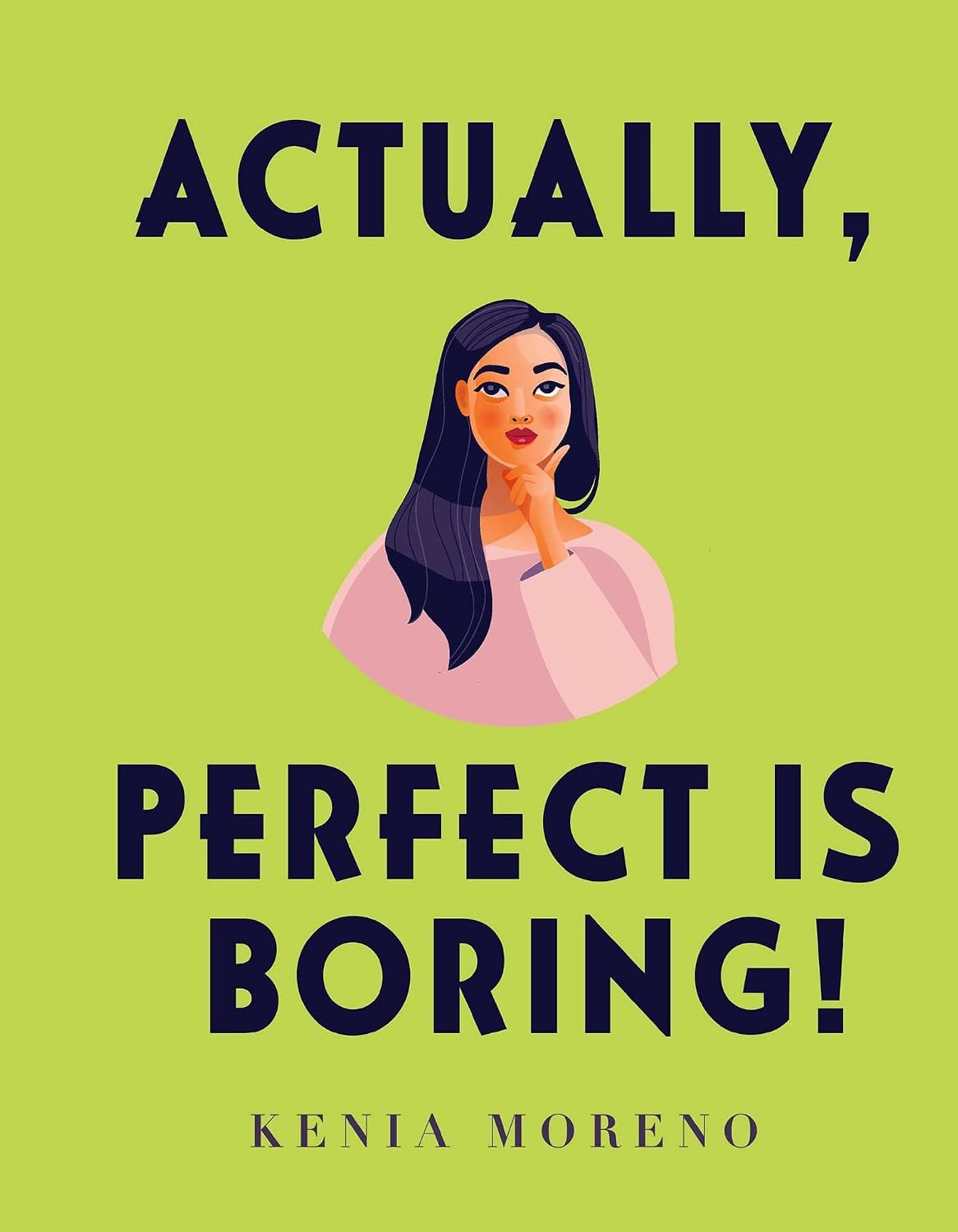
Actually, Perfect Is Boring!
Kenia Moreno questions who defines perfection and makes a concise case for authenticity and self-acceptance.
Books worth discovering. Authors worth knowing.
Perfection changes from one culture and relationship to another. Kenia Moreno treats that instability as a reason to rethink the chase.
S.
When the Ideal Keeps Moving
In Actually, Perfect Is Boring!, Kenia Moreno begins with a simple observation that can unsettle years of learned behavior: perfection is not a stable, universal standard. What one community praises, another questions; what feels necessary at one stage of life may become irrelevant later. The published description identifies pressures to look, behave and think in ways that win approval from other people. Moreno’s response is a short reflection on individuality, urging readers to stop treating their distinct qualities as defects that require correction.
The book is a concise work, with bibliographic descriptions identifying a short print edition rather than a comprehensive clinical manual. That scale is part of how it should be introduced. It promises an accessible invitation to reflect, not a validated treatment program or a detailed course in psychology. A feature can explore its central proposition without inventing chapters, exercises or therapeutic outcomes. Moreno is asking what happens when people spend so much effort adjusting themselves for an audience that they lose confidence in the person they were trying to present.
There is a playful provocation in calling perfection boring. A perfect image might seem desirable because it carries little obvious risk; it invites approval and protects against scrutiny. Yet a life arranged entirely around that image can become narrow. Curiosity, experimentation and humor all depend on the possibility of mistakes. By challenging the value assigned to flawlessness, Moreno invites readers to recognize that unpredictability is not always a defect. This is an interpretation of the documented theme rather than a claim that the book contains a particular anecdote.
Who Gets to Decide What Counts?
Standards of attractiveness, behavior and achievement are taught through families, workplaces, schools and media. They can feel objective precisely because people encounter them so often. Yet standards change across cultures and over time, a point made directly in the bookseller description. If the target keeps moving, a person who bases self-worth on reaching it may spend a lifetime adjusting without gaining security. Moreno’s challenge is not simply to ignore every outside opinion. It is to ask which expectations are useful and which demand the surrender of identity.
The pressure to fit in can be especially strong where belonging matters most. A young person may imitate friends to avoid isolation; an adult may hide an unpopular conviction to preserve family harmony or professional standing. Sometimes adaptation is considerate and necessary. At other times it erases something important. The book’s emphasis on being oneself creates space for discussing that difference. Authenticity need not mean refusing compromise or telling everyone every private thought. It can mean recognizing what one values before making the compromises ordinary relationships require.
Perfectionism can also masquerade as a practical strategy. People may believe that one more credential, one more correction or one more improvement will finally make criticism impossible. In reality, the standards by which others judge a person can change without warning. A reflective text that encourages self-acceptance offers a different starting point: worth does not need to be earned through the perpetual elimination of imperfections. The principle is broadly resonant, though it should not be presented as proof that all pressures disappear once someone adopts it.
The Difference Between Growth and Self-Erasure
At first glance, celebrating imperfection may sound like rejecting ambition. That is not a necessary reading. A person can develop skills, apologize for mistakes and work toward difficult goals while remaining convinced that their basic identity deserves respect. The distinction is between growth pursued out of interest or responsibility and change demanded by shame. Moreno’s book is publicly described as a call to embrace uniqueness rather than edit oneself into conformity. That suggests a framework in which improvement is possible without making personal dignity conditional.
Imagine someone preparing to speak in a meeting. They may reasonably want to communicate more clearly or understand the topic better. That desire differs from believing they have no right to contribute until their accent, appearance or personality resembles everyone else’s. This example illustrates how the book’s theme can be considered in everyday life; it is not an episode attributed to Moreno. Such distinctions give the broad word “authenticity” practical force. They ask a person to consider not merely what they want to change but why that change feels compulsory.
Self-acceptance also need not require constant confidence. It can include admitting uncertainty, noticing envy or acknowledging a poor decision without turning the entire self into a failure. A perfectionist standard leaves little room for ordinary human inconsistency. A kinder standard makes accountability possible because mistakes no longer threaten the person’s right to belong. Moreno’s wider author profile emphasizes self-realization and responsibility, which makes this reading consistent with her publicly described concerns without implying any particular method appears in the book.
Culture, Identity and a Wider Conversation
The author identifies a cross-cultural upbringing in her public BookBaby profile. She describes being born in Havana, raised in Aden and later living in the United States. This biographical context may help explain her interest in how environments influence expectations, though it would be speculative to assign a specific experience to a passage we cannot verify. What is supported is her declared concern with self-awareness and personal growth. The title’s emphasis on standards changing among communities fits that wider conversation.
Readers may recognize the problem in online culture, where edited images and carefully chosen achievements make other people’s lives appear unusually complete. Comparison is easy when only the polished surfaces are visible. But the challenge is not unique to digital life. Long before social media, people managed impressions through clothing, conversation, credentials and social roles. Moreno’s compact message can be placed in that larger context without claiming the book provides a history of media or a formal study of social comparison.
The idea that individuality benefits the wider world is central to the published description. That argument can sound sentimental until one considers how creativity depends on differences in experience and taste. If every person attempted to reproduce the same approved style of thinking, problem-solving and artistic expression would lose variety. The familiar advice to “be yourself” becomes more substantial when linked to this social question: what forms of contribution become possible only because a person’s abilities or interests do not match those of a surrounding group?
What a Short Reflection Can Offer
Because the book is brief, its usefulness may lie in prompting readers to examine assumptions rather than providing exhaustive explanations. A single idea can remain productive after the text ends. Readers might ask whose approval they are working hardest to secure, which changes make their lives better and which changes are simply attempts to avoid disapproval. These are suggested reflection questions consistent with the book’s premise, not exercises quoted from its pages. They offer a way to approach the book without overstating its contents.
The strongest audience may be people interested in accessible personal growth writing, self-acceptance and the social dimensions of perfectionism. Those looking for evidence-based therapy or guidance about a specific mental-health diagnosis will need other resources; the product description does not establish that kind of intervention. Moreno’s work belongs more comfortably in a tradition of brief reflective encouragement. Readers can value that invitation without expecting it to solve every complicated relationship or practical problem.
Actually, Perfect Is Boring! argues, in its publicly documented terms, that a changing external standard is a fragile foundation for self-worth. Kenia Moreno asks readers to recognize the value of the qualities that make them distinct. The idea is modest in length but potentially expansive in application: progress is not the same thing as conformity, belonging should not require total self-erasure, and imperfection can leave room for a more interesting life.
About the book.
Moreno’s short BookBaby reflection challenges standards of appearance, behavior and approval, encouraging readers to value their uniqueness rather than reshape themselves for social acceptance.
Editorial book feature, not paid sponsorship. Research-based commentary from named public sources, not a first-hand complete-book review. The cover placeholder will be resolved by the owner’s publishing automation.
Found a book worth opening?
Books worth discovering. Authors worth knowing.
Return to the Journal →