
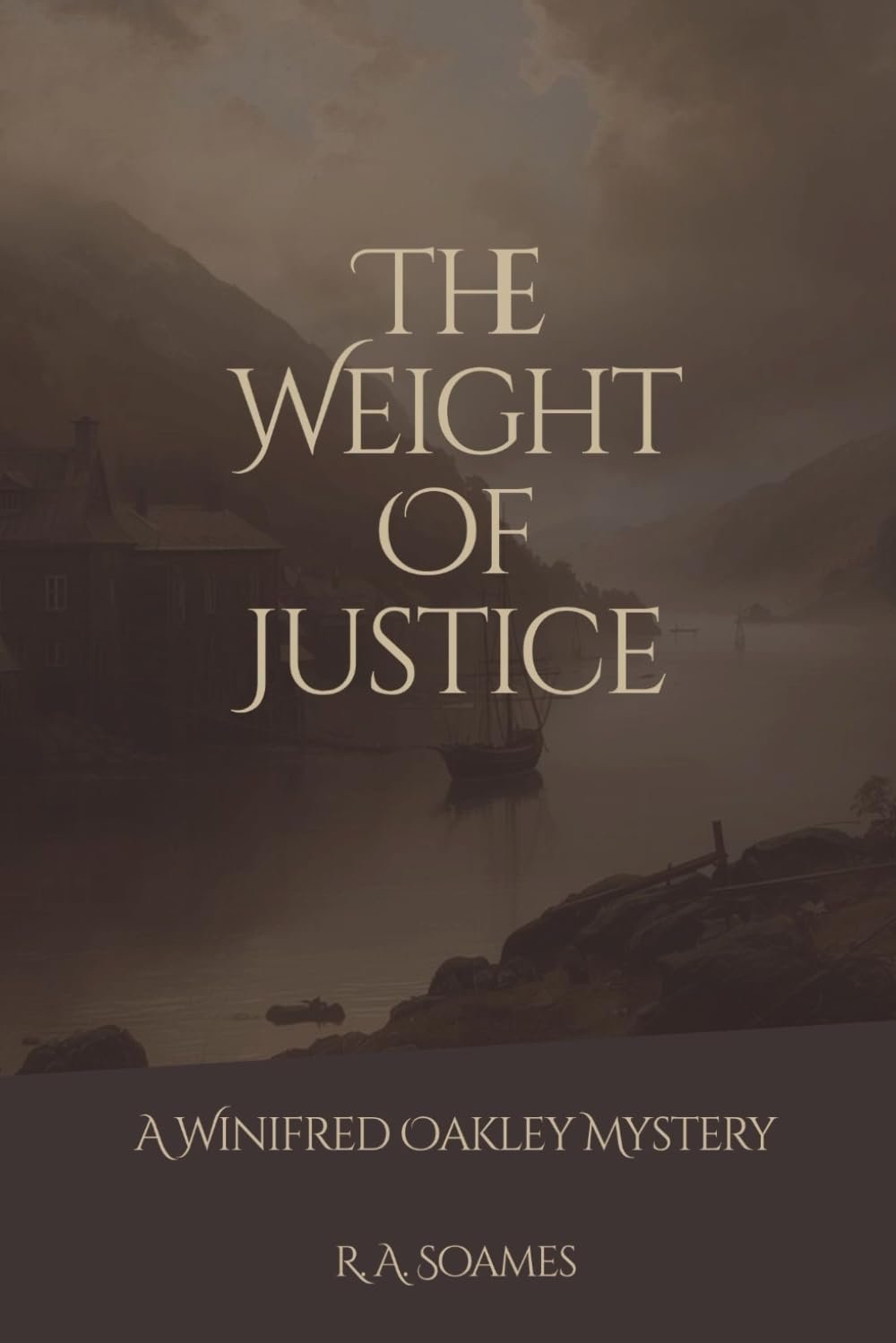
The Weight of Justice
A third entry in the Winifred Oakley historical mystery series invites questions of truth, power, and fair judgment.
Books worth discovering. Authors worth knowing.
A mystery called The Weight of Justice invites readers to ask who gets to define justice.
S.
A Mystery with a Verified Place in a Series
The Weight of Justice is identified in bookseller records as the third Winifred Oakley mystery by R. A. Soames. The available bibliographic material establishes its title, authorship, series position and a 2025 paperback edition. It does not supply a dependable synopsis of the particular case, its suspects or its ending. That absence matters. A worthwhile editorial spotlight should tell readers what can be known rather than inventing a crime simply because the book belongs to a detective series.
The title nevertheless provides a meaningful doorway into questions characteristic of mystery fiction. Justice is not identical to solving a puzzle. A detective may determine what happened while the people affected continue debating what accountability should mean. Readers approaching this volume can keep that distinction in mind as a possible theme without assuming that it is explicitly developed in an undocumented scene. This feature offers context and reading questions rather than a fabricated plot summary.
Who Is Winifred Oakley?
The first installment of the series, Dividing Lines, is described by a retailer as following Winifred Oakley, a woman from English high society in the early nineteenth century who relocates with her husband to Van Diemen’s Land. In Hobart Town, new acquaintances and unexpected mysteries draw her into investigations that challenge her assumptions. That earlier description establishes the series protagonist and a historical foundation. It does not prove that every later book takes place in the same precise location or follows an identical investigative formula.
A reader can still infer why Winifred makes an appealing central figure. A woman navigating social expectations in a colonial setting may see matters overlooked or dismissed by those granted more formal authority. The gap between her position and her curiosity offers the potential for tension. These are observations about the series framework, not confirmed actions in the third book. Readers should consult the actual volume to learn which relationships, places and conflicts continue into its story.
The Historical Mystery’s Special Questions
Historical detective fiction must operate without the conveniences and assumptions of a modern police procedural. Access to information, the standing of witnesses and the authority to investigate can be shaped by class, gender and political institutions. These constraints help explain the appeal of placing an inquisitive protagonist in a past society. Finding the truth becomes a social as well as intellectual task. Even asking the right question may challenge someone else’s idea of who has the right to speak.
Because the exact plot of The Weight of Justice is not securely available, such observations should remain a lens rather than a description. A reader may find the historical setting used differently in this installment or discover that the principal conflict is not what the title suggests. That possibility is part of honest criticism. The genre creates expectations, but expectations are not evidence. The distinction helps readers approach the work with curiosity instead of false advance certainty.
The Meaning of Justice in a Title
The phrase The Weight of Justice invites consideration of burdens carried by investigators, witnesses and those harmed by wrongdoing. Justice can be desirable and still feel heavy. Establishing responsibility may expose private histories or force a community to confront actions it preferred to ignore. Such possibilities explain the title’s thematic appeal, but none should be attributed as a specific event in this volume without textual confirmation. An editorial note can illuminate a title’s implications without claiming to reconstruct a hidden narrative.
The word weight may also suggest that decisions carry consequences beyond a neat verdict. Readers of mysteries often enjoy the final assembly of clues. Others value the moral uncertainty that can remain after an apparent solution. The series context allows both interests to be kept in view. It does not establish the author’s final position on punishment, forgiveness or restitution. Those are questions to bring into a reading, not conclusions to place in the author’s mouth.
Why Series Order May Matter
A third book carries a different expectation from a standalone novel. Returning readers may already know how a protagonist interprets danger, whom she trusts and which earlier choices continue to affect her. New readers may wonder whether they need the previous volumes to understand the present one. Public listings confirm the numerical position of The Weight of Justice but do not reliably establish how much prior plot knowledge it requires. The safest advice is to consider reading the earlier books if continuity is especially important to you.
Series fiction can reward attention to gradual development. A recurring character may gain confidence, revise loyalties or become aware of limitations that escaped her in the opening story. Conversely, a familiar historical setting can be reexamined through a new problem. These are possibilities within a continuing mystery sequence, not verified changes to Winifred in this particular volume. Keeping that boundary visible allows readers to set expectations without being misled by supposed revelations absent from the sources.
A Colonial Setting Requires Care
The earlier Winifred Oakley story places its heroine in Van Diemen’s Land during the nineteenth century, a context inseparable from colonial power and the lives of Indigenous peoples. Historical fiction set in such a society should not be read as if the setting were an empty landscape awaiting European protagonists. Place names, property claims and official institutions all carry histories that affect whose testimony is believed and whose perspectives are represented. Those considerations are important questions for a reader, whether or not the third volume addresses them directly.
The available sources do not establish the precise geography or treatment of colonial history in The Weight of Justice. This feature therefore does not endorse a historical portrayal it cannot inspect. Instead, it suggests that readers remain attentive to representation whenever an early Australian colonial setting appears in the series. A well-drawn historical mystery can sharpen awareness of power; a careless one can obscure it. Only engagement with the actual text can settle which approach the author adopts.
What the Bibliography Can Tell Us
Bookseller records for The Weight of Justice consistently identify R. A. Soames and place the book within the Winifred Oakley mysteries. Some list a paperback edition dated October 2025 and a length of approximately 144 pages. Those details are useful for finding the correct title and distinguishing it from other mysteries with similar names. They are not substitutes for a synopsis, sample chapter or independently verified reading of the novel. This distinction is especially important when multiple titles use terms such as justice, evidence or truth.
The wider bibliography identifies additional mysteries under Soames’s name and earlier books featuring Winifred. That suggests a sustained interest in serial storytelling, but a catalogue cannot reveal stylistic quality or the precise emotional stakes of an individual volume. Claims of thrilling twists, vivid characterization or a surprising solution would need support from the text or trustworthy reviews. Until that evidence is available, editorial restraint is more useful than an enthusiastic but unsupported plot description.
How to Approach the Third Volume
Readers drawn to amateur sleuths, historical settings and questions about fairness may wish to investigate The Weight of Justice. The strongest approach is to treat the volume as a specific book whose contents remain to be confirmed, not as a generic mystery automatically matching every genre convention. Verify the edition, consider whether to begin with Dividing Lines, and pay attention to how the narrative handles evidence, social authority and the consequences of accusations once you have the book in hand.
The premise one can confidently recommend is modest but clear: a named protagonist continues in a third historical mystery associated with R. A. Soames. The deeper questions are invitations rather than plot facts. Who has authority to define justice, how do investigators weigh competing versions of truth, and what changes when a familiar character returns to another case? This spotlight leaves those answers open. Its purpose is to help readers locate a real book and approach it thoughtfully, without manufacturing the story they should be free to discover themselves.
About the book.
A Winifred Oakley Mystery volume three by R. A. Soames. Public bibliographic records verify the series placement; the particular case and resolution remain unverified.
Sponsored book feature. Research-based original commentary from public author, publisher, retailer or bibliographic sources; not a firsthand complete-book review. A cover placeholder will be resolved by the publishing automation.
Found a book worth opening?
Books worth discovering. Authors worth knowing.
Return to the Journal →