
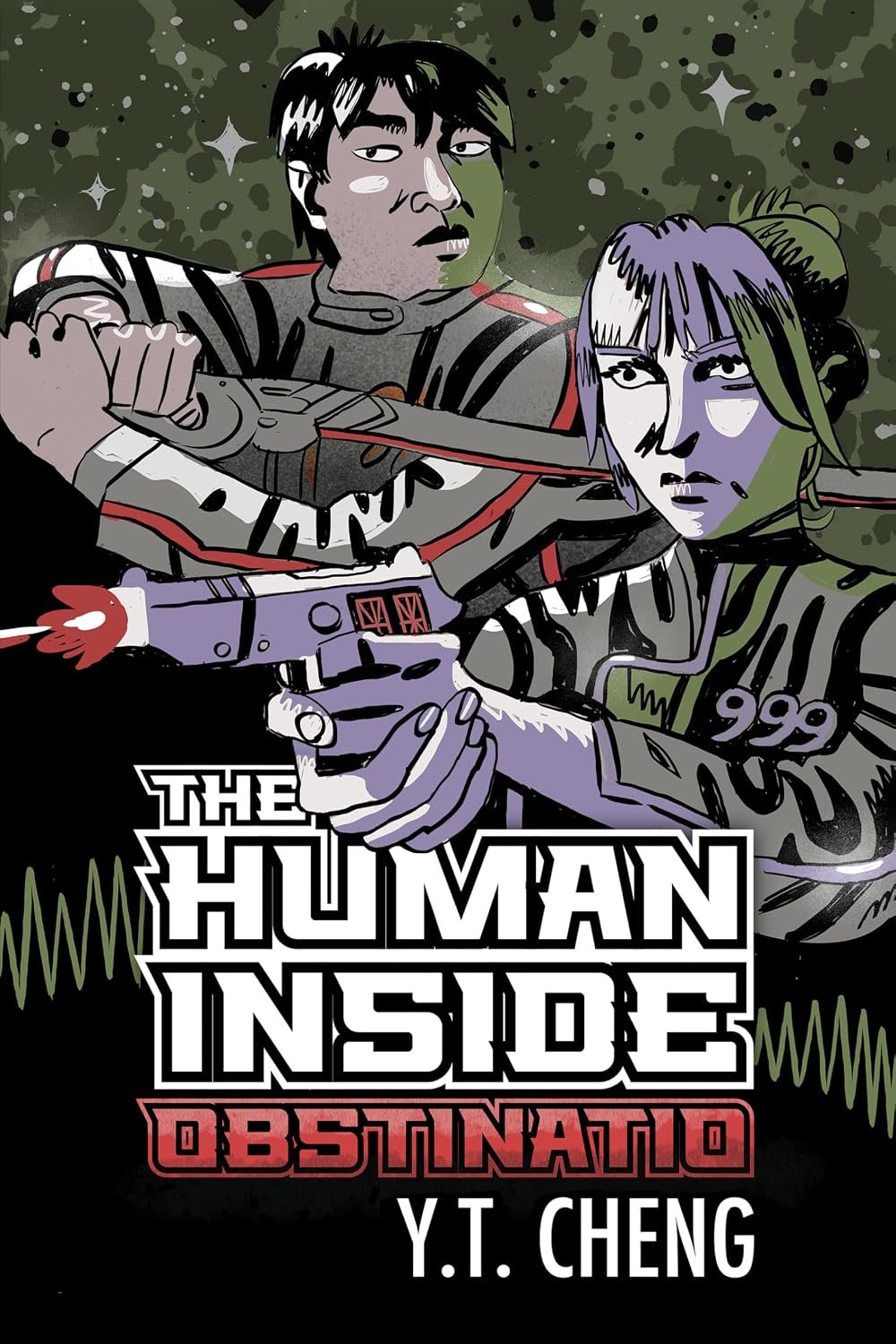
The Human Inside: Obstinatio
An expansive sequel in which divided amborg teams confront threats on Earth and in space.
Books worth discovering. Authors worth knowing.
An expansive sequel in which divided amborg teams confront threats on Earth and in space.
Research-based literary perspective on a verified edition.
The Human Inside: Obstinatio begins from the kind of predicament that makes space opera feel both immense and immediate: the fate of not one universe but two is placed in jeopardy. Y.T. Cheng’s published synopsis describes a dark conspiracy, an Emergency Recall that has become more complicated, amborgs divided into teams, problems unfolding on Earth, a dangerous rescue effort and the search for the mysterious Tandeeri. It is clearly not the premise of a small standalone mystery. The excitement lies in how a collective mission appears to fracture into simultaneous tests of loyalty, judgement and endurance, with no simple route back to the moment when the team first answered the call.
When a mission grows beyond its original boundaries
Adventure narratives often begin with a task that seems difficult but definable. Save a place. Retrieve a person. Stop a threat. In the available description of Obstinatio, the mission no longer fits within a single sentence of that kind. The amborgs have already been recalled and then separated, with a substantial group remaining to respond to emerging trouble on Earth while a smaller team attempts a rescue. Meanwhile a new threat jeopardizes progress already made. Instead of suggesting one straight road toward a final confrontation, the premise establishes a network of pressures.
That widening structure is particularly appropriate for a series interested in the consequences of heroic action. Solving one problem can expose another; success in a remote crisis can carry costs closer to home. What makes this a potentially rewarding sequel is not simply the escalation to a larger enemy. It is the need to keep several responsibilities visible at once. A reader who enjoys tracing cause and effect across locations may find more to consider here than in a tale that reduces every difficulty to one spectacular battle.
Two universes, but no easy overview
The description’s reference to two universes makes an ambitious claim about scale, though it does not supply a detailed cosmology or the scientific rules of the setting. The editorial response should therefore avoid inventing portals, powers or explanations. Instead the striking issue is perspective. A character can experience only a narrow part of an enormous conflict at any given moment. Even an unusually capable group must make decisions with incomplete information. Science fiction frequently turns that limitation into suspense by showing how a small action can matter disproportionately within a much larger system.
Thinking about the two-universe premise also raises a question of obligation. Do the heroes owe special protection to their home world, or does responsibility extend wherever their capacity to help may reach? The plot description identifies threats affecting Earth as well as a wider confrontation, giving readers a reason to ask how competing emergencies are ranked. Such questions do not imply that the text provides an easy ethical answer. They identify the moral pressure naturally created when survival is no longer measured in one location alone.
Why divided teams can create stronger drama
One faction remaining behind and another pursuing a daring rescue is a promising ensemble arrangement because it makes trust a practical necessity. Characters who cannot consult each other constantly must act on the assumption that their allies will do their part. A reunion may therefore be less important than the invisible connection between separate decisions. This approach can also widen the emotional range of an adventure, allowing urgency to take different forms: a defensive response, a rescue under uncertainty, and an investigation into the enemy’s intentions.
For the reader, division can be exhilarating and demanding. Alternating threads work best when each contributes something distinctive instead of merely delaying an answer. The verified synopsis does not reveal the novel’s chapter structure or pacing, so it would be wrong to promise that it handles every strand perfectly. What can be said is that the premise creates room for different kinds of bravery. Remaining behind is not necessarily less courageous than heading toward the unknown, and rescue can be as consequential as confrontation.
The unseen conspiracy as a different sort of threat
A conspiracy is a particularly effective counterweight to the visible scale of intergalactic danger. An enemy whose plans are concealed asks protagonists to question what they think they understand, rather than simply increase their strength. The publicity material describes destructive intentions operating in the shadows. That limited fact changes the nature of the reader’s anticipation: there is something to discover as well as something to survive. Even great power may be inadequate if the people wielding it do not recognize the pattern unfolding around them.
This is one reason stories of escalating conflict benefit from uncertainty. A bigger threat alone risks turning the plot into arithmetic, with ever-larger armies and higher stakes. Mystery restores the importance of judgement. Who can be trusted? What information is missing? What would count as evidence that the team’s interpretation is wrong? These are appropriate questions to bring to Obstinatio, not confirmations that particular twists or betrayals occur in its pages.
The lure of the Tandeeri
The mysterious Tandeeri are singled out as a possible source of hope. Because the synopsis does not define them in detail, their role is best described as an open question rather than a solved piece of world-building. Their presence nevertheless introduces a useful dramatic idea: the most powerful characters may have to seek assistance from something they do not fully comprehend. That reverses the fantasy of total self-sufficiency. It suggests that persistence, the quality implied by the book’s Latin-derived subtitle, may need to coexist with an ability to ask for help.
There is a distinction between stubbornness and perseverance. One refuses to adjust; the other can continue toward a purpose while changing methods. A title like Obstinatio gives readers reason to look for that difference. Who remains committed to the larger mission? Who mistakes repetition for resolve? The work may answer those questions in ways its summary does not disclose. The important point is that endurance becomes interesting when the goal is worth defending but the path cannot remain fixed.
What continuity asks of the reader
Those entering here should be aware that the publisher’s description presumes an earlier Emergency Recall and ongoing relationships among the amborgs. Starting with the preceding books may help establish why particular people, losses and obligations matter. Returning readers will probably bring their own memory of prior decisions, which can enrich the significance of separation and reunion. As with other large-canvas series, context is part of the pleasure, but it can also be a commitment. The safest recommendation is to examine the series order before choosing Obstinatio as a first encounter.
This is a sponsored book feature according to the current MarketAnyBook queue. Sponsorship does not convert promotional description into an independent reading verdict. The public material supports the names, broad events, stakes and credits; it does not support claims about the quality of every plot resolution, the emotional force of the ending or the full range of character arcs. Those judgements properly belong to readers who have spent time with the complete work.
Who may want to read it
Obstinatio is most likely to appeal to science-fiction readers who enjoy long-form continuity, ensemble action and vast speculative conflicts that distribute attention across several locations. The two-universe premise will especially interest those who favour space opera on an ambitious scale, while the hidden conspiracy and search for unfamiliar allies may attract readers who like mystery inside their action. It is less clearly a fit for someone seeking a compact, entirely self-contained narrative. The listing establishes that this is a continuing adventure, and its layered setup is a reason to arrive with an interest in following the wider series. The central invitation is not that every answer has been supplied, but that the stakes keep forcing the heroes to reconsider what persistence demands.
Y.T. Cheng is credited as author, with Michael Batista as illustrator and Skyler Surber as editor in the queue. Those edition credits deserve preservation. At its most interesting level, the book’s verified premise asks whether a group built to protect others can survive the moment when even its greatest cooperative effort no longer seems sufficient.
About the book.
An expansive sequel in which divided amborg teams confront threats on Earth and in space. The purchase link preserves the original listing in the queue.
The book is designated as a sponsored feature in the MarketAnyBook queue. This article is an original research-based introduction, not a firsthand review; editorial interpretation is identified as such. Sources comprise publicly available publisher, retailer or bibliographic descriptions and the verified queue and cover; detailed interior content has not been independently examined.
Found a book worth opening?
Books worth discovering. Authors worth knowing.
Return to the Journal →