
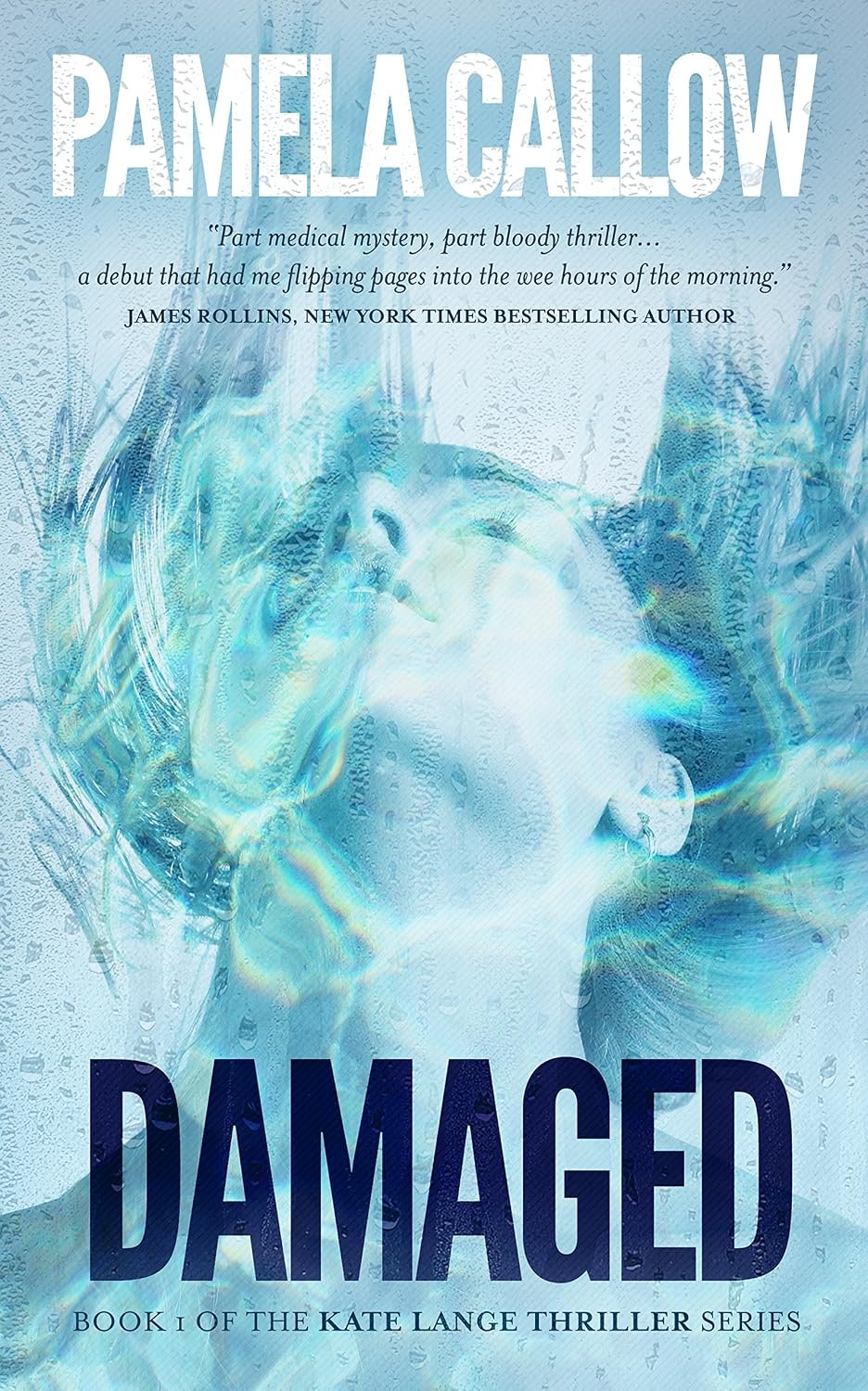
DAMAGED
A young lawyer’s pursuit of redemption pulls her into a murder case and a medical conspiracy.
Books worth discovering. Authors worth knowing.
A young lawyer’s pursuit of redemption pulls her into a murder case and a medical conspiracy.
Research-based literary perspective on a verified edition.
Pamela Callow’s DAMAGED offers a sharp variation on the legal thriller: its heroine fears she has harmed someone by giving advice in good faith. Kate Lange arrives at a powerful law firm carrying grief over her sister’s death and the bruising aftermath of a broken engagement. A grandmother approaches her about a private-school student’s custody situation; later the teenager is murdered. Kate cannot dismiss the possibility that her own counsel helped put the girl in danger. The publisher’s synopsis makes this the opening movement of a story involving medical suspense, institutional power, and a serial killer known as the Body Butcher. Its central force, however, is the intensely personal question of how responsibility survives when the consequences of a professional decision become devastating.
A lawyer who wants to earn her place
Kate’s new position is not merely background decoration. The published account places her inside an ambitious firm where she feels under pressure to prove herself. Legal thrillers have long used offices, courts and professional hierarchies to reveal who is permitted to exercise authority, and who is encouraged to doubt their own judgement. The ability to advise a client depends not only on knowledge but also on confidence, institutional support and a willingness to act when powerful people prefer caution. For Kate, that professional challenge intersects with an old personal wound: she has chosen a career in which the moral weight of decisions cannot be kept entirely separate from private grief.
The firm’s managing partner, Randall Barrett, appears in the synopsis as an important figure in Kate’s precarious status. Without inventing his motives or later choices, it is reasonable to notice the imbalance of power built into the setup. Kate has an obligation to the people who seek her help, but she must also answer to the workplace that controls her future. Such divided loyalties create the conditions for suspense even before a threat becomes physical. The reader’s first question may not be who committed the murder, but whether Kate can act effectively while others judge the cost of her involvement.
The unbearable distance between advice and outcome
One reason this premise is compelling is that a lawyer can make a prudent recommendation without controlling what every other person does afterward. Advice travels beyond the room in which it is given. It is interpreted, contested and sometimes exploited. The young client’s death makes the distance between intention and outcome almost impossible for Kate to bear. The story’s described impetus is therefore not a simple wish to solve a crime, but an urgent need to determine whether the harm could have been prevented.
This distinction matters to the moral atmosphere of a thriller. Guilt can be appropriate when someone has acted wrongly; it can also arise from uncertainty when a person cannot bear the thought of being connected to a tragedy. The publisher’s description locates Kate between those possibilities. As readers follow the investigation, one productive question is how the novel distinguishes accountability from self-punishment. Does the search for answers clarify what she actually knows, or does fear make every unknown feel like an accusation? The synopsis provides the question, while the text itself must supply any answer.
Where law meets medical power
The publisher identifies a conspiracy touching biomedical research, and the marketing materials place the novel between medical mystery and legal suspense. That combination has a special resonance because both fields depend on expertise, professional standards and the public’s trust. Most patients and clients cannot independently verify every technical decision made on their behalf. Institutions therefore hold power not simply through money or status, but through control of information. A thriller can turn that ordinary asymmetry into a source of dread by asking what happens when technical knowledge and hidden interests become entangled.
It is important not to mistake the novel’s fictional premise for evidence that real medical researchers behave in the way its villains may. Crime fiction magnifies ethical failures to build drama. Its value often lies in prompting questions about accountability, consent and the safeguards people expect from professionals. A reader can enjoy the heightened suspense without treating the imagined conspiracy as a general claim about medicine or law. That boundary is especially useful in a genre whose apparent realism makes its dangers feel close to everyday life.
A danger with a name
The description names the Body Butcher as a serial-killer threat, giving the story a more visceral register than the professional dilemmas of its opening. The nickname is deliberately unsettling, linking bodily vulnerability with the possibility that skilled knowledge can be turned toward harm. Paired with the biomedical thread, it suggests why Callow’s book is marketed as a particularly forceful suspense novel. Yet readers should not assume specific scenes or levels of on-page violence from the synopsis alone. The safer assessment is that the advertised conflict includes murder, predatory danger and the risk of intimate physical harm.
There is also a useful structural question in combining a particular killer with a wider conspiracy. Is the most frightening danger an identifiable individual, or the system that permits wrongdoing to remain concealed? Crime narratives can draw energy from the tension between these levels. Confronting one person offers the possibility of decisive justice; understanding an institution requires a longer, less comfortable examination of incentives and silence. DAMAGED is clearly positioned to bring both scales into Kate’s orbit, whatever shape their relationship takes in the complete novel.
Redemption without easy certainty
Kate’s grief over her sister and the death of the student set up two different forms of loss. One belongs to a past she carries into the story; the other intensifies the crisis in her new professional life. It would be presumptuous to declare that the novel resolves either wound in a particular way. What the description establishes is that she wants redemption and will risk her position to pursue the truth. That desire can be both admirable and dangerous. An investigator driven solely by proof may overlook her own limits; an investigator driven by guilt may struggle to recognize when she has done enough.
Such contradictions make a protagonist more interesting than a flawless champion. Kate is not introduced as someone effortlessly protected by institutional prestige. She is described as exposed, doubted and forced to confront the possibility of failure. Her vulnerability helps humanize a genre sometimes dominated by intricate mechanisms and specialized terminology. When the protagonist’s reasons for acting are deeply personal, suspense becomes not only the anticipation of the next revelation but also the fear of what the truth will require her to accept.
Who may want to read it
Readers who enjoy legal thrillers, medical mysteries and determined protagonists operating under professional pressure are natural candidates for DAMAGED. The blend will likely suit those who like a procedural framework but also want an emotional motive driving the investigation. Because the public description involves the murder of a teenager, serial-killer danger and disturbing medical stakes, readers who prefer low-violence mysteries should check content information before choosing it. The book is identified as the first Kate Lange thriller, which makes it a logical entry point for readers interested in a continuing character. Its original publication predates the present feature by many years; the queue’s “New Releases” routing category should not be confused with a new publication claim. The established plot is sufficient to recommend consideration, not to assert a personal rating.
Callow’s author biography and series information are available through her official website and bibliographic listings. The feature does not claim a complete cover-to-cover review. It invites an attentive reading of a story in which the pursuit of justice begins with a disturbing and very human uncertainty: what if the person who wanted to help has unwittingly become part of the harm?
About the book.
A young lawyer’s pursuit of redemption pulls her into a murder case and a medical conspiracy. The purchase link preserves the original listing in the queue.
This is an independent research-based editorial introduction, not a claim to firsthand reading or a personal review of the full book. Sources comprise publicly available publisher, retailer or bibliographic descriptions and the verified queue and cover; detailed interior content has not been independently examined.
Found a book worth opening?
Books worth discovering. Authors worth knowing.
Return to the Journal →