
EERIE
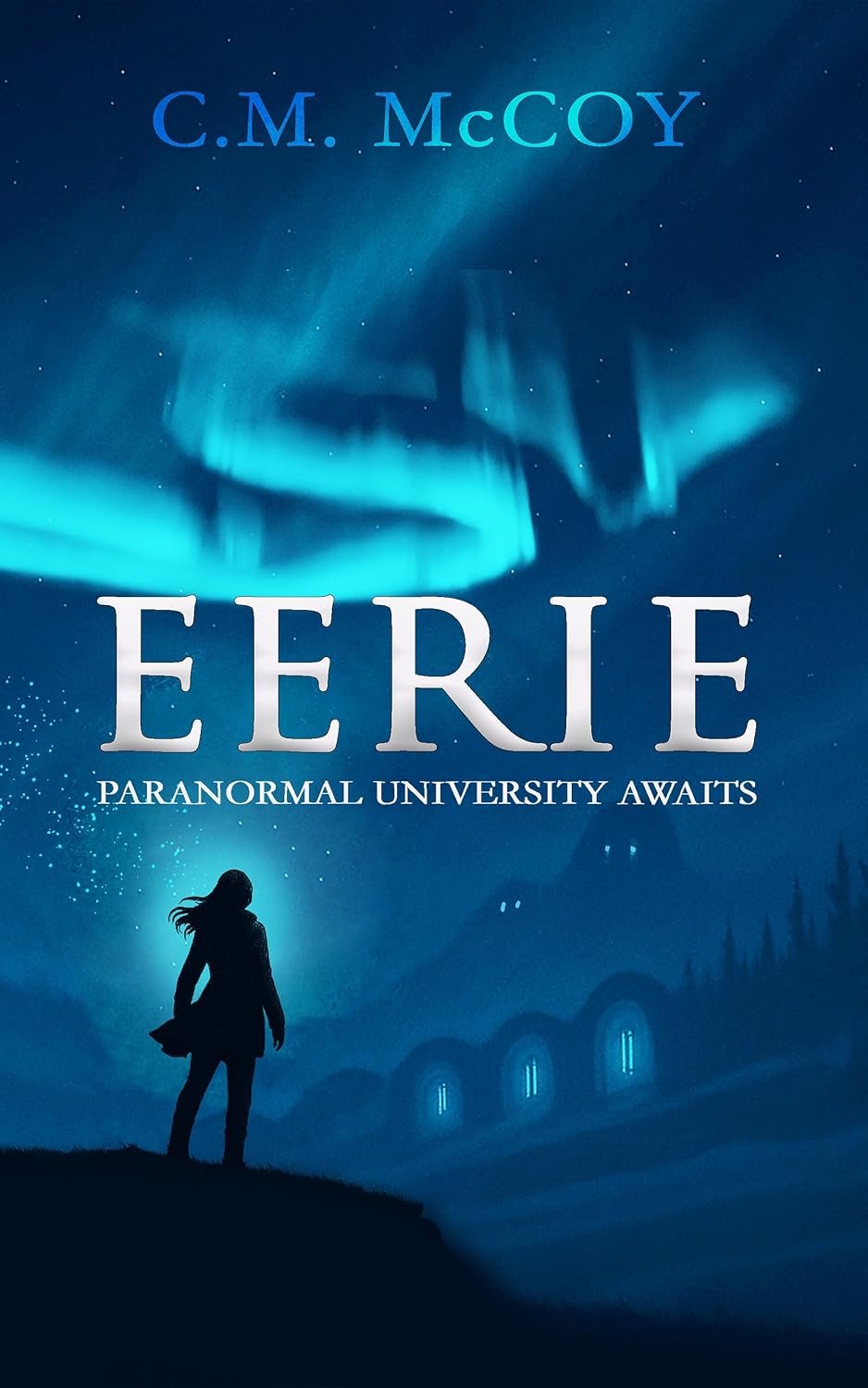
A young woman enters an Alaskan paranormal university while confronting dangerous family mysteries.
Books worth discovering. Authors worth knowing.
A young woman enters an Alaskan paranormal university while confronting dangerous family mysteries.
Research-based literary perspective on a verified edition.
A university that studies the supernatural promises more than strange lectures. It promises a way to explain experiences that ordinary life refuses to accommodate. In C.M. McCoy’s EERIE, the available description for a 2025 edition places eighteen-year-old Hailey Hartley on a path toward an Alaskan research campus known as ParaScience University. Her dreams blur into reality, the disappearance of her sister becomes a driving mystery and an ancient entity seems to be hunting her. The premise brings together dark academia, paranormal suspense and the emotional uncertainty of forbidden attraction. Its most interesting underlying question is whether gaining knowledge makes an unfamiliar world safer, or only makes its dangers harder to deny.
The university as a threshold
School stories are often about acquiring a language for an experience that previously seemed bewildering. A student arrives in an institution where rules, experts and fellow learners promise to turn uncertainty into knowledge. A university dedicated to the supernatural intensifies that familiar hope. If dreams, myths or impossible beings can be studied through research, then perhaps fear itself can be classified and understood. McCoy’s premise positions Hailey at the edge of such a world, with personal reasons to seek answers that extend beyond intellectual curiosity.
There is also a productive unease in the institutional setting. Universities grant authority through expertise, but they do not guarantee that every authority figure is benevolent. A campus surrounded by Alaskan wilderness can feel both protected and isolated. The public description identifies remote Alaska as important to the setting, yet it does not authorize claims about specific laboratories or campus rituals. The tension is already clear: a place designed to investigate danger may bring its students closer to that danger than any ordinary classroom would.
Dreams that refuse to stay private
Hailey’s dreams are described as merging with reality and growing more disturbing. Dreams usually belong to an intimate space where images can be frightening without becoming public events. Once a fantastic story makes that boundary porous, the protagonist can no longer rely on the distinction between inner perception and external threat. This is a classic engine for uncanny fiction, but it can also give concrete shape to the experience of not trusting one’s own understanding of the world. The resulting suspense does not require constant action. An ordinary moment may become charged because a character cannot be certain what kind of event is taking place.
A reader can ask whether the novel uses dream imagery as a language of emotional life, a source of clues or both. The verified description supports the existence of dangerous dreams and an ancient pursuer, not a detailed account of how the mechanism works. That limitation is worth preserving. An editorial introduction is strongest when it identifies what makes the premise distinctive without depriving the story of its discoveries. The appeal here lies in allowing the uncertainty to remain genuinely uncertain until the narrative earns a fuller explanation.
A missing sister changes the scale of the mystery
The revised edition’s public description identifies Hailey’s sister as missing without a trace. That matters because a family disappearance gives urgency to mysteries that could otherwise remain abstract puzzles about mythology. An investigator may want to understand an unusual phenomenon; a sister wants to know what happened to someone she loves. Those motives can coincide while remaining emotionally different. The nearer the personal stake, the harder it becomes to maintain scholarly distance. Hailey’s circumstances create a reason to enter danger that does not depend on enthusiasm for adventure.
Family ties also complicate identity. People inherit stories, assumptions and omissions from those around them, often discovering only later how incomplete the account was. The available synopsis says Hailey uncovers frightening truths about herself and her family. It would be inappropriate to name those truths without reliable evidence. As a general reading lens, however, the mixture of genealogy and supernatural pursuit invites a question about belonging: can discovering where a person comes from change what they owe to the people who raised or protected them?
Dark academia and the temptation of explanation
Dark-academia fiction often turns intellectual desire into a source of risk. The wish to know more can be noble, but the environment may reward secrecy, competition or a dangerous confidence in one’s own cleverness. In EERIE, the public material explicitly places science beside mythology. That intersection is intriguing because the two can be treated as competing worldviews or as different methods of naming things that are not yet understood. The premise need not be read as proving any supernatural claim; it is fiction exploring what happens when a research institution takes the impossible seriously.
Scientific language in fantasy can bring both atmosphere and ethical questions. Who may conduct an investigation, what consent is required, and what should happen when an experiment puts others at risk? These are not assertions about a particular plot scene. They are questions generated by the decision to place paranormal danger within an academic setting. Readers who enjoy imaginative world-building may appreciate watching the author establish where the campus’s explanations work and where they fail.
Attraction across a dangerous boundary
The book description also evokes an enigmatic being who may be protector or monster. That ambiguity is central to paranormal romance because attraction is shaped by uncertainty about power. A character who appears compelling can also be dangerous; a protective gesture may be generous or controlling. Stories that combine intimacy with supernatural threat become most engaging when they allow the protagonist to make meaningful choices rather than simply accept that an extraordinary bond excuses every risk. The promotional material describes a dilemma, not a settled answer.
The reader can therefore look for how Hailey’s agency is handled. Does the story give her room to question what she is told? Is danger treated as a romantic ornament, or does it remain an obstacle with consequences? The possibility that a protector could also be a threat makes the question unusually sharp. Such concerns are useful whether a reader approaches the novel primarily for suspense or for romance. They allow the two genres to illuminate each other instead of taking turns in separate scenes.
Edition history deserves attention
McCoy’s EERIE has appeared in more than one version. A contemporary Google Books entry describes a December 2025 edition at ParaScience University, while an earlier Publishers Weekly review discusses an older edition associated with Bear Towne University and a different framing of the sister’s fate. These are not details to merge into one imaginary continuous plot. The exact Amazon listing in the MarketAnyBook queue is retained, but readers comparing online descriptions should take edition differences seriously. A character name or location in an older review should not be casually applied to a revised text.
This is particularly important for a feature seeking to be accurate rather than merely persuasive. Edition differences can affect chronology, plot emphasis and even the promise made to prospective readers. The 2025 description is the primary foundation used here. The older review is relevant as a bibliographic warning, not a substitute for inspecting the linked edition. Readers who are interested in the series should ensure that the sample and edition they select match their expectations.
Who may want to read it
EERIE should be considered by readers of dark academia, young-adult or crossover paranormal fantasy and romances in which a powerful mystery threatens the relationship at its heart. The Alaskan wilderness and supernatural research campus offer a distinctive alternative to a conventional school or urban magic setting. A reader who enjoys puzzling out rules and motives may particularly appreciate the collision of science and myth, while those seeking a light campus romance should be aware of the described disappearance, nightmares and danger. The work is identified as a series opening, so readers may wish to inspect the edition and publication history before choosing a starting point. This sponsored feature is research-based and makes no claim about the resolution of its mysteries or the quality of every chapter.
C.M. McCoy is the credited author; the queue also credits Colleen Oefelein as illustrator. The verified premise places Hailey in a world where seeking knowledge and seeking safety may lead in different directions. That tension is a compelling reason to open the book, with the understanding that the actual edition, not borrowed details from an older one, must supply the answers.
About the book.
A young woman enters an Alaskan paranormal university while confronting dangerous family mysteries. The purchase link preserves the original listing in the queue.
The book is designated as a sponsored feature in the MarketAnyBook queue. This article is an original research-based introduction, not a firsthand review; editorial interpretation is identified as such. Sources comprise publicly available publisher, retailer or bibliographic descriptions and the verified queue and cover; detailed interior content has not been independently examined.
Found a book worth opening?
Books worth discovering. Authors worth knowing.
Return to the Journal →