
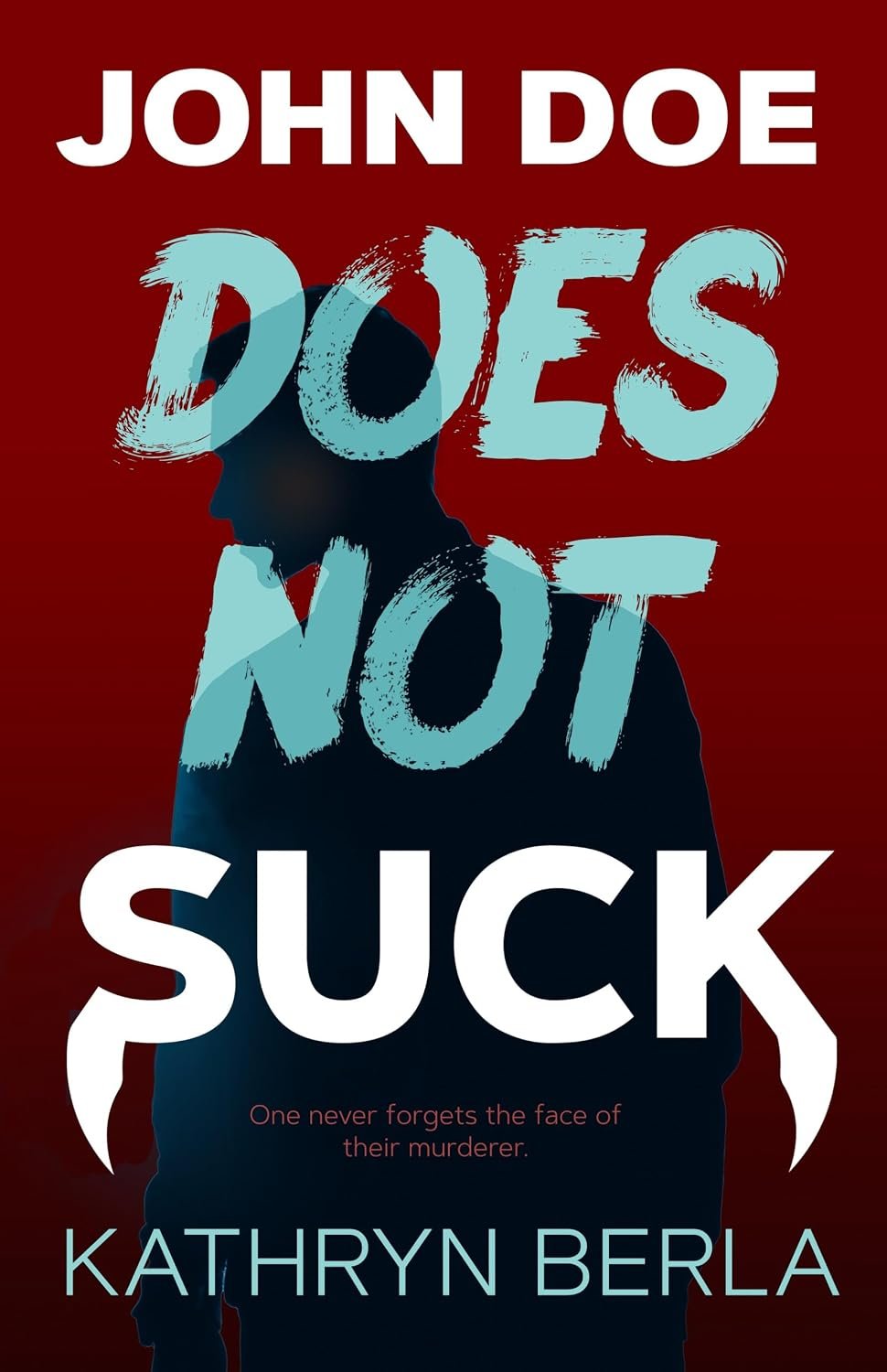
John Doe Does Not Suck
A teenage-looking 317-year-old vampire joins an amateur hunt for a serial killer.
Books worth discovering. Authors worth knowing.
A teenage-looking 317-year-old vampire joins an amateur hunt for a serial killer.
Research-based literary perspective on a verified edition.
John Doe has a problem familiar to many aspiring writers: nobody wants his book. His complication is less ordinary. In Kathryn Berla’s John Doe Does Not Suck, the protagonist is a 317-year-old vampire passing as seventeen, and his memoir about being the last vampire has been rejected by literary agents. He also struggles with OCD and anxiety. After enrolling in a criminology course, he is drawn by fellow student Angela Ruiz into investigating the Six o’Clock Slasher, a killer who has eluded police for two years. The official description promises a young-adult mystery with supernatural complications, but its most interesting conceit may be the gap between someone who has lived for centuries and someone who still feels profoundly uncertain about his place in the world.
The very old teenager
Vampire stories often use immortality to imagine sophistication, power or immunity from ordinary embarrassment. Berla’s premise makes the opposite choice. John is very old, but he looks seventeen and faces the humiliating experience of literary rejection. He is not a cultural icon who has mastered every century. He is a person with a project he wants others to value, and an industry that has apparently decided the subject is out of fashion. That contradiction is comic, but it also gives the character a recognizable emotional centre. Expertise and experience do not guarantee an easy sense of belonging.
The age discrepancy can do more than produce jokes. Adolescence is commonly associated with uncertainty about identity and social acceptance; the vampire’s long life suggests that such questions may not disappear on schedule. In a story about someone who appears to be a teenager, readers can examine whether maturity is measured in years or in the ability to relate honestly to other people. We should not invent the novel’s answer, but the premise sets up a productive contrast between the clock’s passage and inner development.
A memoir nobody wants to publish
John’s rejected manuscript is titled The Last Vampire, according to the publisher. The joke about agents losing interest in vampire books is pointed because vampires have had many cycles of popularity in fiction. A supposedly unique supernatural being is told that his experience is too familiar to sell. This is a neatly self-aware way to introduce a fantasy narrative. It asks whether a story is valuable because it meets a trend, or because it carries the singular perspective of the person who tells it.
Rejection can be comic from a distance and devastating from within. For a character already troubled by anxiety, another refusal may confirm the fear that nobody wants to hear what he has to say. The public description links his authorial frustration with daily OCD and anxiety struggles, while leaving the actual internal portrayal to the full novel. The most responsible reading is to take those conditions seriously without assuming the book is a clinical resource. They may shape his experience, but they need not define the limits of his character.
Immortality is a form of loneliness
John believes himself to be the last of his kind. That idea changes the emotional meaning of a familiar vampire fantasy. Immortality promises more time, but more time is not the same as more companionship. If a character feels that no one shares his condition, the centuries can become a burden rather than a privilege. The publisher’s synopsis says John finds it difficult to live with being the last vampire. A reader can therefore look beyond familiar questions about supernatural strength and consider what it would mean to lack an ordinary community of peers.
This loneliness also creates an ethical problem if John begins to suspect that the killer he pursues might be another vampire. The published description raises the possibility without resolving it. Would the existence of another being like him feel like salvation, threat or both? Even a dangerous resemblance can become emotionally charged when someone fears absolute isolation. The novel appears designed to put identity under pressure through mystery. Readers can discover how the character handles that pressure without the feature pretending to know what the investigation reveals.
An amateur detective team
Angela Ruiz is described as convincing John that the two students should pursue a serial killer despite having little formal preparation. Her interest in crime investigation partly draws on television, which gives the partnership an accessible comic dimension. The contrast between pop-cultural confidence and real danger is a useful source of suspense. People often absorb the conventions of crime-solving from stories in which clues arrive at convenient moments and evidence points toward a satisfying finale. An actual inquiry, even in fiction, can be more confusing and dangerous.
The duo’s friendship or partnership may also help define John beyond his condition. A protagonist who spends much of his life hiding can be challenged simply by having to collaborate. He must make decisions with someone whose assumptions and experience differ sharply from his own. Angela’s enthusiasm may bring courage or recklessness; John’s long life may bring knowledge or hesitation. The description supports these differences in premise, not a detailed assessment of their chemistry. The reader is invited to watch how their contrasting ways of interpreting the world shape the investigation.
Comedy alongside fear
The title John Doe Does Not Suck announces a playful tone through a pun associated with vampires. But the synopsis contains serious subjects: a serial killer, anxiety, the fear of being alone and an investigation that may expose vulnerable people to harm. Comedy can make that combination approachable when it arises from character rather than trivializing the danger. It can give readers a little space to consider what would otherwise be relentlessly bleak. The most interesting humorous fantasy recognizes that an extraordinary creature may still be embarrassed, insecure or unsure what to do next.
The self-aware joke about vampire publishing trends adds another layer. The book exists within a genre crowded with well-known conventions, and its protagonist is frustrated by that very crowding. This invites readers to enjoy their own familiarity with vampire fiction while paying attention to what this novel alters. Instead of assuming that fangs automatically imply romance or predation, the premise introduces an anxious writer turned reluctant detective. That reorientation is substantial enough to distinguish the work before any final judgement about its execution.
Crime fiction and the meaning of responsibility
When Angela and John decide to investigate the Six o’Clock Slasher, the pair crosses from curiosity into a situation with possible consequences for others. Amateur-detective stories can be exciting because they free protagonists from institutional rules, but that freedom also raises questions. What evidence do they have? When might their actions interfere with an official investigation? Does bravery justify risking someone else’s safety? These considerations need not make the story moralistic. They add suspense by reminding readers that an appealing hunch and a responsible decision are not always the same thing.
John’s suspected connection between the killer and vampirism gives the ethical stakes an additional dimension. A person who believes his identity is unique might find it harder to judge evidence without bias. Hope for belonging can distort fear; fear can distort the wish to discover the truth. The publisher deliberately leaves that possibility unresolved. Readers who value mysteries can appreciate the tension without having the answer supplied in an editorial introduction. The story’s central puzzle and the protagonist’s need for connection appear meaningfully intertwined.
Who may want to read it
John Doe Does Not Suck is likely to appeal to young-adult readers who enjoy quirky supernatural protagonists, self-aware vampire fiction and mysteries with an unlikely investigative pair. Its combination of literary rejection jokes, a centuries-old narrator and a serial-killer case may satisfy readers who like humour alongside suspense. Those drawn to representations of OCD and anxiety may also be interested, with the understanding that fictional representation should be evaluated carefully and is not clinical advice. The publisher identifies it as a January 2026 release and a 280-page book, giving readers clear bibliographic context. Anyone seeking a traditional vampire romance or a strictly procedural detective novel may want to examine a sample first. The verified description promises an unusual blend, not an exact proportion of its elements.
Berla’s publisher and independent ebook listings agree on the protagonist, Angela and the central investigation. This is a research-based editorial introduction rather than a firsthand review. The premise’s lasting appeal lies in the collision of two questions: what if you were alone for centuries, and what if the one person who could prove you are not alone were also the person you most needed to stop?
About the book.
A teenage-looking 317-year-old vampire joins an amateur hunt for a serial killer. The purchase link preserves the original listing in the queue.
This is an independent research-based editorial introduction, not a claim to firsthand reading or a personal review of the full book. Sources comprise publicly available publisher, retailer or bibliographic descriptions and the verified queue and cover; detailed interior content has not been independently examined.
Found a book worth opening?
Books worth discovering. Authors worth knowing.
Return to the Journal →