
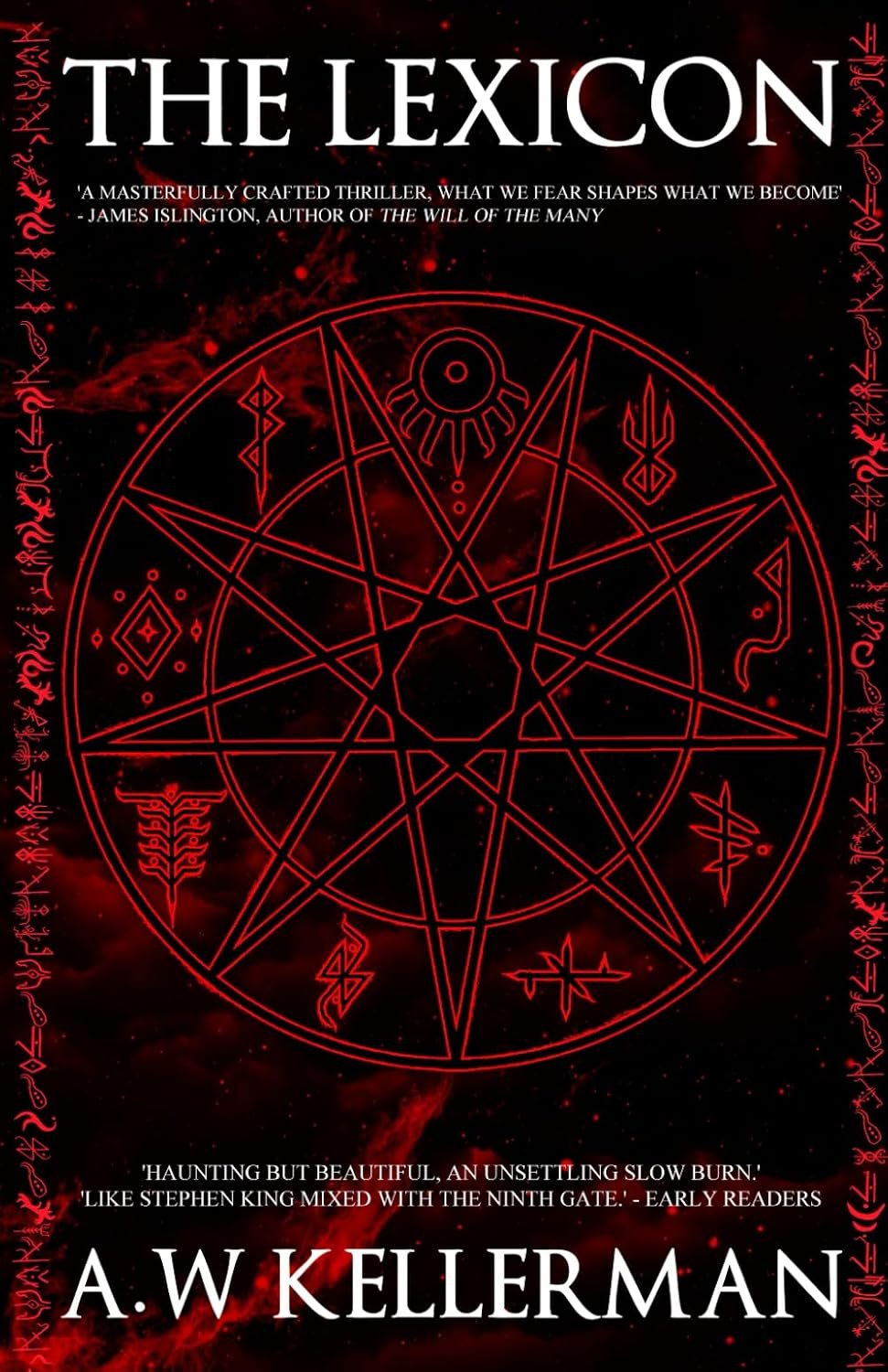
The Lexicon
A discontented historian pursues a lost artefact while an ominous sleeping god searches for someone vulnerable enough to answer its call.
Books worth discovering. Authors worth knowing.
A discontented historian pursues a lost artefact while an ominous sleeping god searches for someone vulnerable enough to answer its call.
Original editorial introduction, grounded in the verified book edition and public descriptions.
Obsession begins to feel different when it can answer back. In A.W. Kellerman's The Lexicon, a history professor who feels stranded in his own life becomes involved in an expedition to recover an artefact with a reputation for extraordinary power. The public synopsis names Leo Morley, his college in Varlisle, a glacial cave, and a mysterious force called the Red Moon. Those concrete ingredients point toward an intriguing combination: academic adventure, occult temptation, and a psychological portrait of someone who may be unusually receptive to a disastrous offer.
A professor at the threshold
Leo teaches history at Bearbrass College of Varlisle. The source description places him after the deaths of his parents, living with his cat and struggling to find much meaning in his ordinary work. This is a more revealing starting point than the conventional picture of an intrepid hero eagerly searching for a supernatural treasure. His discontent matters because the expedition does not merely disrupt a comfortable life; it appears at a moment when the prospect of direction has special force. Readers can approach the invitation as a test of longing before they approach it as a hunt for an object.
Historical expertise offers one kind of authority: it enables careful comparison of documents, eras, and testimony. An object said to possess great power asks for a different response, one in which caution becomes harder to sustain once personal need enters the picture. The synopsis does not specify what scholarship Leo brings to the search or how the expedition is organized, so this feature cannot invent archaeological procedures or rival academics. What is clear is that Kellerman places a scholarly professional at the boundary between explanation and an encounter that may defeat ordinary explanation. That threshold gives the premise its special unease.
What the lost book seems to want
According to the published synopsis, the Lexicon is hidden in a glacial cave, and Leo begins experiencing unusual dreams after being recruited to find it. The artefact is not simply a prize to be picked up and catalogued. It is described as promising him power while inviting him to act as a conduit for the sleeping god called the Red Moon. The god seeks someone capable of breaking nine seals. Those details establish a clear narrative pressure: the seeker may become part of the mechanism that releases what should remain dormant.
There is a compelling contradiction here. Leo wants purpose, but the purpose apparently offered to him may belong to an intelligence with aims of its own. The difference between choosing a calling and being recruited by a manipulative force is a fertile subject for dark fantasy and cosmic horror. The synopsis describes the power as looking for a vulnerable person; it does not establish precisely how the dreams work or whether Leo submits. Rather than supplying those missing plot turns, a careful introduction can ask whether the greatest danger lies in the relic itself or in the temptation to accept its interpretation of Leo's unhappiness.
Isolation as an opening for horror
The description of Leo as recently bereaved and unsatisfied allows an emotional reading without pretending to diagnose him. Grief can change the scale of everyday ambitions, and a life without a felt direction may make even a frightening invitation seem like an improvement. In stories about forbidden knowledge, discovery is often treated as the reward. The Lexicon's setup suggests that discovery could be the first step toward losing the freedom to decide what knowledge is for. That possibility turns the professor's original dissatisfaction into an active part of the dramatic structure.
The glacial setting reinforces this reading in a different register. Ice can preserve something across years while separating it from living human societies. The published materials do not state why the cave holds this artefact or what its wider mythology entails, so any more detailed account would be speculation. Still, the contrast between a modern college and a remote frozen hiding place helps explain the story's apparent movement from institutional order toward a space that resists familiar rules. A promising reading question is what happens when the past ceases to be an object of study and begins making demands upon the present.
The moral cost of a promised transformation
Dark speculative fiction frequently builds suspense around an unequal bargain. One party may understand the terms entirely; the other may know only that life could be different. Here the public account gives the Red Moon an appetite for release and describes Leo as broken enough to be shaped. The language directs attention to persuasion as much as spectacle. A reader interested in psychological stakes can watch for how the story treats consent, desperation, and the desire to matter. Are dreams an offer, a warning, or a form of coercion? The synopsis deliberately leaves the answer open.
Equally important is the distinction between the narrator's claims about this world and the beliefs of its characters. A god who speaks through sleep belongs to the fictional premise; the feature does not offer supernatural claims as real-world fact. Likewise, the number of seals provides a specific piece of mythology but not permission to invent the events required to break them. Keeping those boundaries visible can make the feature more inviting. It lets readers appreciate the structure of an ominous promise without presenting a speculative reconstruction as though it had been verified from the novel's pages.
Who is likely to be drawn to this book?
The Lexicon looks especially suited to readers who enjoy an ordinary, intellectually trained protagonist encountering forces that cannot be contained by ordinary expertise. Its lost artefact, hidden cave, dream encounters, and sleeping divinity will interest audiences drawn to occult fantasy, academic mysteries, and psychological horror. Readers who prefer the supernatural to remain ambiguous may find the dream element particularly enticing, while readers seeking brisk action should note that public descriptions emphasize motivation and temptation alongside the expedition. No detailed pacing claim can be made without examining the complete book. The better promise is a premise where the wish for a new life appears inseparable from the risk of being transformed by something else.
An invitation to question the bargain
One striking feature of the setup is that Leo's need for purpose is understandable even when the power offered to him is ominous. A good mystery does more than conceal its answer; it makes the question urgent for a particular person. The history professor, the glacial artefact, and the Red Moon are documented elements. The emotional and moral questions raised by their combination are editorial interpretation. Taken together, they make The Lexicon worth investigating not as a catalogue of monster lore but as a story about how a person may be persuaded to lend his future to an ancient demand. Whether Leo recognizes that danger, and what he chooses after recognition, are for the book itself to disclose.
About the book.
A discontented historian pursues a lost artefact while an ominous sleeping god searches for someone vulnerable enough to answer its call. Public bibliographic details have been distinguished from editorial interpretation.
Sponsored book feature: the MarketAnyBook queue lists this book as sponsored. This original research-based editorial article is not a firsthand reading or an independent endorsement. Bibliographic descriptions and author or publisher statements are interpreted with clear source limits. The original purchase URL remains unchanged; WordPress cover media is added later by the owner’s publisher.
Found a book worth opening?
Books worth discovering. Authors worth knowing.
Return to the Journal →