
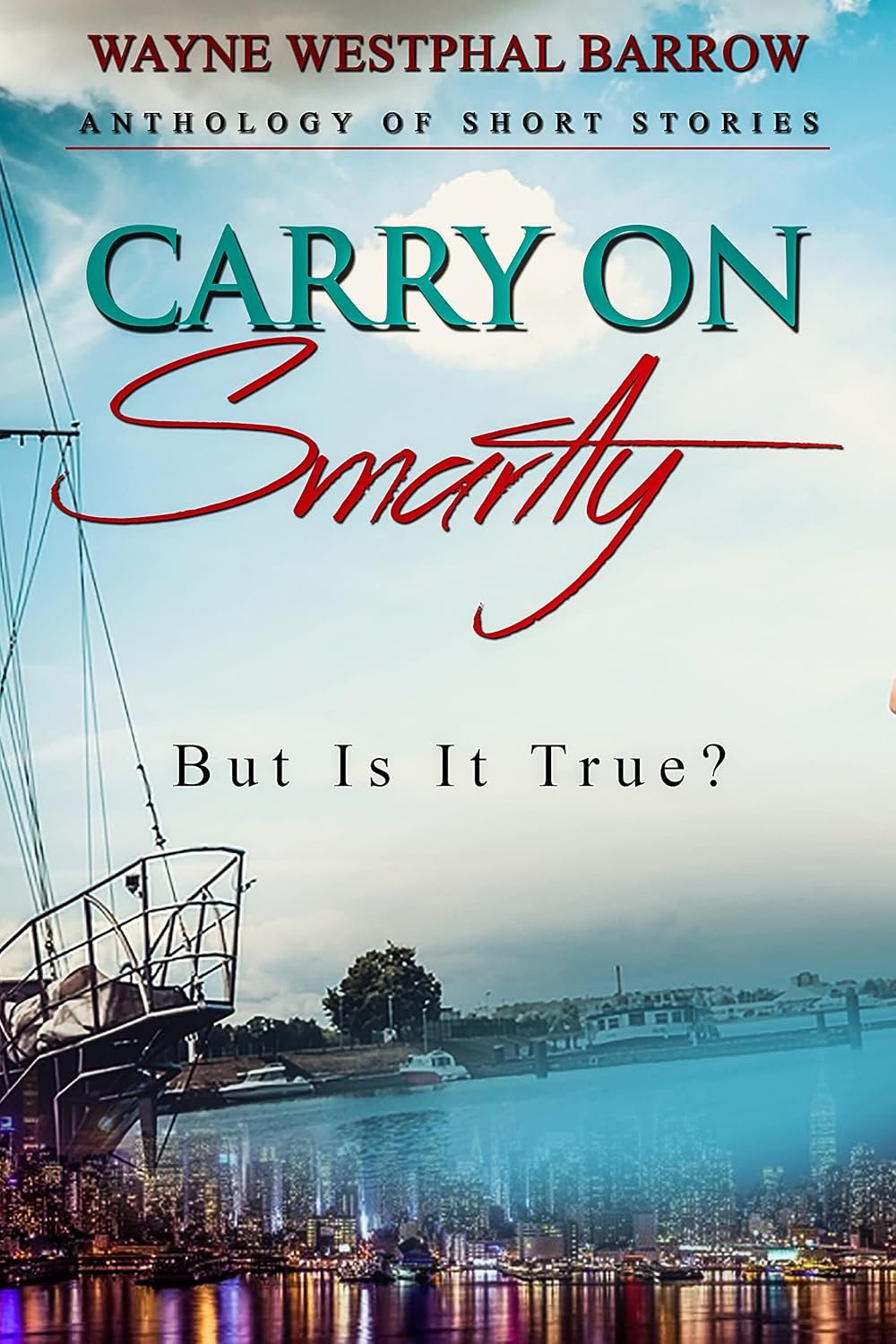
Carry on Smartly: But Is It True?
Wayne Westphal Barrow blends Caribbean-set fiction and real-life observation in twenty stories about truth, faith and human contradiction.
Books worth discovering. Authors worth knowing.
Wayne Westphal Barrow blends Caribbean-set fiction and real-life observation in twenty stories about truth, faith and human contradiction.
Original editorial introduction, grounded in the verified book edition and public descriptions.
The most improbable story at a family gathering often begins with a familiar assurance: this really happened. Wayne Westphal Barrow's Carry on Smartly: But Is It True? makes that uncertainty central to a collection of twenty stories set against Caribbean life and human relationships. Its published description explicitly describes fiction touched by lived experience, ranging from the mundane to the strange. The title therefore does not announce a fact-checking exercise. It makes the uneasy, entertaining territory between witnessed behavior and embellished storytelling part of the appeal.
A Caribbean setting with room for contradiction
Barrow's stories are described as moving through fictional settings in several Caribbean countries. That geographic context is more than a collection of attractive backgrounds. The author identifies his roots and experiences in Barbados, Guyana, and Trinidad and Tobago in his public biography, and his writing has long engaged with community, society, and the unexpected turns of everyday life. The individual stories are not verified as autobiographical accounts, however. Treating every episode as a disguised true story would flatten a collection that deliberately plays with fiction and reality.
The description promises emotions that readers can recognize: hope, despair, faith, passion, and common human failings. Those themes do not require grand institutions or historical upheaval to matter. A conversation, a minor ethical choice, a boast, or a misunderstanding can expose how people defend their own version of events. The public synopsis does not identify the names and actions of characters in each of the twenty pieces, so it would be careless to manufacture sample storylines. The critical interest lies in the range of experience the author says the collection addresses and in the storyteller's relationship to the truth behind a good tale.
When experience becomes fiction
A work described as fiction tainted with real life asks its reader to do two things at once. On one level, the reader can enjoy a situation for its narrative impact without requiring documentary proof. On another, the claim of familiarity invites recognition of social behavior that may be too awkward, generous, or extraordinary to seem made up. Barrow's premise plays with that dual response. The question in the title gives permission to doubt, but not necessarily to dismiss; stories often reveal something about human conduct even when their events cannot be corroborated.
This is why a collection of short pieces can approach truth differently from a conventional memoir. A memoir makes an implicit agreement about personal recollection and accountability. Fiction can rearrange time, invent dialogue, merge people, and heighten coincidence for artistic purposes. The book is presented as fiction, and a careful feature should keep that classification visible. The title's challenge becomes a reading pleasure rather than a demand for evidence that the book does not claim to provide. The reader can wonder what feels authentic in the emotional choices without deciding which individual incidents literally occurred.
Justice, spirituality and the daily use of power
The published account names justice, spirituality, power, and ethics among the collection's interests. Those are broad words, but their placement beside everyday human frailties suggests a particular kind of attention: moral questions occur in neighborhoods and relationships as well as in courts or churches. A small community can make reputation consequential. Friendship can complicate fairness. The desire to do right can collide with family loyalty or personal survival. These are editorial possibilities raised by the documented themes, not invented descriptions of individual scenes in Barrow's stories.
The phrase But Is It True? also encourages skepticism toward narrators who sound too certain. A person may be sincere and mistaken, persuasive and self-serving, or technically accurate while omitting the part that changes everything. That is a useful lens for short fiction rooted in a culture of oral retelling. The author's own playful public persona suggests an appreciation for exaggeration and irony, yet it would be unsupported to claim that every piece is comic. The reported tonal range includes despair as well as hope. Readers should expect the possibility of discomfort alongside amusement.
The importance of the story collection form
Twenty separate stories can create a different rhythm from a long novel. Each offers an opportunity to establish its own tension, introduce people whose lives may not overlap with the next piece, and arrive at a distinct emotional or moral turning point. Without a verified table of contents or full reading, there is no basis to assign a particular plot to a particular story. Still, the form helps explain the appeal of a book built around variety. A reader may find that one story feels like an anecdote and another like an ethical parable, with the shared voice making the changes of direction coherent.
The collection also invites attention to the difference between the event and its retelling. What gets emphasized when someone recounts a humiliating mistake? Which detail is omitted when a character is trying to appear honorable? Whose testimony receives the benefit of the doubt? These questions are not asserted answers about Barrow's pages. They are productive ways to approach a book whose title foregrounds the instability of certainty. Fiction's freedom to reshape experience can become the very mechanism by which it asks readers to examine their own confident assumptions.
Who is likely to enjoy this collection?
Carry on Smartly: But Is It True? may appeal to readers of short fiction who value distinct human encounters over a single long plot. Its Caribbean context offers a welcome point of view, while the described blend of humor, faith, hope, despair, justice, and social observation suggests a collection with several emotional registers. Readers curious about the boundary between reality and invention will find the title's premise especially inviting. Those seeking a strictly factual anthology should remember that it is marketed as fiction. Those expecting an uninterrupted comic sequence should likewise allow for more serious concerns. The pleasures suggested by its description come from variety, recognizable human contradictions, and stories that may remain debatable after the last page.
A question that belongs to the reader
Barrow's published biography describes a life shaped by several Caribbean societies and by work outside literary publishing. Those verified details help explain the scope of the voice, but they do not authorize a one-to-one identification of fictional characters with real people. The most useful response to the title may be to reconsider what readers mean when they call a story true. Does factual accuracy create its emotional weight, or can a clearly invented exchange clarify something the reader has witnessed elsewhere? This book's available description makes that an especially fitting question. A research-based introduction cannot settle it on the book's behalf; it can give the reader a reason to open the collection and test the stories against experience.
About the book.
Wayne Westphal Barrow blends Caribbean-set fiction and real-life observation in twenty stories about truth, faith and human contradiction. Public bibliographic details have been distinguished from editorial interpretation.
Independent editorial feature: this is a source-based introduction, not a firsthand review of the complete book. Bibliographic descriptions and author or publisher statements are interpreted with clear source limits. The original purchase URL remains unchanged; WordPress cover media is added later by the owner’s publisher.
Found a book worth opening?
Books worth discovering. Authors worth knowing.
Return to the Journal →