
King Herod's Treasure
Queer romance and the seductive uncertainty of an ancient treasure.
Books worth discovering. Authors worth knowing.
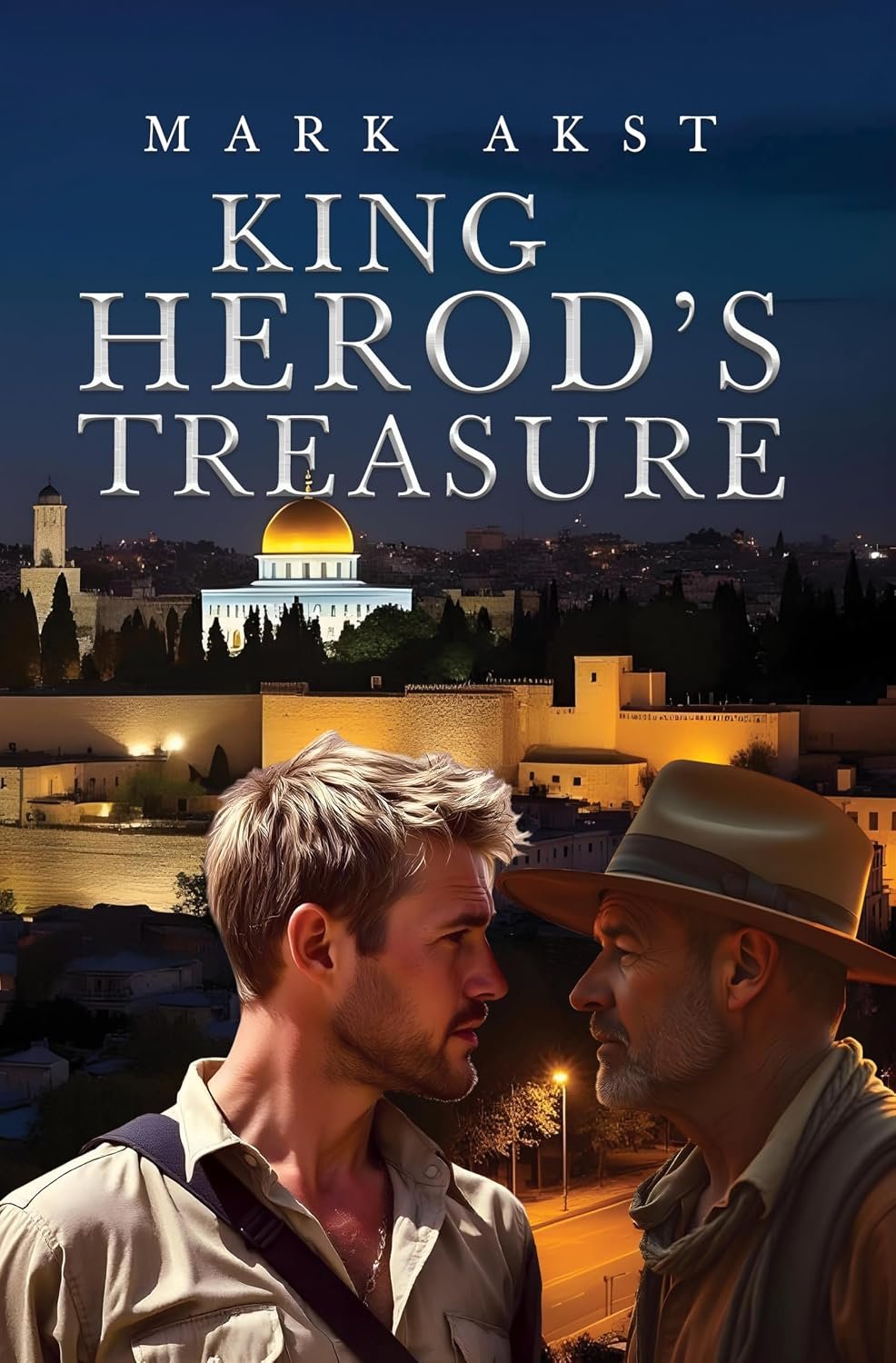
Mark Akst’s King Herod’s Treasure combines a gay romance with an adventure through the ancient ruins and modern landscapes of Israel.
An original critical assessment, grounded in verified public book descriptions.
Mark Akst’s King Herod’s Treasure combines a gay romance with an adventure through the ancient ruins and modern landscapes of Israel.
Two love stories inside a treasure hunt
Mark Akst’s King Herod’s Treasure combines a gay romance with an adventure through the ancient ruins and modern landscapes of Israel. The available synopsis describes two quite different men whose relationship develops alongside the accidental discovery of royal jewels connected, in the fiction, to Herod the Great. This is a striking blend of registers. The romance depends on present-tense intimacy; the hunt depends on an appetite for what has been buried. A successful combination would let the past complicate the men’s understanding of each other rather than merely supply costly objects to pursue. The publisher-facing description gives the broad situation but little reliable detail about the protagonists’ names, the research supporting the archaeological premise or the sequence of events. That limitation should shape the review rather than be covered by invented scenes.
Herod as historical imagination
Herod the Great is a figure capable of making an ancient setting feel immediately charged: rule, wealth, architecture and political violence cluster around his historical reputation. Adventure fiction can use such associations to raise the stakes of an imagined discovery. But the description’s claim about jewels sought by Romans is part of the novel’s fictional proposition, not a historical fact independently established here. The responsible reader can enjoy the romance of lost treasure while remaining alert to the line between evidence and invention. Archaeology is not a ready-made supply of secret doors; it is a discipline of context, uncertain dating and careful inference. The story’s handling of that distinction would be an important criterion in any full-length literary evaluation.
Desire, difference and the tourist gaze
A central romance between men with different backgrounds can invite questions of trust and power, especially when the setting is a place with layered religious, national and archaeological significance. The book’s marketing refers to a gay/daddy relationship. Readers will reasonably want to know whether the partnership develops through mutual recognition or relies almost entirely on an established romantic dynamic. There is nothing inherently superficial about familiar genre patterns; their value depends on the individuality of the people inhabiting them. The other question is how the landscapes of Israel function: as historically and socially complex places, or only as scenic backdrops to a couple’s adventure. Neither question can be answered fairly from a short synopsis, but both are essential to the work’s stated ambitions.
The pleasures of an improbable discovery
Treasure stories have always been sustained by a productive improbability. Readers enter partly because they want a hidden object to be found and partly because they enjoy the complications the object introduces. In this case the promised royal jewels can act as a test: how do people behave when exceptional luck makes ordinary commitments fragile? Romance and adventure can reinforce one another when the emotional and material rewards remain in tension. A chase that merely interrupts intimacy may feel episodic; a relationship that never affects the quest may feel appended. Those are craft questions for an eventual firsthand review. For a listing-based editorial assessment, the distinctive attraction is the ambition to make an archaeological conceit and a gay love story carry each other.
A cautious invitation
King Herod’s Treasure may appeal to readers who enjoy romantic adventures with historical settings, queer protagonists and archaeological intrigue. Readers expecting rigorously sourced historical reconstruction should distinguish fiction from research, and those looking for high-literary psychological realism may find the described genre combination less to their taste. Its promise is an accessible convergence of romance and discovery; its major unanswered question is whether the author gives both halves equivalent depth. There is enough verified information to outline the appeal, but not to judge dialogue, suspense mechanics or historical accuracy confidently. The book is worth exploring with those expectations in mind.
The map and the relationship
Treasure adventures often rely on a pair of protagonists who possess contrasting abilities. Difference can create both productive disagreement and romantic attraction, particularly when the partners are drawn toward the same mystery for different reasons. Akst’s description advertises contrasting personalities rather than supplying a detailed cast list, so it is best not to pretend to know which character is skeptical, impulsive or cautious. The critical possibility remains clear. A historical mystery offers choices about trust: whom to believe, what evidence to value, when to proceed and when to turn back. If those choices alter how the men understand each other, the quest becomes an expressive part of the romance rather than a detachable series of clues. Readers attracted to both genres will likely judge the book on that integration, not simply on whether the jewels are finally found.
A setting with lives of its own
Modern Israel contains communities and conflicts that cannot be adequately represented by the romance of ancient stones alone. Historical adventure has the liberty to focus on particular places, but it should not confuse a tourist itinerary with cultural understanding. Herod’s history and the remnants of his building projects are inherently dramatic; they also exist within a present whose complexity deserves attention. A source-based reviewer cannot assert that the novel treats contemporary politics sensitively or insensitively without direct evidence. What can be done is identify the responsibility created by the chosen setting. The book’s promise of ancient and modern marvels will be most persuasive if those categories illuminate each other, allowing readers to see why the past is still contested and valued rather than treating archaeological discovery as a neutral prize anyone might claim.
What remains when the glitter fades
The royal jewels are a spectacular object around which to organize desire, yet their dramatic value depends on what the characters learn while pursuing them. An adventure in which everyone behaves the same before and after discovery leaves its prize emotionally weightless. An adventure that alters loyalty or reveals a hidden value makes the prize matter even to readers who do not care about gold. Akst’s advertised combination of history, archaeology and intimacy gives the book several ways to develop that idea. The definitive assessment must wait for the full work, but prospective readers can reasonably look for a treasure story whose real discoveries concern people as much as objects.
About the book.
This review examines the documented premise and its critical implications; literary execution cannot be completely assessed without a full text.
Non-sponsored editorial review according to the MarketAnyBook queue. Based on publicly accessible descriptions and bibliographic evidence; it is not a claim of full-book firsthand reading. Assessments of unverified interior craft are withheld.
Found a book worth opening?
Books worth discovering. Authors worth knowing.
Return to the Journal →