
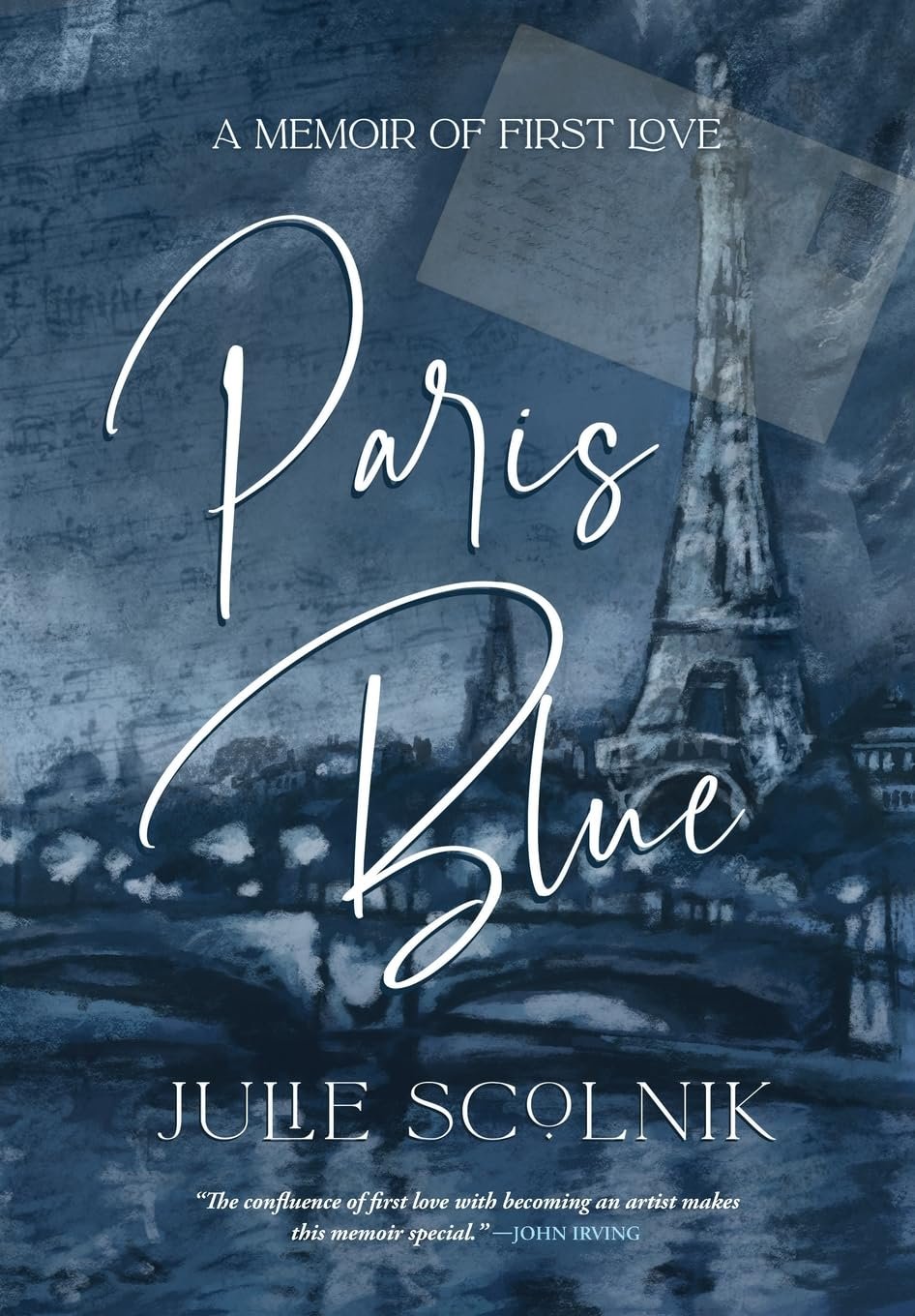
Paris Blue: A Memoir of First Love
Paris, classical music, first love, and the long afterlife of memory.
Books worth discovering. Authors worth knowing.
Julie Scolnik’s Paris Blue begins in a clearly situated moment: Paris, 1976.
An original critical assessment, grounded in verified public book descriptions.
Julie Scolnik’s Paris Blue begins in a clearly situated moment: Paris, 1976.
A memoir that listens to its own echo
Julie Scolnik’s Paris Blue begins in a clearly situated moment: Paris, 1976. A twenty-year-old American student arrives to study the flute and joins the chorus of the Orchestre de Paris, where she meets Luc, a married French lawyer. Their involvement becomes the center of a story that extends far beyond the initial romance. The author’s account describes an abrupt end after eighteen months and a subsequent search for understanding over many years. This is not simply a memoir about the enchantment of first love; its subject is the survival of a relationship inside memory after the relationship itself changes or disappears. That long duration gives the work its most intriguing premise. The question is less what happened in Paris than why certain experiences remain unfinished long after their outward events have ended.
Music as more than picturesque atmosphere
The Parisian streets and cafés can seduce a reader before any emotional complexity arrives, but the musical context offers something firmer. Scolnik’s identity as a developing flutist places discipline, practice and listening beside the volatility of romantic attraction. To make music with others is to negotiate attention, timing and responsiveness; a romance can demand similar qualities without guaranteeing reciprocity. The meeting occurs within a chorus, a group organized around simultaneous voices. That makes the setting thematically suggestive without requiring us to claim the memoir is formally arranged like a score. In a book about what another person has meant over decades, music may provide an especially apt vocabulary for persistence, repetition and silence. Such readings are interpretation, not evidence of particular narrative techniques in unread pages.
The risk of retrospective enchantment
Memoir gives its writer two selves: the person who lived through events and the person now able to interpret them. Scolnik’s story has an unusually wide gap between those positions. The young student encounters Paris and Luc with limited knowledge; the older narrator can consider the relationship’s consequences and ambiguities. Mature reflection can make early passion intelligible, but it can also tidy it into a predetermined lesson. The premise is strongest if it lets the younger woman’s confusion remain felt rather than correcting every impulse from the vantage of age. Independent critical commentary has remarked on the book’s willingness to show both attraction and disillusion, a useful indication that the narrative is not sold solely as a travel postcard.
Ethics inside the fairy tale
The official description calls the memoir a fairy tale with a dark underside. That qualification is crucial because Luc is married when the two meet. A story of forbidden romance risks turning everyone outside the couple into an obstacle, but a memoir has the additional obligation of honoring complicated actual lives. A serious reader need not insist on a moral verdict; it is enough to ask how the telling accommodates secrecy, uneven power, desire and the long aftermath of decisions. Scolnik’s continuing search for answers suggests that emotional closure may not be something the people involved can grant each other on demand. The tension between romance as remembered beauty and romance as an ethically entangled history is what makes this book more than an account of youthful infatuation.
Who may want to hear this story
Paris Blue belongs on the reading list of people drawn to reflective memoir, classical music, literary Paris and accounts of first love that resist the neatness of a conventional romantic ending. It may be especially resonant for readers interested in how grief can attach to relationships that did not end through death yet still feel permanently lost. Readers wanting a brisk, plot-first travel romance should know that the story spans years of reflection and searching. The author’s verified premise has narrative richness, and outside reviews supply some independent indication of craft, but this local assessment still does not substitute for a direct full-text reading. As an invitation to examine what memory preserves and what it invents, the memoir has an unusually compelling shape.
What the passage of time does to truth
A love story told close to its events may follow what the characters hope will happen. A memoir written decades later must also consider the meanings imposed afterward. The contrast is particularly delicate when recollection is shaped by long unanswered questions. The narrator may discover new evidence, reconsider a letter or understand an old argument differently; even without any new fact, age can alter how an event is felt. Scolnik’s published outline makes that prolonged search for understanding central. It invites readers to examine the narrator’s double responsibility to the intensity of youth and the judgment of later life. The most convincing retrospective memoirs neither mock the younger self nor grant that self infallibility. They show how an experience can remain genuinely transforming even when its participants eventually disagree about what it meant.
Paris as a temptation for both writer and reader
There is a reason first-love narratives so often choose a beautiful city: the landscape supplies a ready-made emotional vocabulary. Paris can turn a chance meeting into an apparent inevitability and make unhappiness seem aesthetically elevated. That allure is part of the story, but also a difficulty the memoir must negotiate. A landscape should not do all the emotional work. The actual relationship—its silences, imbalances and conflicting obligations—must remain visible beneath the music and architecture. In available descriptions, the memoir is distinguished by the darker aftermath that interrupts its enchanted beginning. That tension makes it possible to read the city not simply as an idealized setting but as the place where the narrator first learned how differently love and knowledge can move. The work’s duration and its insistence on revisiting rather than merely remembering give the premise its considerable psychological reach.
First love and the question of proportion
The feeling that an early romance defined an entire life can be both sincere and misleading. What grants one relationship such enormous power? Youth, displacement, artistic ambition and secrecy may each intensify memory. Scolnik’s memoir appears interested in that accumulation rather than treating love-at-first-sight as sufficient explanation. The passage of decades raises a further question about proportion: can a formative experience remain central without occupying every later possibility? Readers may bring sharply different answers depending on their histories. That openness is a source of literary richness. The memoir’s premise does not require universal agreement about the lovers to make the narrator’s long search for meaning worth following.
About the book.
This review examines the documented premise and its critical implications; literary execution cannot be completely assessed without a full text.
Non-sponsored editorial review according to the MarketAnyBook queue. Based on publicly accessible descriptions and bibliographic evidence; it is not a claim of full-book firsthand reading. Assessments of unverified interior craft are withheld.
Found a book worth opening?
Books worth discovering. Authors worth knowing.
Return to the Journal →