
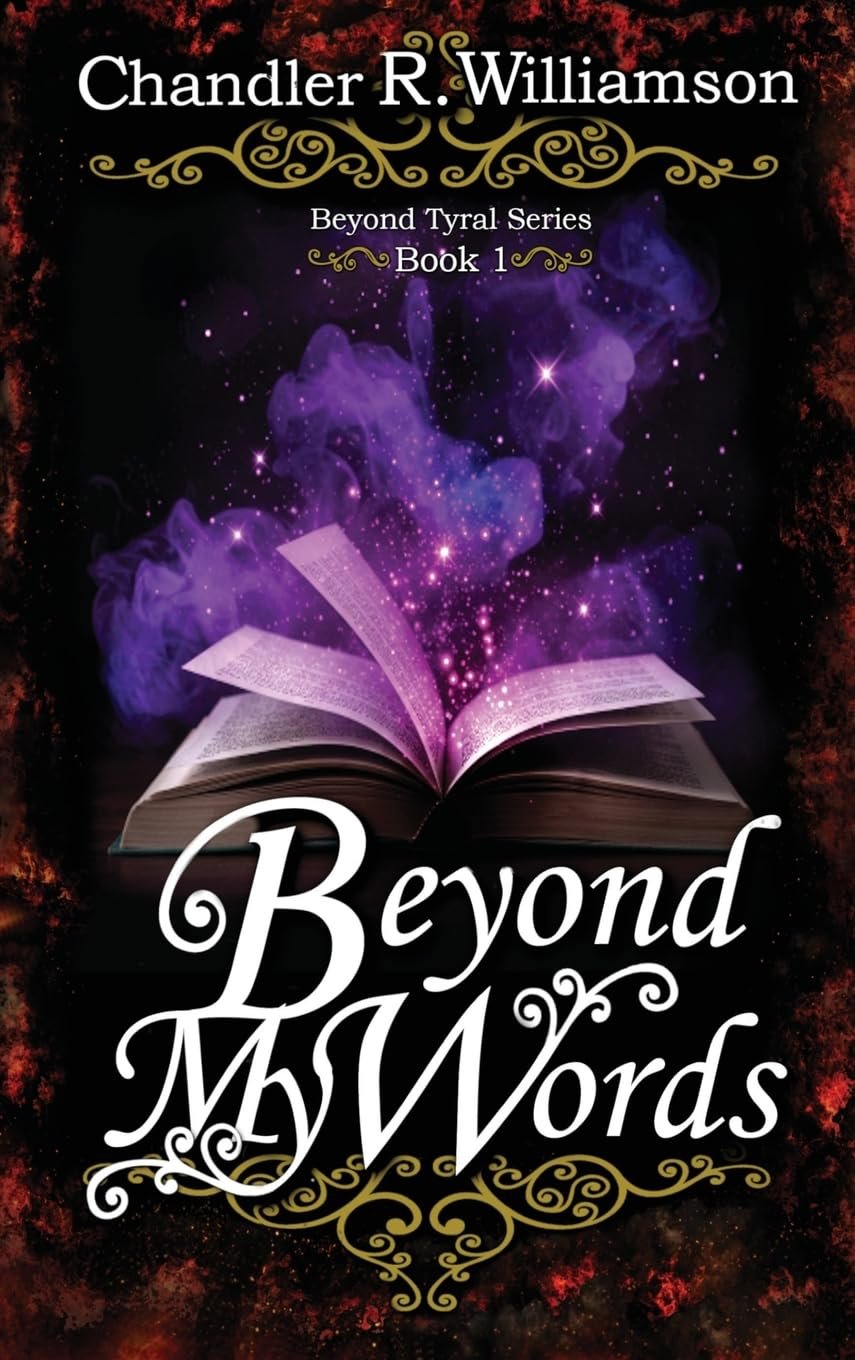
Beyond My Words: Book 1 of the Beyond Tyral Series
What happens when a story becomes answerable for the life of its author? Chandler R. Williamson’s Beyond My Words gives that fantasy a romantic and unexpectedly uneasy form. Ellie Derée, eighteen…
Books worth discovering. Authors worth knowing.
What happens when a story becomes answerable for the life of its author? Chandler R. Williamson’s Beyond My Words gives that fantasy a romantic and unexpectedly uneasy form. Ellie Derée, eighteen and living in Taylor’s Grove, writes tales drawn partly from the magical stories her absent father once told. Then she meets Erick McKinley, a prince…
Considered reviews, grounded in the book’s documented promise.
What happens when a story becomes answerable for the life of its author? Chandler R. Williamson’s Beyond My Words gives that fantasy a romantic and unexpectedly uneasy form. Ellie Derée, eighteen and living in Taylor’s Grove, writes tales drawn partly from the magical stories her absent father once told. Then she meets Erick McKinley, a prince apparently stepped out of those pages and condemned to become a dragon under moonlight. The curse can be undone by true love, but Ellie’s own experience of heartbreak and abuse makes trust harder than a fairytale formula suggests. The premise links the imaginative power of storytelling with the difficult work of choosing intimacy.
The young writer as creator and witness
Ellie is not merely a heroine entering another world: her writing appears to have helped generate or preserve that world. That conceit raises the question of an author’s responsibility to invented lives. Fantasy can sometimes treat creation as wish fulfilment, allowing a young person finally to control circumstances that ordinary life has rendered frightening. Williamson introduces a complication by making the prince’s condition potentially irreversible. If Ellie must face consequences that she never expected when writing, the book’s magical system becomes a metaphor for growing awareness that imagination does not exempt anyone from responsibility. The retailer synopsis explicitly ties her stories and choices to Erick’s fate; its details do not license an invented account of her later decisions.
The dragon curse and the clock
Erick’s nightly transformation is an evocative obstacle because it binds identity to a cycle, while the approaching ball imposes a deadline. The narrative mechanism could be familiar, yet it offers a useful tension: one person needs an urgent declaration of love, and the other needs time to recover the capacity to trust. A romance that values Ellie’s agency cannot treat her fear as a defect to be corrected on the prince’s schedule. The strongest possible reading would make the curse a problem shared by two people with separate needs, rather than an argument that her consent must be hurried. This is an ethical measure derived from the synopsis, not a verdict on the ending.
Trauma without a magical shortcut
Public descriptions identify abuse and prior heartbreak as reasons Ellie guards her emotional life. Such history deserves more careful handling than the trope of the damaged heroine instantly healed by an exceptional man. Magical rescue and emotional recovery operate on different clocks. The book’s appeal will depend on whether Ellie is allowed doubts, setbacks and judgment independent of her romantic destiny. There is potential literary depth in the contrast between what she can write—stories with coherent arcs and satisfying endings—and what she can bear in experience, where certainty is rare. The published summary foregrounds that tension, but a full evaluation would require attention to the actual language around her trauma.
The inheritance of family stories
Ellie’s missing father is associated with the original dragon-and-kingdom tales. That detail connects fantasy to memory and makes authorship intergenerational: she may be both inventing and rewriting an inheritance. Children frequently receive stories before they understand the circumstances that produced them. As adolescents become writers in their own right, those inherited patterns can become materials for revision. This could be the book’s most emotionally interesting undercurrent, if the novel grants the father’s absence weight beyond convenient backstory. The description establishes his disappearance and the origin of the tales but not the precise circumstances behind either.
The place of hope in romantic fantasy
The advertised message is that love can defeat a dark curse; the meaningful question is what sort of love. If it means uncritical surrender, the story’s attention to Ellie’s vulnerability risks collapsing. If it means solidarity between people who retain freedom to refuse, the familiar ending acquires moral force. Young-adult fantasy romance thrives on clear stakes, and Beyond My Words offers an especially legible emotional test: courage must not be mistaken for recklessness. Readers can approach the novel for its fairytale architecture while remaining alert to whether its relationships earn their transformative claims.
The double edge of being an author inside the story
When Ellie discovers that writing can reach beyond the page, her craft changes from refuge into exposure. The very stories that offered distance from pain may now place someone else in danger. That is a rare opportunity to dramatize the ethical side of imagination: a writer may love a character, yet still have used that character to arrange a world according to private desire. A compelling fantasy can let Ellie confront the mismatch between imagined control and another person’s autonomy. Such a plot could also examine how young artists use inherited tales to process absence. Her father’s stories were not just entertainment; in the established premise, they are part of how she learned to invent.
What a happy ending would have to earn
The approaching ball and Erick’s curse point toward a fairy-tale deadline, but Ellie’s emotional history complicates any simple romantic bargain. If the only available solution is that she instantly trusts him, the fantasy risks demanding that a survivor suspend judgment for the hero’s sake. A more satisfying outcome would give her knowledge, choice and the right to understand the danger before acting. This is the standard of romantic agency, not a prediction about the finished plot. Young readers often encounter stories that confuse intensity with certainty. Beyond My Words has the possibility of drawing a sharper line between the thrill of destiny and the slower evidence of care.
Who will value this book
This book will interest readers who enjoy metafictional portals, cursed princes, dragons and healing-centered fantasy romance. Its premise has solid support from the author’s own book page, but the prose style, the exact mechanics of the magic and the ultimate romantic resolution have not been independently evaluated here.
Scope of this assessment
This is a research-based editorial review drawn from identified bibliographic, author and publisher sources. It considers the work’s documented premise and the critical questions it invites, without claiming a complete firsthand reading. No unverified scene, character action or ending is asserted.
About the book.
An evidence-bounded critical introduction to young-adult fantasy romance. Published descriptions support the stated premise; interpretations are identified as editorial analysis, not confirmed plot details.
This is an unsponsored, research-based editorial review, not a claim to firsthand reading of the complete book.
Found a book worth opening?
Books worth discovering. Authors worth knowing.
Return to the Journal →