
The Happiness Pathway
Happiness books often promise a destination: become successful, discover the right habit, and the feeling will follow. Charu Moorjani’s The Happiness Pathway begins by disputing that order. Its…
Books worth discovering. Authors worth knowing.
Happiness books often promise a destination: become successful, discover the right habit, and the feeling will follow. Charu Moorjani’s The Happiness Pathway begins by disputing that order. Its stated argument is that happiness is built through repeated choices, deeper self-knowledge and a willingness to confront emotional wounds, rather than found…
Considered reviews, grounded in the book’s documented promise.
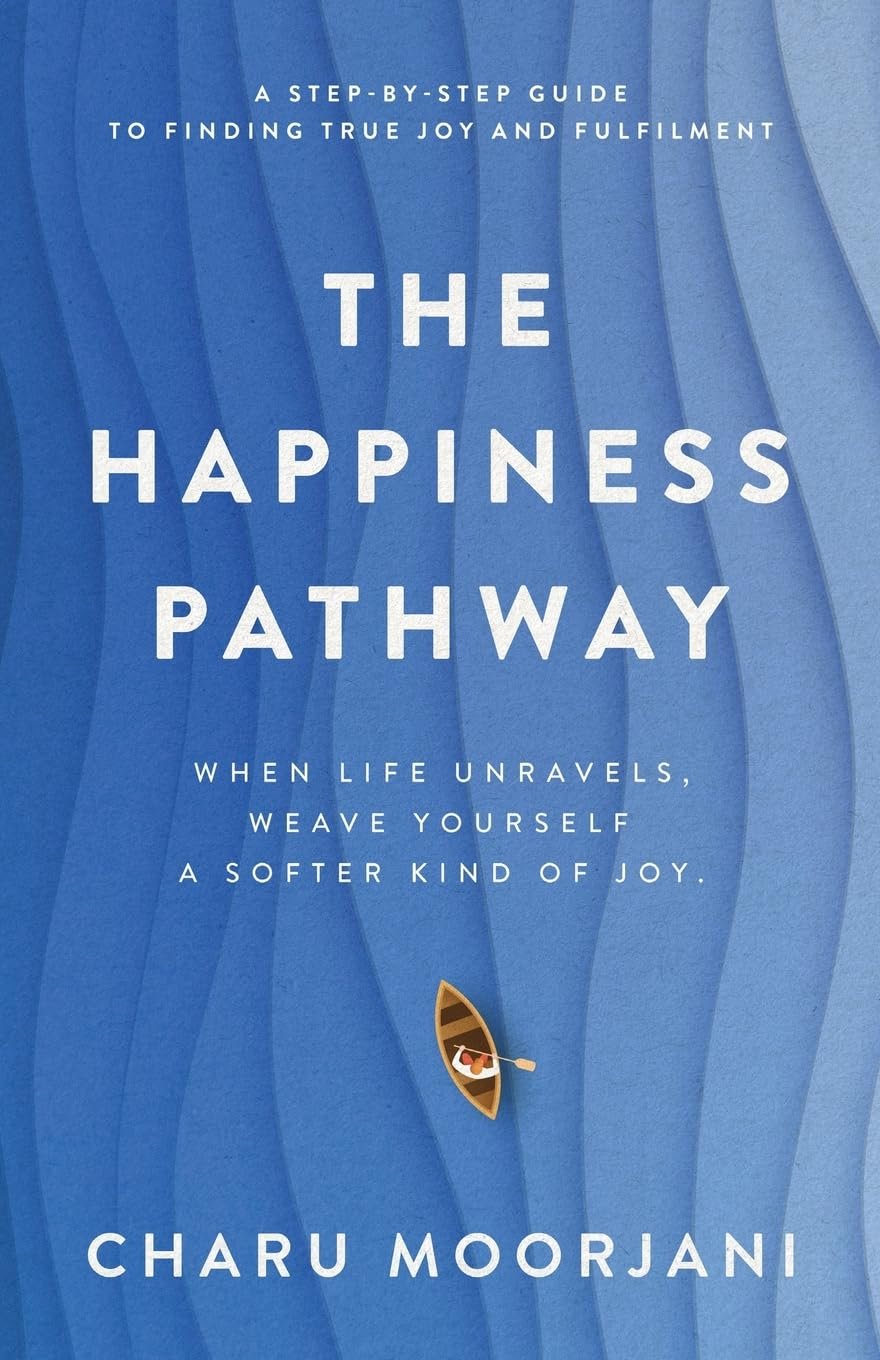
Happiness books often promise a destination: become successful, discover the right habit, and the feeling will follow. Charu Moorjani’s The Happiness Pathway begins by disputing that order. Its stated argument is that happiness is built through repeated choices, deeper self-knowledge and a willingness to confront emotional wounds, rather than found once the outer markers of achievement fall into place. The work combines memoir, positive-psychology language and practical exercises. Its strongest critical proposition is the refusal to confuse a well-performing life with a life experienced as meaningful from the inside.
From possession to practice
The book’s governing metaphor is a pathway rather than a trophy, and the distinction matters. If happiness is a possession, losing it feels like personal failure; if it is a set of practices, interruption can be understood as part of ordinary life. Moorjani’s description emphasizes self-awareness, boundaries, compassion and intentional choices. These are accessible themes, but a reader is entitled to ask how specifically the book explains their interaction. Does a proposed exercise allow for social constraint and exhaustion, or assume unlimited personal control? The best personal-growth books make room for economic, family and health realities that will not yield to positive thinking. The public synopsis promises practical steps, but it does not establish that every step is equally appropriate for every reader.
The self behind the public achievement
Moorjani explicitly addresses people who seem to be succeeding externally while feeling misaligned within. That audience gives the work a sharper focus than general exhortations to be cheerful. The friction between social approval and private value is real: someone can meet every expectation and still be working toward goals they never chose. A useful review should therefore ask whether the book helps identify the origin of a desire, not merely increase motivation to pursue it. The difference between ambition and conformity is more interesting than the difference between optimism and pessimism. The documented premise creates room for that distinction.
Personal history versus scientific authority
The work’s promotional material invokes neuroscience and positive psychology alongside lived experience. The three kinds of evidence should not be treated as interchangeable. A personal story can communicate what an experience felt like; a psychological study can test a particular proposition; neither automatically establishes a universal route to fulfilment. The strongest reading approach is to preserve the memoir’s emotional truth while examining broad claims independently. Exercises may be useful as prompts without being therapies, and self-kindness is valuable without replacing professional treatment where needed. A serious review avoids either dismissing the book’s warmth or elevating its language of science beyond the support that the sources actually demonstrate.
Boundaries as an ethical question
The book’s discussion of boundaries is especially consequential. Setting limits is sometimes presented as a self-protective gesture with obvious moral clarity, but real relationships involve mutual duties, dependency and negotiated care. The critical question is whether a guide can distinguish the relief of saying no from the longer work of communicating that no with honesty. Moorjani’s focus on intentional choice could be helpful here. It becomes more valuable when the reader is invited to examine conflicting commitments rather than simply follow a new list of prescriptions. The public overview identifies boundaries as a topic, not the exact examples the book uses.
A practical promise that deserves testing
The listed 296-page format suggests space for a substantial progression, yet length does not by itself prove depth. Readers may judge the practical value by whether reflections produce distinct insights, whether exercises repeat themselves and whether the book acknowledges uncertainty. Its central claim—that joy must be cultivated rather than chased—is not new, but originality in self-help often resides in method, voice and the specificity of experience. The author’s personal storytelling is therefore not an ornament. It is potentially the part that turns familiar counsel into a recognizable human argument. The full text is needed to assess that result.
The limits of individual agency
One of the most difficult subjects for a happiness guide is the boundary between personal choice and circumstances a person cannot simply redesign. Boundaries and compassionate habits are valuable, but not everyone has the financial security, health, childcare or social permission to change a routine overnight. A rigorous reader may therefore ask whether Moorjani’s exercises allow for gradual, constrained action rather than assuming that insight is immediately executable. The public promise is step-by-step guidance. That phrase raises the burden of specificity: which step is realistic for someone under pressure, and what counts as progress when an external condition does not improve? A book that acknowledges limitation is often more humane, and more useful, than one that turns happiness into another measure of individual performance.
How to read a workbook-like promise
Practical nonfiction should be judged partly by the behavior it asks of its reader. An exercise can be thoughtful but too vague to complete; a reflective question can be uncomfortable yet valuable if its purpose is explained. Moorjani draws on personal story, psychological vocabulary and practice, so the strongest reading mode is active and discerning. Readers should try a prompt, notice what it brings up, and distinguish what feels illuminating from what merely sounds reassuring. The book can be a companion to self-examination without becoming an authority over every life decision. That is not a modest dismissal of its aims. It is a way to give the work a fair chance to demonstrate usefulness where usefulness can actually be assessed.
Who will value this book
This is suitable for readers looking for reflective self-help grounded in personal narrative and small, intentional practices. It is less appropriate as a substitute for clinical mental-health care or as proof that any one framework guarantees happiness. Our judgment is based on the Google Books description and bibliographic information, not direct testing of the full exercise sequence.
Scope of this assessment
This is a research-based editorial review drawn from identified bibliographic, author and publisher sources. It considers the work’s documented premise and the critical questions it invites, without claiming a complete firsthand reading. No unverified scene, character action or ending is asserted.
About the book.
An evidence-bounded critical introduction to evidence-informed personal-growth and happiness guide. Published descriptions support the stated premise; interpretations are identified as editorial analysis, not confirmed plot details.
This review concerns a book marked sponsored in the current MarketAnyBook queue. Sponsorship is disclosed, and all observations remain research-based.
Found a book worth opening?
Books worth discovering. Authors worth knowing.
Return to the Journal →