
The Soul-Sung (The Vaeritas Saga Book 1)
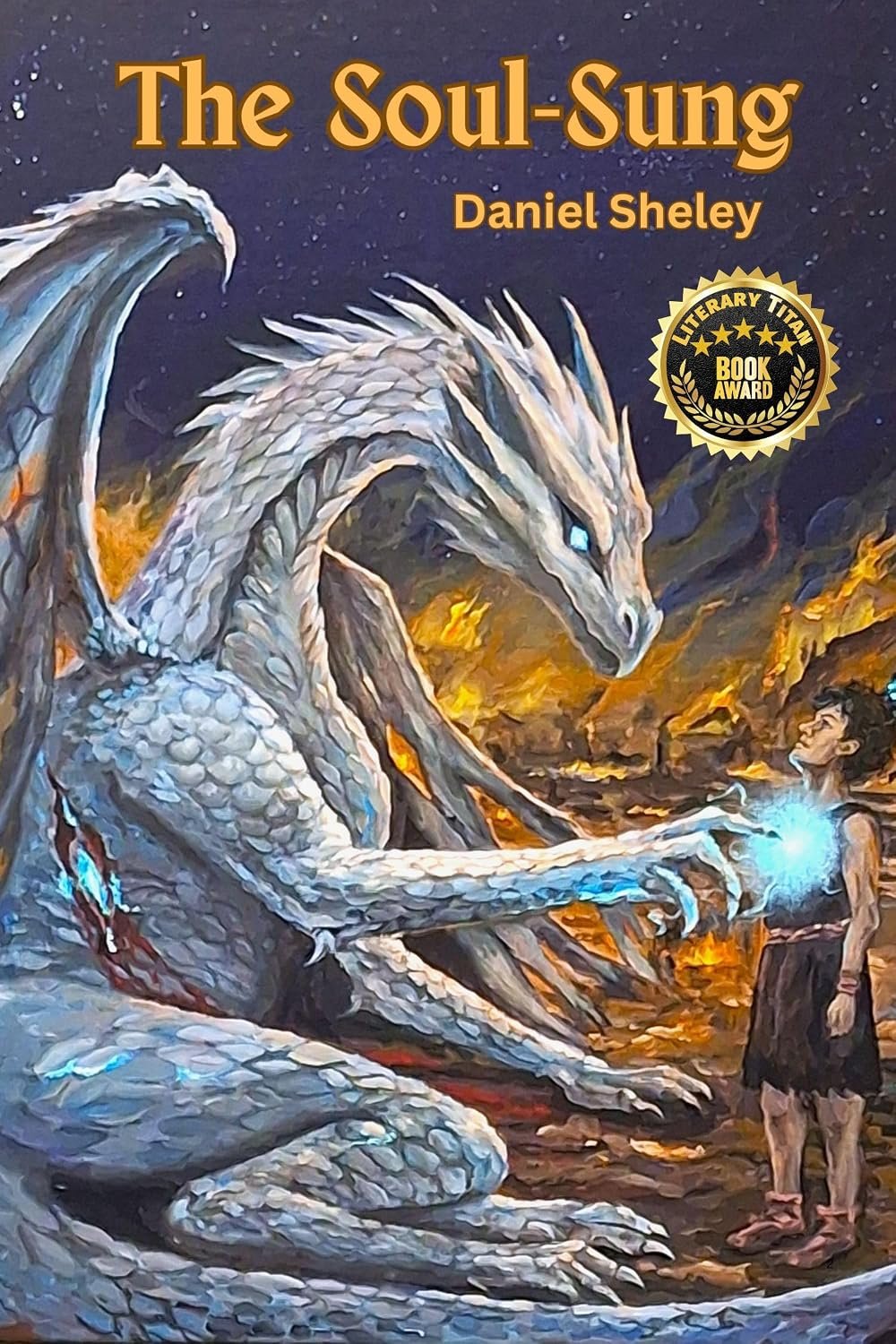
In The Soul-Sung, Daniel Sheley makes change literal and dangerous. Denny, a boy from Duskmere, survives the destruction of his home after the dying Draken Watcher Yverra places an ancient…
Books worth discovering. Authors worth knowing.
In The Soul-Sung, Daniel Sheley makes change literal and dangerous. Denny, a boy from Duskmere, survives the destruction of his home after the dying Draken Watcher Yverra places an ancient world-song inside him. The Song is connected to the Veym, a force with the ability to alter the world, and it is not meant for a human vessel. Meanwhile Kaelari…
Considered reviews, grounded in the book’s documented promise.
In The Soul-Sung, Daniel Sheley makes change literal and dangerous. Denny, a boy from Duskmere, survives the destruction of his home after the dying Draken Watcher Yverra places an ancient world-song inside him. The Song is connected to the Veym, a force with the ability to alter the world, and it is not meant for a human vessel. Meanwhile Kaelari faces a contested succession, Vaskor presses a brutal claim to power and Veridan seeks influence through ritual. The novel’s ambitious design joins personal transformation to political rupture: everyone wants change, but almost nobody can agree who should control it.
Power that will not remain outside the body
Fantasy frequently grants a chosen figure an extraordinary ability and then asks what that power can accomplish. Here the more arresting question is what such power does to the person carrying it. Denny's inheritance is not portrayed in the available synopsis as a clean victory. It threatens to remake him from within, turning the body into a place where world-shaping forces and private identity contest the same ground. That is fertile dramatic material because survival and self-preservation are no longer identical. A rescue can also be a violation; an unwanted gift may hold possibilities no one understands. A nuanced treatment would let the character resist the mythic destiny assigned to him.
One crisis, several moral vocabularies
Kaelari's leadership problem provides a necessary counterpoint. A young claimant working within inherited obligations has different priorities from a boy abruptly chosen by a supernatural event. Vaskor's coercive ambition and Veridan's calculated manipulation indicate that legitimacy is not secured simply by having followers or special knowledge. These factions give the series political texture: control of the Song might be framed as protection, conquest, sacred duty or self-defense. The reported multiple perspectives are therefore not merely a technique for extending the map; they are a way of staging incompatible accounts of what the world needs.
A mythology about change rather than stability
Sheley has described change as the saga's central theme and refers to Draken, Watchers and fractured tribes. The mythology promises a broad architecture, but complexity is only a virtue when the reader can follow emotional consequence through unfamiliar terms. A glossary and cast list may assist orientation; they cannot substitute for scenes in which a relationship gives the cosmology weight. If readers care whether Denny trusts Kaelari or whether a watcher fears losing moral authority, the nomenclature has done its work. The most effective epic worlds feel large because individual choices remain painful within them.
The promise and hazard of a first volume
As the opening part of the Vaeritas Saga, the book has to establish its rules while preserving uncertainty about their ultimate implications. The difference between intriguing ambiguity and simple obscurity matters. A first volume should not require the reader to master a private encyclopedia before the first human stake becomes apparent. Available descriptions suggest a deliberate opposition between inherited order and disruptive transformation. How elegantly that conflict is paced through the chapters remains an open matter absent a complete reading, but the premise is strikingly specific.
An ethical thread beneath spectacle
Destruction, succession, and mystical inheritance might create a sequence of battles and revelations. Yet the defining ethical question is who pays for somebody else's necessity. The village that burns, the leader asked to command, the host who never consented to carry the Song: each embodies a different price. In that sense the protagonist need not be most interesting as the center of a prophecy. He may be compelling precisely because he cannot yet determine whether the force inside him makes him responsible for a world he did not choose.
What the Song means to a society
The Veym is described as a force capable of changing the world, which immediately raises questions about ownership. A clan, priest or warrior might view such an ability as communal property, divine mandate, military resource or existential threat. Denny is therefore not simply a boy with an unusual gift; he is an argument other people wish to win. Epic fantasy becomes politically alive when power is more than an object to seize: it creates competing theories of authority. The synopsis establishes that multiple factions seek the survivor. That convergence promises ideological conflict, although only the actual narrative can show whether those positions receive genuine texture rather than serving as labels for good and evil.
A young leader’s counterstory
Kaelari's predicament helps keep the novel from following a single chosen-one trajectory. She is shaped by inherited expectations even as her community fractures; Denny is shaped by an inheritance he never requested. Their circumstances mirror one another without being identical. That structural possibility is valuable because fantasy can too easily make spontaneous power more important than the unglamorous responsibilities of leadership. The harder moral question is not only who can wield transformation, but who must negotiate its consequences tomorrow. Whether the book gives these strands equal dramatic force should be tested in the chapters, yet the published account gives them clear reasons to coexist.
The imaginative burden of a name
Soul-Sung implies that a person might become a vessel for another kind of expression. It can make sound, memory and agency part of the story's metaphysics, not just decorative language. But a music-based magic system demands discipline: readers should learn what it cannot do as well as what it can. Limits are often more dramatically productive than unlimited wonders. Sheley has acknowledged music's importance to the novel and has explained his interest in mythic traditions. Such context supports a reading attentive to the significance of the Song, without licensing a claim that every aspect of its workings is transparent or successfully handled.
Who will value this book
A strong prospect for readers who favor multi-perspective epic fantasy, ethically compromised power and the transformation of reluctant protagonists. Readers seeking a completely self-contained story should remember that this is volume one. The judgment here is about the documented architecture and themes, not a claimed firsthand assessment of every scene or the ending.
Scope of this assessment
This is a research-based editorial review drawn from identified bibliographic, author and publisher sources. It considers the work’s documented premise and the critical questions it invites, without claiming a complete firsthand reading. No unverified scene, character action or ending is asserted.
About the book.
An evidence-bounded critical introduction to epic fantasy and transformation narrative. Published descriptions support the stated premise; interpretations are identified as editorial analysis, not confirmed plot details.
This is an unsponsored, research-based editorial review, not a claim to firsthand reading of the complete book.
Found a book worth opening?
Books worth discovering. Authors worth knowing.
Return to the Journal →