
The Withering Road
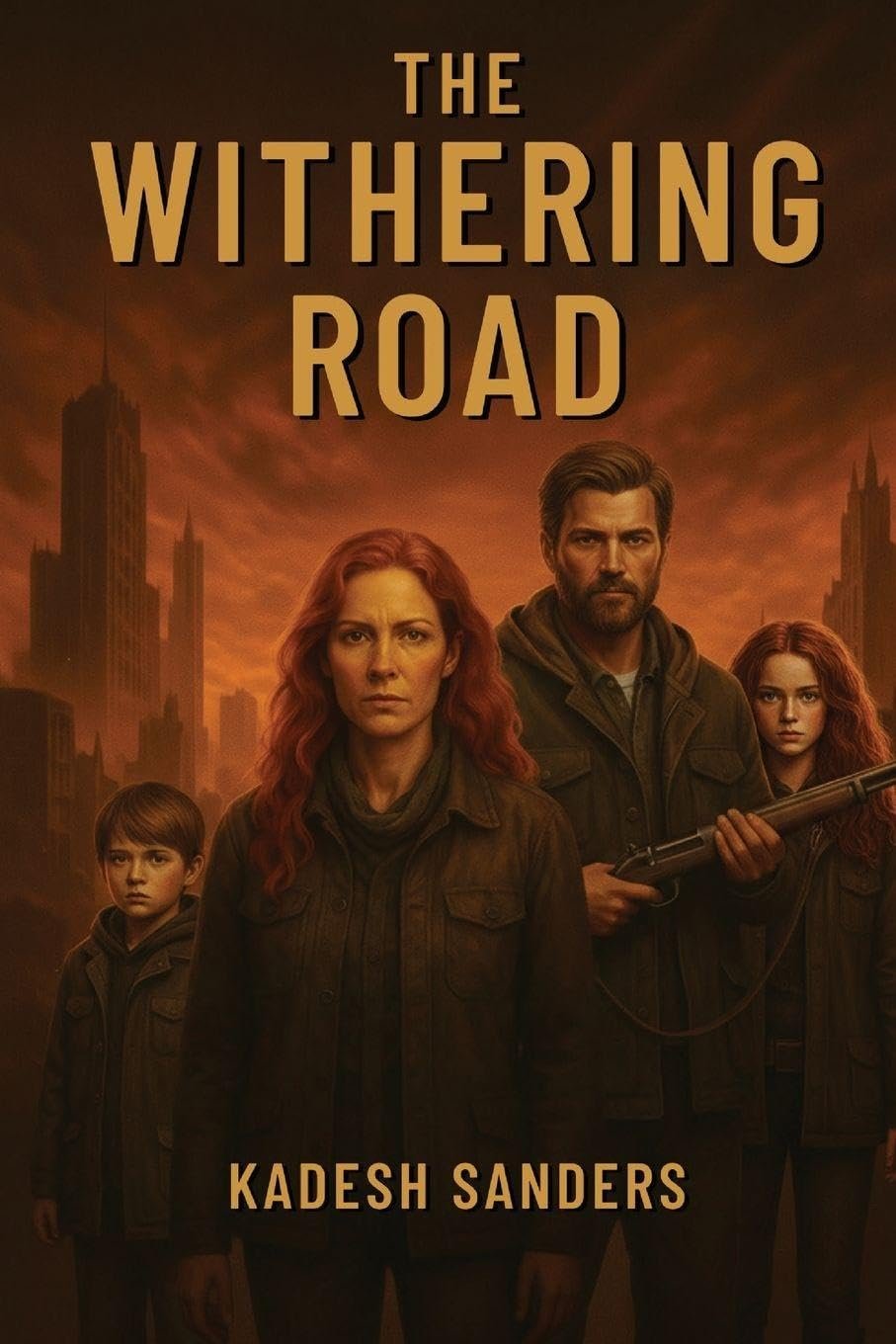
The Withering Road begins after invasion and nuclear devastation have made ordinary civil order untenable. In the nation of New Egypt, a family takes to a broken road while authoritarian force and…
Books worth discovering. Authors worth knowing.
The Withering Road begins after invasion and nuclear devastation have made ordinary civil order untenable. In the nation of New Egypt, a family takes to a broken road while authoritarian force and opportunism spread through the ruins. Kadesh Sanders’s premise positions survival as both physical ordeal and moral test: in a world governed increasingly…
Considered reviews, grounded in the book’s documented promise.
The Withering Road begins after invasion and nuclear devastation have made ordinary civil order untenable. In the nation of New Egypt, a family takes to a broken road while authoritarian force and opportunism spread through the ruins. Kadesh Sanders’s premise positions survival as both physical ordeal and moral test: in a world governed increasingly by fear, whom can a person trust, and how much of one's ethical life can be carried through catastrophe? The family focus creates a useful human scale within the large spectacle of national collapse.
When the road is not freedom
The open road often symbolizes possibility in fiction. Here it is closer to exposure. Leaving a damaged home may be necessary, yet movement means surrendering whatever limited security remains. The landscape therefore operates as an ethical pressure system, not merely a series of visual set pieces. A compelling version of this material makes decisions about shelter, strangers and shared resources matter as much as dramatic escape. The published account establishes a family flight across a fractured country; it does not justify invented incidents on their route.
The intimate consequences of apocalypse
Large-scale destruction can become abstract quickly. An entire city burns; a map changes; a political order falls. A family's internal structure is less easily reduced to numbers. Parents may disagree about acceptable risk, children may notice what adults conceal, and love can increase rather than remove vulnerability. Those are interpretive possibilities rather than verified scenes, but they explain why the synopsis's emphasis on family is promising. A catastrophe story earns its emotional force when danger changes the distribution of responsibility among people who already care for one another.
A world after institutions
The description associates the disaster with authoritarian rule and the opportunistic struggle to dominate survivors. Such framing encourages readers to distinguish legitimate coordination from domination dressed as necessary discipline. In emergencies, people do need systems. The terrible question is how quickly protection becomes a justification for obedience without accountability. Science-fiction disaster narratives can explore that boundary with unusual clarity because familiar institutions have been removed. The risk is that tyranny becomes a simple villainous costume rather than a recognizable social temptation.
Belief, loyalty and resistance
The available preview includes religious and geopolitical rhetoric, and publisher material emphasizes quiet resistance. The combination may offer more than a contest between heroic travellers and brutal rulers. Belief can sustain people; it can also be used to sanctify conquest. Loyalty can protect the vulnerable while encouraging silence about wrongdoing. The novel’s premise contains the elements for such distinctions, although the available sources do not establish how persuasively every character embodies them. Reviewers should distinguish the ethical opportunity of the setup from an unearned declaration that the book fully realizes it.
Pacing a long disaster
A post-apocalyptic journey can exhaust readers if each obstacle merely announces that the world is dangerous. The more memorable structure gives successive encounters different moral weights and allows the survivors' priorities to change. New Egypt's particular geography and the mechanisms of catastrophe should also remain coherent enough for suspense to feel earned. The public preview shows a dramatic opening and the contrast between ordinary domestic rhythm and emergency. That contrast, if maintained, could make devastation feel personal rather than decorative.
Political language before the disaster
The accessible preview emphasizes how leaders can justify aggression through speeches about destiny, resources and presumed national virtue. That material gives the catastrophe a human cause rather than treating devastation as an impersonal meteor strike. It invites attention to rhetoric: violence can be prepared in public long before weapons are used, especially when a population is asked to mistake superiority for moral entitlement. A speculative novel is at its most unsettling when such mechanisms feel recognizable without requiring a one-to-one comparison with a particular contemporary government. The text's invented geopolitics may offer precisely that distance, but readers should test whether its complexity survives beyond the prologue.
Hope without easy optimism
The publisher emphasizes hope as something costly. That is a strong choice for a survival narrative because optimism can ring false in a landscape of deprivation. Hope here might mean agreeing to help another person despite the possibility of betrayal, or refusing to surrender the smallest ethical boundary. Those are conceptual illustrations, not reported plot scenes. Their importance lies in the difference between feeling hopeful and acting as though the future still matters. When the cost is made concrete, love and loyalty become decisions under pressure, not comforting abstractions.
The moral weight of a shared name
New Egypt suggests a society with an imagined collective history. Whether that history is developed in detail matters to the credibility of the collapse. A ruined country should have been a lived place before it became an adventure landscape. It had customs, work, neighbors and routines. The preview's ordinary domestic detail before emergency is therefore potentially valuable, placing a human day next to the machinery of invasion. Readers may reasonably ask whether the novel continues to preserve such particularity after its pace accelerates, instead of letting everyone become interchangeable refugees from a generalized dystopia.
The larger question after survival
If the family succeeds in escaping immediate danger, the moral challenge would not automatically end. A future society must be built from the habits its survivors preserve. The same fear that protects a household may tempt it to abandon strangers; the same loyalty that sustains relationships may harden into suspicion of outsiders. The published premise gives this problem real potential. Rather than treating survival as a purely biological victory, the novel can ask what deserves to survive with the people themselves. That is the weight behind its emphasis on love and quiet resistance, and the standard by which its dystopian drama should ultimately be judged.
Who will value this book
Readers attracted to family-centered apocalypse fiction, survival ethics and authoritarian dystopia have a well-defined premise here. The tone appears serious and violent, so it is less suitable for readers seeking a light adventure. This assessment is based on a publisher synopsis and accessible sample, not a claim to a complete reading.
Scope of this assessment
This is a research-based editorial review drawn from identified bibliographic, author and publisher sources. It considers the work’s documented premise and the critical questions it invites, without claiming a complete firsthand reading. No unverified scene, character action or ending is asserted.
About the book.
An evidence-bounded critical introduction to post-apocalyptic survival and family-centered speculative fiction. Published descriptions support the stated premise; interpretations are identified as editorial analysis, not confirmed plot details.
This is an unsponsored, research-based editorial review, not a claim to firsthand reading of the complete book.
Found a book worth opening?
Books worth discovering. Authors worth knowing.
Return to the Journal →