
A City of Fire & Ash
A restored city is not necessarily a peaceful one. The publisher description of R. W. Huntington’s A City of Fire & Ash , the second volume.
Books worth discovering. Authors worth knowing.
A restored city is not necessarily a peaceful one. The publisher description of R. W. Huntington’s A City of Fire & Ash , the second volume.
Evidence-conscious literary criticism, not a claim of firsthand full-text reading.
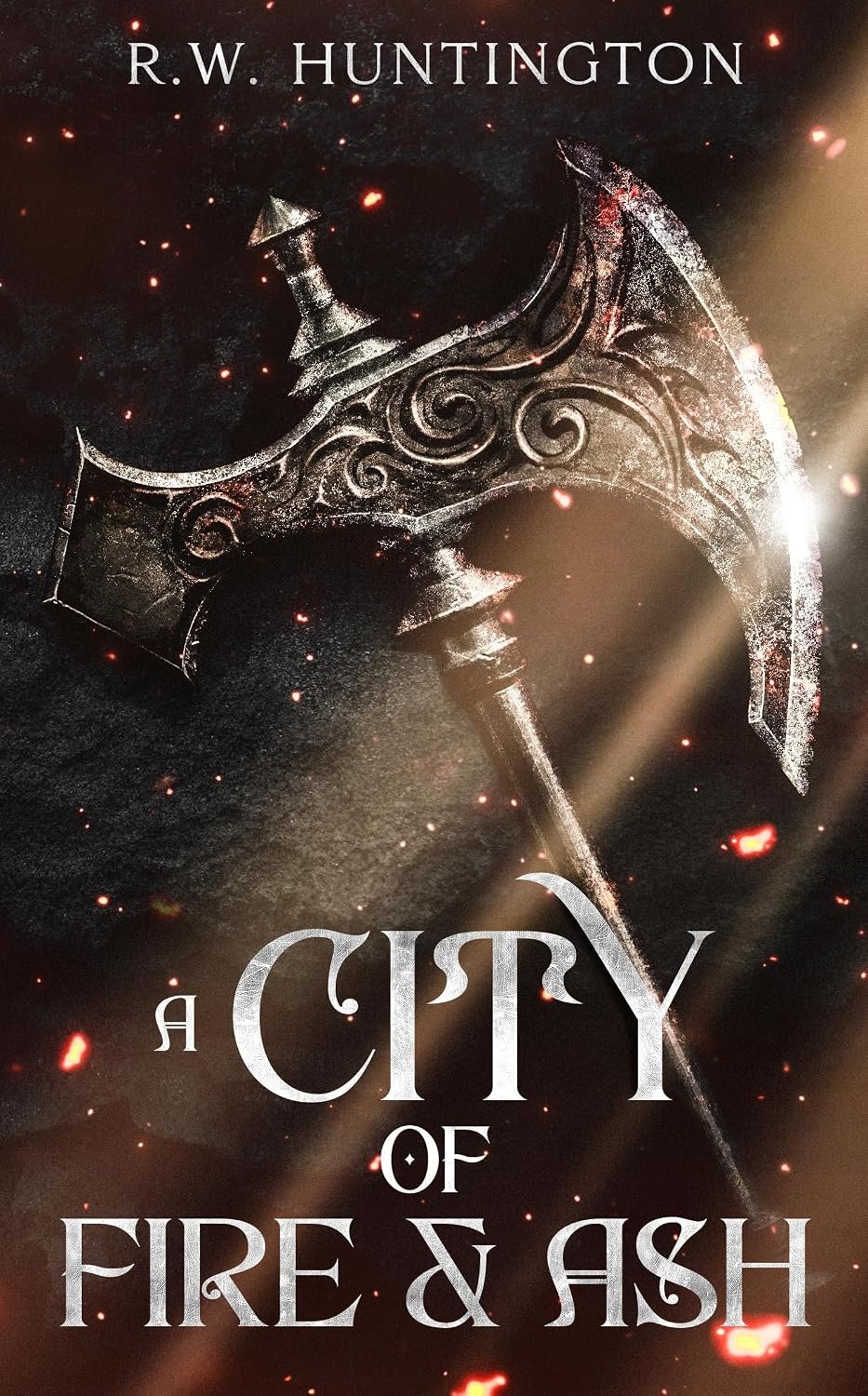
A restored city is not necessarily a peaceful one. The publisher description of R. W. Huntington’s A City of Fire & Ash, the second volume in A War for Iron & Stone, starts five years after the dwarven city of Kragstone was retaken. A previous military victory has produced a new social and political situation, rather than a final resolution. That choice is promising because epic fantasy becomes more interesting when its protagonists must live with what their battles made possible.
After the celebrated victory The available series synopsis recalls Ulfrid Bloodaxe and his companions defeating a goblin army and a sorcerer named Zyldove in order to reclaim Kragstone. Now Ulfrid commands a dwarven company alongside Balroc and continues hunting remaining goblin forces beneath High Peak. Emissaries from the human king Harmond interrupt that work with a proclamation that may endanger the dwarven city. This is a deliberately different engine for the sequel: the problem arrives through diplomacy and authority even while the weapons have barely been put away.
A five-year gap gives the story an opportunity to consider what has changed during a period that would otherwise be summarized as happily ever after. Military commanders become political figures whether they seek that role or not. Old loyalties may feel less simple when peace requires negotiation, resources and a willingness to accept uncomfortable bargains. The synopsis does not establish how Huntington handles those questions, but it does establish a situation in which they are germane.
Iron, stone and competing futures Fantasy titles often emphasize materials because physical places carry the memory of conflict. Iron may stand for weapons, industry or resolve; stone for inheritance and the durable shape of a home. The sequel’s imagery of fire and ash complicates that durability. Even a fortress once thought safe can be threatened by destruction, and ruins can hold both grief and the possibility of renewal. These readings of the language are critical possibilities, not descriptions of particular scenes.
Huntington’s premise also contains an attractive shift in scale. The protagonist’s pursuit of scattered enemies belongs to the familiar vocabulary of adventure. A king’s proclamation demands an understanding of who has the power to decide a people’s future. A mature sequel could allow those scales to challenge one another: the capable fighter must confront circumstances that cannot be defeated with a blade. Readers should watch for whether political developments arise from established relationships or merely supply a new villain to fight.
What the second volume must earn Sequels inherit obligations. A returning reader deserves continuity of character and consequence; a newcomer needs enough orientation to understand why the earlier victory matters. The publicly available description points to the former, but does not prove the latter. It also leaves open the moral texture of the goblin conflict. Epic fantasy is at its most compelling when enemies have histories and when power is treated as a problem to examine, not merely a privilege to celebrate.
Another question is how the intervening years have altered Ulfrid. If his earlier story was about proving himself through action, commandership should ask something different of him: restraint, judgment, the care of subordinates and responsibility for choices other people must carry out. His friendship with Balroc is part of the advertised setup. Whether that bond becomes a source of challenge or simply dependable support remains unknown.
The politics of rebuilding Reconstruction can be a richer narrative challenge than conquest. Reclaiming Kragstone may have united people in a clear campaign; maintaining it requires decisions about resources, authority and what to do with those who were excluded from the victory. A five-year interval creates narrative room for habits to settle into institutions. Ulfrid’s military command may now be part of the city’s ordinary life, making the human king’s intervention more disruptive than a new invasion would have been. This line of analysis follows from the supplied setup; it remains a question to test in the novel rather than an account of scenes already verified.
King Harmond’s emissaries also suggest that a territory’s future can be shaped by powers outside its walls. Fantasy politics often become a contest between competing maps of legitimacy: one people understand land through memory and sacrifice, another through crown and treaty. The premise would be especially effective if it resists presenting those visions as wholly interchangeable. A reader entering a second volume should be alert to how the author handles scale: whether the fate of a city is carried by a few named heroes or allowed to become a collective problem with consequences for ordinary inhabitants. That would make the sequel’s stakes qualitatively different from those of the first book.
Companionship after the quest The connection between Ulfrid and Balroc is another potential source of continuity. Friendships forged in danger can change when one person becomes a commander, when a cause becomes a profession or when loyalty begins to conflict with judgment. Epic fantasy sometimes treats companions as a dependable chorus around its central hero. A more searching novel could allow them to disagree without betraying the relationship. This possibility does not establish a particular disagreement in Huntington’s text. It shows why the known premise is capable of supporting more than a repetition of battles beneath a mountain.
A recommendation with context This is most naturally a book for readers continuing <em>A War for Iron & Stone</em>. The synopsis relies on an earlier conflict and named characters, and its emotional weight will likely be strongest for people who remember the reclamation of Kragstone. Lovers of dwarven fantasy, military adventure and kingdom-level political stakes may find the new premise appealing. Readers seeking a standalone novel should first check how readily it introduces returning characters and histories.
The evaluation here rests on series descriptions and bibliographic information, not a complete reading. Even so, A City of Fire & Ash has a meaningful starting question: what happens when defeating an enemy turns out to be easier than securing a future? It is the right kind of question for a second book, because it promises not simply a larger battle but a deeper reckoning with the victories already won.
About the book.
The title, contributors, routing category, original retailer link and unique Drive image file were checked against the live queue. The review is based on publicly available evidence and original editorial analysis.
This is an unsponsored editorial book review. This research-based critical review interprets the verified book listing and available external descriptions; it does not claim a complete reading.
Found a book worth opening?
Books worth discovering. Authors worth knowing.
Return to the Journal →