
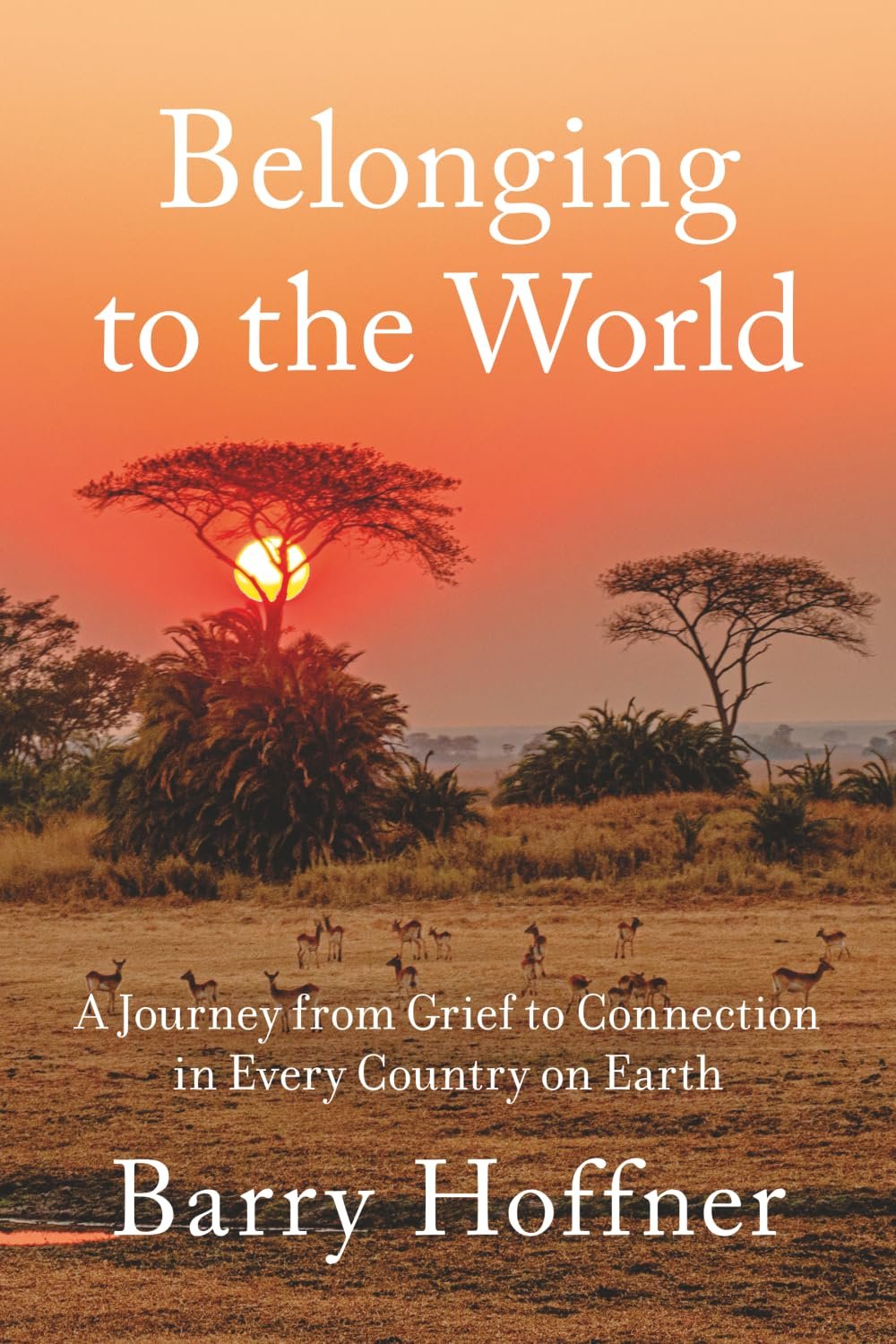
Belonging to the World
Barry Hoffner’s Belonging to the World begins from a rupture that no itinerary can undo: the sudden death of Jackie, his wife and travel companion. He returns to travel and undertakes the daunting project of…
Books worth discovering. Authors worth knowing.
Barry Hoffner’s Belonging to the World begins from a rupture that no itinerary can undo: the sudden death of Jackie, his wife and travel companion. He returns to travel and undertakes the daunting project of visiting every country on Earth. The publisher identifies an ambition reaching 193 countries, but the book’s real subject appears to be the…
Book-specific criticism, grounded in what the available sources support.
Barry Hoffner’s Belonging to the World begins from a rupture that no itinerary can undo: the sudden death of Jackie, his wife and travel companion. He returns to travel and undertakes the daunting project of visiting every country on Earth. The publisher identifies an ambition reaching 193 countries, but the book’s real subject appears to be the difference between movement as distraction and movement as a way of encountering other lives. The journey is therefore both outward and inward, with neither direction safely substituted for the other.
The itinerary as a structure for grief
Travel memoirs routinely promise transformation through new places; their danger is turning the world into scenery for the traveller’s personal development. Hoffner’s synopsis is at least candid about the difficult question. Does constant motion help the bereaved person engage with loss or provide an elaborate means of postponing it? An independent review of the book notes that the author himself considers the ambiguity. That admission matters more than any impressive count of borders crossed. A credible journey through grief would resist the idea of a single destination at which mourning is finished. It would allow travel to change the terms of sorrow without claiming to make its origin disappear.
Counting places, meeting people
The ambition to visit all countries creates a readily legible narrative frame. Readers can measure progress, anticipate difficulty and compare unfamiliar settings. Yet the moral value of the journey depends on what happens inside those stops. A passport stamp is evidence of movement; it is not proof of connection. The publisher points to encounters with guides, residents, fellow travellers and people living amid hardship. A careful account must grant these people the dignity of lives continuing beyond their encounter with the visiting narrator. Hoffner’s stated purpose becomes more interesting when he treats them as relationships rather than emblems of human kindness assembled to heal him.
The presence of Jackie
There is a profound risk in any bereavement narrative that the person who died becomes chiefly the event that changes the survivor. The book’s description retains Jackie as a travel partner and as the person honoured in an educational scholarship programme. That institutional connection is especially significant: remembrance extends into the future through opportunities for young women rather than being confined to private recollection. The critical question is how Hoffner balances the memory of a particular marriage with his growing attention to strangers. A memoir can become more generous through grief without turning its subject into a universal moral symbol.
A world wider than headlines
Hoffner’s synopsis explicitly contrasts lived encounters with the simplifications of news coverage. This can be a worthwhile corrective, though travel narratives risk creating new simplifications when a few memorable conversations are taken to stand for an entire country. The strongest writing of place is curious about history, inequality and the narrator’s own limits of perception. The reader should expect not only expressions of optimism but attention to the conditions that make hospitality costly or remarkable. The published material establishes the journey’s broad terms, not whether every country receives such nuanced treatment.
A credible promise of belonging
The title asks for a distinction between belonging to one place and recognising obligations to a wider human world. Hoffner’s personal story makes that idea tangible because travel was part of his life before the loss as well as afterward. It is not a sudden hobby that conveniently solves grief. The wider journey may disclose the ways attachment survives through action, memory and ongoing commitments. Still, a memoir’s success is ultimately a matter of voice and the quality of encounters selected for the page. Critical sympathy should not be mistaken for a judgment already reached about all 344 pages.
The ethics of being welcomed
Hospitality can become an easy virtue in travel writing: the narrator arrives vulnerable, someone offers generosity, and a lesson about shared humanity follows. But hospitality often takes place across unequal resources and uncertain risks. A visitor can leave; a local host remains with the consequences of local politics, scarcity or conflict. Hoffner’s account promises encounters in places marked by hardship, so the critic should ask how he depicts that difference in mobility and choice. His search for connection would become richer if it recognises that generosity is not owed to him and that his gratitude does not erase the other person’s separate life. These are demanding standards for a memoir that hopes to make the world seem more open, yet they are also what can keep its hope from becoming sentimental.
A mission that outlasts the traveller
The educational work associated with Jackie’s memory lends the narrative a second form of movement. Travel brings the narrator into changing environments; a scholarship programme can create lasting possibilities for people who may never share his route. This does not make philanthropy an automatic answer to grief, nor does it exempt the account from scrutiny. The connection between personal remembrance and material support is meaningful because it turns memory into an ongoing relationship with the future. A reader may therefore understand the memoir as a study of what happens when attachment changes shape rather than simply ends. The published material justifies that interpretation while leaving the quality of individual episodes for a full-text critic to assess.
Who will find value here
This memoir deserves attention from readers of emotionally serious travel writing and accounts of life after bereavement. Its unusual geographical scale is not the only attraction; more promising is its acknowledged uncertainty about what movement can and cannot mend. Readers expecting a practical country-by-country guide may be disappointed, while those interested in grief, ethical travel and the reconstruction of purpose may find a well-defined narrative to investigate.
What this review can establish
This is an independent, research-based editorial assessment of the identified book, informed by the listed publisher, author and bibliographic materials. The analysis identifies documented premises, meaningful genre expectations and open critical questions. It is not a firsthand claim to have read every chapter or inspected the entire illustrated edition; judgments about the quality of prose, plot resolution and any unverified interior material are reserved for a full-text review.
About the book.
A limited-source, independent editorial evaluation of travel and bereavement memoir. Facts are drawn from the listed book record and separately identified public descriptions; speculative editorial questions are not presented as plot facts.
This is an unsponsored editorial review based on verified public descriptions and bibliographic materials, not a claim to firsthand reading of the complete book.
Found a book worth opening?
Books worth discovering. Authors worth knowing.
Return to the Journal →