
Casket Girls: A Novel
Women of different backgrounds cross the Atlantic to 1727 Louisiana and confront the uncertainties of a new colonial society.
Books worth discovering. Authors worth knowing.
Women of different backgrounds cross the Atlantic to 1727 Louisiana and confront the uncertainties of a new colonial society.
A historical ensemble that distinguishes the documented colonial setting from imagined individual lives.
Women who arrive with histories of their own
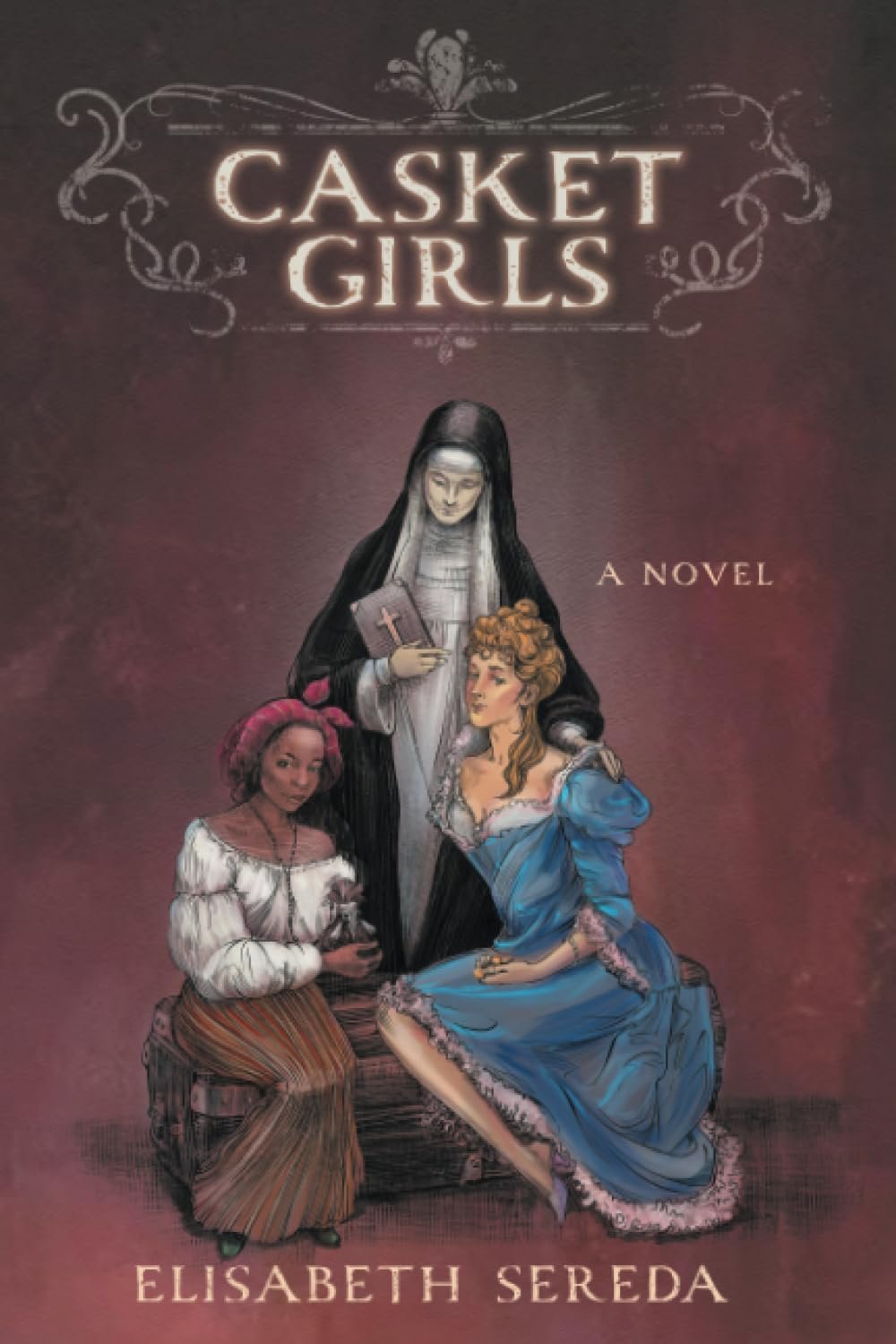
Historical fiction can make a familiar city unfamiliar again by returning it to an unsettled moment before its streets, customs and identity have hardened into the picture we recognize. Elisabeth Sereda’s Casket Girls: A Novel takes that approach to New Orleans. The publisher’s account sets the opening in 1727, when women from markedly different backgrounds make a six-month ocean crossing to the French colony of Louisiana. The travelers include a Parisian aristocrat whose reputation has become a scandal, a free woman of color from Cuba, an enslaved girl associated in the description with voodoo skills, a widow with a secret, a rural French girl, and others traveling with twelve Ursuline nuns. This isn’t a premise built around a single heroine discovering an exotic destination. It announces an ensemble in which each woman’s history complicates the others’ prospects.
The name “casket girls” carries historical associations, but a novel can take that point of departure without pretending to be a documentary record. The publisher explicitly distinguishes the book’s fictional lives and long-form story from the history that inspires it. Some characters are based on real people; their interconnected experiences over roughly twenty years are imagined. That distinction is essential to reading the book fairly. An account of what a particular character said, saw or survived should be understood as historical fiction unless corroborated separately. The attraction here is not an impossible promise to reproduce the past exactly, but the chance to consider how people with unequal power might navigate one emerging colonial society.
A crossing that does not make everyone equal
The six-month voyage gives the story a striking shared beginning. Travel brings people into the same physical space, but it does not erase distinctions of freedom, race, wealth, religion or reputation. The promotional description makes those differences part of the central design. An enslaved traveler cannot reasonably be assumed to have the same range of choices as an aristocrat; a woman with access to money and connections is differently situated from someone who must rely on protection offered by strangers. These are interpretive questions the premise raises, rather than a claim that the novel resolves them in any particular way. Attentive readers can ask whose account sets the terms of a scene and whose fears are forced into silence.
The Ursuline convent becomes an especially interesting point of intersection. According to the publisher, the women find safety and education with the nuns, while danger persists outside. That tension can support different types of scenes and motivations: shelter offers an opportunity to rebuild, but cannot guarantee lasting independence. In a colonial setting, even apparently protective institutions exist inside larger hierarchies. Readers drawn to religious history may be interested in what a community of women can provide; readers attentive to systems of power will want to notice who can enter such a sanctuary, under what conditions, and with whose permission. The book’s description invites those conversations without requiring one to declare that all its characters experience the institution alike.
New Orleans before it became a symbol
Popular images of New Orleans often jump immediately to later music, cuisine, architecture, carnival and legends. Casket Girls points to an earlier world identified in the synopsis as La Nouvelle Orléans, a French outpost in North America. Here, a port represents exchange and exploitation at once. People, commodities, beliefs and opportunities meet in the same place, but not on equal terms. Sereda’s advertised cast includes figures linked to criminal activity, maritime commerce and spiritual traditions, making the setting a framework for complicated loyalties rather than decorative scenery. Its New Orleans is a place where community must be negotiated in conditions of uncertainty.
One of the most useful ways to approach historical fiction is to ask what it makes visible and what it chooses to leave unexplained. Sereda’s overview mentions Catholicism and voodoo, pirates and smugglers, violence and redemption. The juxtaposition suggests that the novel is interested in coexistence and conflict between different social worlds. It would be misleading, however, to turn promotional terms into an invented chapter-by-chapter summary or treat all references to spiritual practice as interchangeable. The fiction should be allowed to create its own characters and moral difficulties, while the reader maintains a distinction between literary representation and verifiable cultural history.
Secrets create a shared plot without shared motives
Multiple protagonists can be challenging when each needs an individual stake in events. The publisher’s description relies on hidden pasts and lives that gradually intertwine. That is a useful structural promise: the secrets are not simply decorations attached to a group portrait, but potential sources of misunderstanding, danger and eventual recognition. Readers might enter the story interested in the noblewoman, the widow or the girls living under coercion, then discover that another person’s choices alter the meaning of the first. Because their social positions differ, even apparently similar acts could carry different consequences. The appeal of an ensemble lies in that shifting scale of vulnerability and agency.
The promotional overview explicitly mentions both crimes committed against women and crimes committed by some of them. That detail prevents a simplistic expectation of uniformly virtuous survivors. Historical adventure and social drama often become more convincing when their protagonists retain imperfect judgment and conflicting priorities. It is reasonable to anticipate complicated ethical questions from that premise; it is not responsible to invent which person commits which act. This feature therefore concentrates on the book’s verified framing and the reading experience it proposes, not on presumed revelations or scenes a source has not established.
History, survival and the cost of belonging
Survival is a word with many dimensions. Reaching land is one achievement; staying alive and finding a place in the emerging community may require entirely different ones. For a person far from home, language, religion, kinship and status shape everyday possibilities. Sereda’s synopsis emphasizes tragedy and redemption across a twenty-year span, suggesting that the characters’ story extends well beyond an initial voyage. Long time frames are well suited to showing how decisions made during one crisis echo into later relationships. They also allow a novel to change its understanding of a person without denying what she suffered or did before.
There is another intriguing feature in the choice of title. Although the term groups the travelers, the description makes clear that their individual identities matter. A reader may wish to track when society treats the women as a category and when the narrative allows them to be distinct people. That question is relevant to stories of migration and settlement more broadly: official labels are convenient, but human lives do not fit neatly within them. A historical novelist can use the friction between label and person to make a distant moment emotionally understandable.
Who should read Casket Girls?
This is a strong prospect for readers who enjoy historical ensemble novels, colonial-era settings and stories in which women’s lives intersect across differences in power and class. It may also interest readers who like their historical fiction to acknowledge uncomfortable institutions rather than present a nostalgic tableau. The presence of slavery, crime, peril and social coercion in the verified synopsis means the book should not be framed as a light costume adventure. Anyone seeking an academically documented history of the Ursulines or early Louisiana should pair the novel with historical scholarship, not treat fictional scenes as evidence. Readers open to a many-stranded, morally complicated imagined past will find the premise especially appealing.
Elisabeth Sereda is credited as the author in the publisher and bibliographic listings. Those sources describe Casket Girls as historical fiction rooted in actual events, with characters who are partly historically inspired and partly invented. Beyond the publicly documented presentation, the responsible posture is to let the novel speak on its own terms rather than manufacture biographical claims. The most promising reason to open it is the encounter it stages between stories history often tells separately: voyages, missions, enslavement, migration, rivalry and survival in an emerging New Orleans.
About the book.
Historical fiction; colonial Louisiana ensemble novel. A historical ensemble that distinguishes the documented colonial setting from imagined individual lives.
Independent research-based book feature, not a claim of a complete firsthand reading. Cover placeholders await the owner’s Python automation.
Found a book worth opening?
Books worth discovering. Authors worth knowing.
Return to the Journal →