
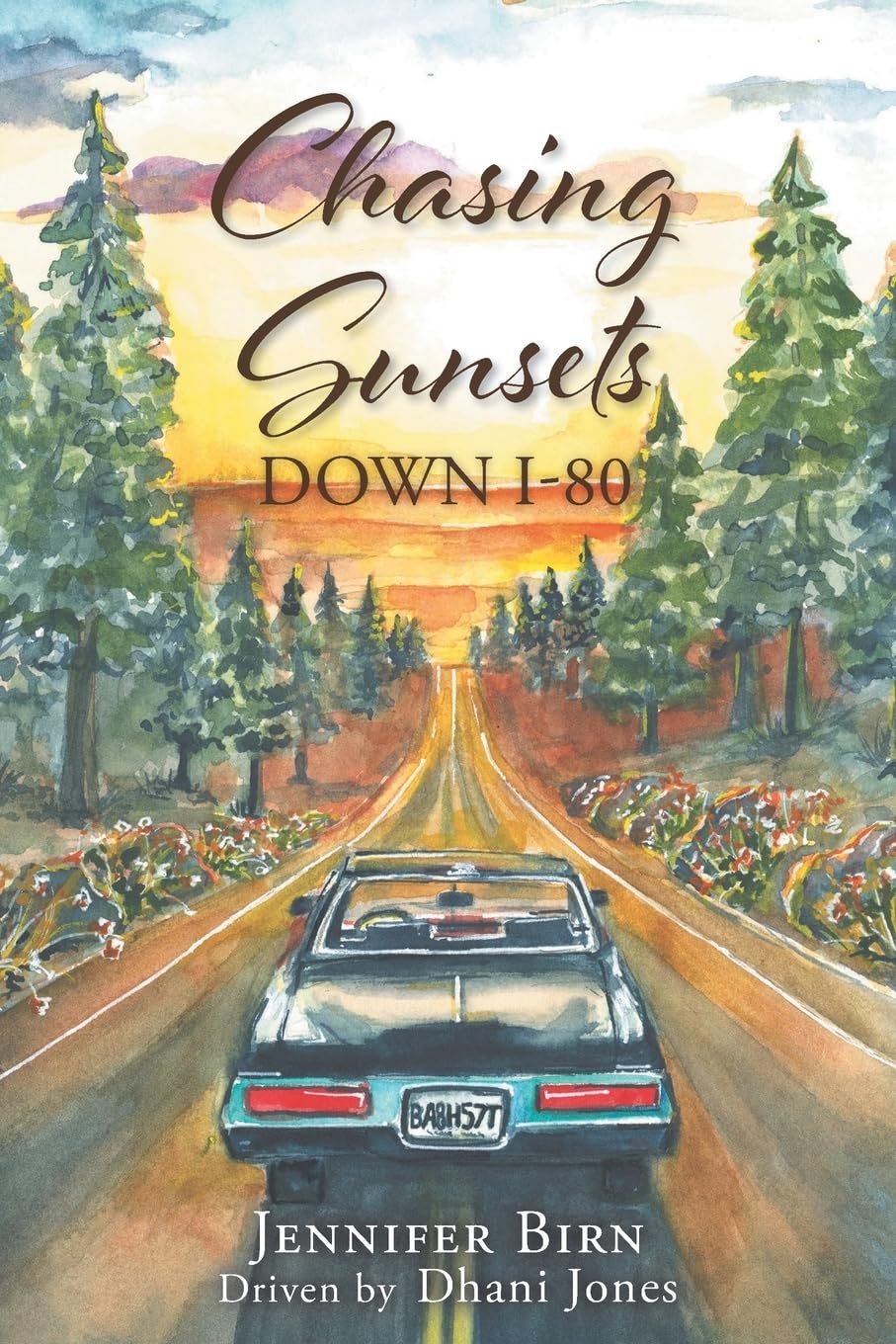
Chasing Sunsets Down I-80
A granddaughter’s journey through inherited memories traces the love and resilience of a family shaped by the Holocaust.
Books worth discovering. Authors worth knowing.
One journey holds three generations of history, and every generation remembers a different road.
J.
Three Generations on the Same Road
Chasing Sunsets Down I-80, developed by Jennifer Birn with Dhani Jones, spans three generations of a family shaped by migration, survival and the long afterlife of history. Its premise reaches back to Frederic and Charlotte Rosenthal, Holocaust survivors who travel to the United States and begin rebuilding after the Second World War. It also belongs to their granddaughter Sarah Emma, whose conversations with a reporter named Liam open space for family stories that have not been fully understood. The title suggests physical movement, but the more interesting journey is between different generations’ versions of the past.
The authors anchor that larger subject in domestic choices rather than asking readers to view history only as a sequence of famous events. A family can cross an ocean and still carry fear across decades. A child can inherit advantages created by sacrifices she never witnessed, along with silences she struggles to interpret. The novel’s premise asks what happens when someone finally decides to investigate the emotional costs of a family story that once seemed settled.
Frederic and Charlotte Begin Again
Frederic and Charlotte arrive in America with little money and with their first child expected soon. The published synopsis gives their destination as Three Oaks, Michigan, and places their journey roughly a year and a half after the war’s end. These details give the novel’s historical strand an immediate emotional problem. Survival has not automatically produced security. The couple must imagine parenthood amid financial uncertainty, unfamiliar institutions and the lingering effects of catastrophic loss.
A responsible reading must distinguish the fictional Rosenthals’ experience from the experiences of all Holocaust survivors. There is no single immigrant story, and the violence of the Holocaust should not be reduced to motivational background for an American success narrative. The novel’s specific family becomes a way of contemplating choices people make under sharply unequal conditions. What does it mean to pursue ordinary happiness when ordinary life has already been shattered? The prospect of a child’s birth makes that question particularly urgent.
Sarah Emma as Listener and Storyteller
Sarah Emma occupies a later position in the family timeline. She can ask questions about people and decisions that formed her world before she was born. The description identifies her as recounting stories to Liam, a local reporter, giving the novel an interesting frame: remembrance becomes a conversation rather than an untouched archive. This invites readers to think about how every account is shaped by who tells it, who asks and which details are still available to be told.
The published author note indicates that Sarah Emma investigates long-buried family secrets after her mother’s death. Grief becomes a reason to revisit inherited knowledge. A person mourning a parent may discover that the family narrative contained omissions or contradictions, not necessarily because anyone intended harm but because silence can become a survival strategy. The book therefore joins a familiar mystery of identity with a gentler, more demanding question about whether knowing the truth will alter the way a person remembers those she loves.
What Secrets Do to Love
The retailer description identifies family secrets, class differences and many forms of love as central concerns. Those themes connect without collapsing into a single explanation. People can conceal difficult memories to protect children, maintain appearances or avoid reliving pain, but the same acts of concealment may leave future generations confused about their origins. Love can motivate both disclosure and silence. The narrative tension lies in the fact that good intentions do not guarantee harmless consequences.
Because the full plot is not established by the synopsis, it would be irresponsible to nominate a specific secret or describe a final revelation. The important feature of the premise is that an intimate investigation can rearrange assumptions about a family’s past. Sarah Emma must make room for relatives as complex people who lived under circumstances she did not choose. That complexity is more durable than any one twist. It offers the possibility of compassion without making every decision automatically excusable.
Geography as a Form of Memory
Interstate 80 in the title functions as more than an incidental road number. Roads connect places, and crossing them creates an opportunity for conversations in which one person remembers a landscape differently from another. Birn has described making a multi-day research drive with Jones to retrace the characters’ route. That detail helps clarify the book’s interest in movement as something both material and emotional. Locations can become prompts that reveal what official family accounts leave untouched.
The route also allows the novel to place private experience against changing American backgrounds. A journey between communities is never only about distance: it involves class, migration, work, aspirations and the ability to belong. In a three-generation novel, those concerns can change meaning as historical conditions change. A road is fixed enough to return to, yet every traveler brings different knowledge and needs. That makes the sunset image suggestive without requiring readers to invent symbolic scenes not documented in the source descriptions.
Collaboration and a Layered Narrative
Jennifer Birn and Dhani Jones are both credited on the book, and Birn has publicly described how their collaboration helped develop the story. Jones’s background in professional sports and business does not, by itself, determine the literary voice. What matters more is the deliberate pairing of research, travel and interest in lives connected across time. A multigenerational novel asks its creators to keep several emotional registers active: historical survival, later family relationships and a contemporary investigation into identity.
The possibility of different tones is part of the appeal. Moments of romance or pleasure do not erase the characters’ experiences of sorrow; grief does not mean the story must remain uniformly bleak. The broader structure offers room to examine how a family’s sense of itself is assembled from accounts that are incomplete, contradictory or surprisingly tender. Readers should assess how these strands work together in the novel, rather than assume its ambition automatically produces a seamless result.
For Readers of Family-Centered Historical Fiction
The book is positioned as both historical fiction and a contemporary love story. Readers who enjoy dual or multiple timelines, inherited secrets and protagonists trying to understand their parents or grandparents are the clearest audience. It may especially resonate with those interested in how migration stories are transmitted through families. Because Holocaust history is part of its premise, the narrative also calls for sensitivity and a willingness to distinguish imaginative fiction from primary historical testimony.
A productive reading question is how the book distributes emotional authority across generations. Does the contemporary narrator allow the past its own complexity, or does it become only an explanation for her present concerns? Another is whether love appears as romance alone or encompasses loyalty, sacrifice and the desire to protect someone from knowledge. These questions give readers a way to engage the novel’s ambition without requiring advance knowledge of its plot outcomes or private revelations.
The Past Is Not Finished with the Present
Chasing Sunsets Down I-80 offers a story in which a family may be geographically settled long before its history is emotionally settled. Frederic and Charlotte’s postwar beginning belongs to an earlier era, but Sarah Emma’s need to understand them shows that inheritance can arrive as questions as much as possessions. The novel invites reflection on how people honor difficult experiences without letting those experiences become the entire definition of a later generation. Memory here is a relationship requiring attention rather than an object one simply owns.
Birn and Jones’s road-shaped narrative presents different kinds of love as the ties that make such remembering worthwhile. Readers who take up the novel may encounter uncertainty, grief, tenderness and the surprise of newly understood family bonds. Its most lasting question is not whether every secret can be uncovered but what it means to listen responsibly to lives whose choices helped create one’s own. The journey down the interstate becomes a possible route toward that deeper form of recognition.
About the book.
Sarah Emma recounts the story of grandparents Frederic and Charlotte Rosenthal, Holocaust survivors who began rebuilding a life in postwar America, while speaking with reporter Liam.
Sponsored book feature. Research-based original commentary from public author, publisher, retailer or bibliographic sources; not a firsthand complete-book review. A cover placeholder will be resolved by the publishing automation.
Found a book worth opening?
Books worth discovering. Authors worth knowing.
Return to the Journal →