
Courting Freedom
As the American Civil War approaches, a Southern family’s move to Gettysburg tangles love, loyalties, and the demand for freedom.
Books worth discovering. Authors worth knowing.
For Emilie Prescott, the future is both a courtship and a historical reckoning.
B.
Gettysburg Before It Becomes a Symbol
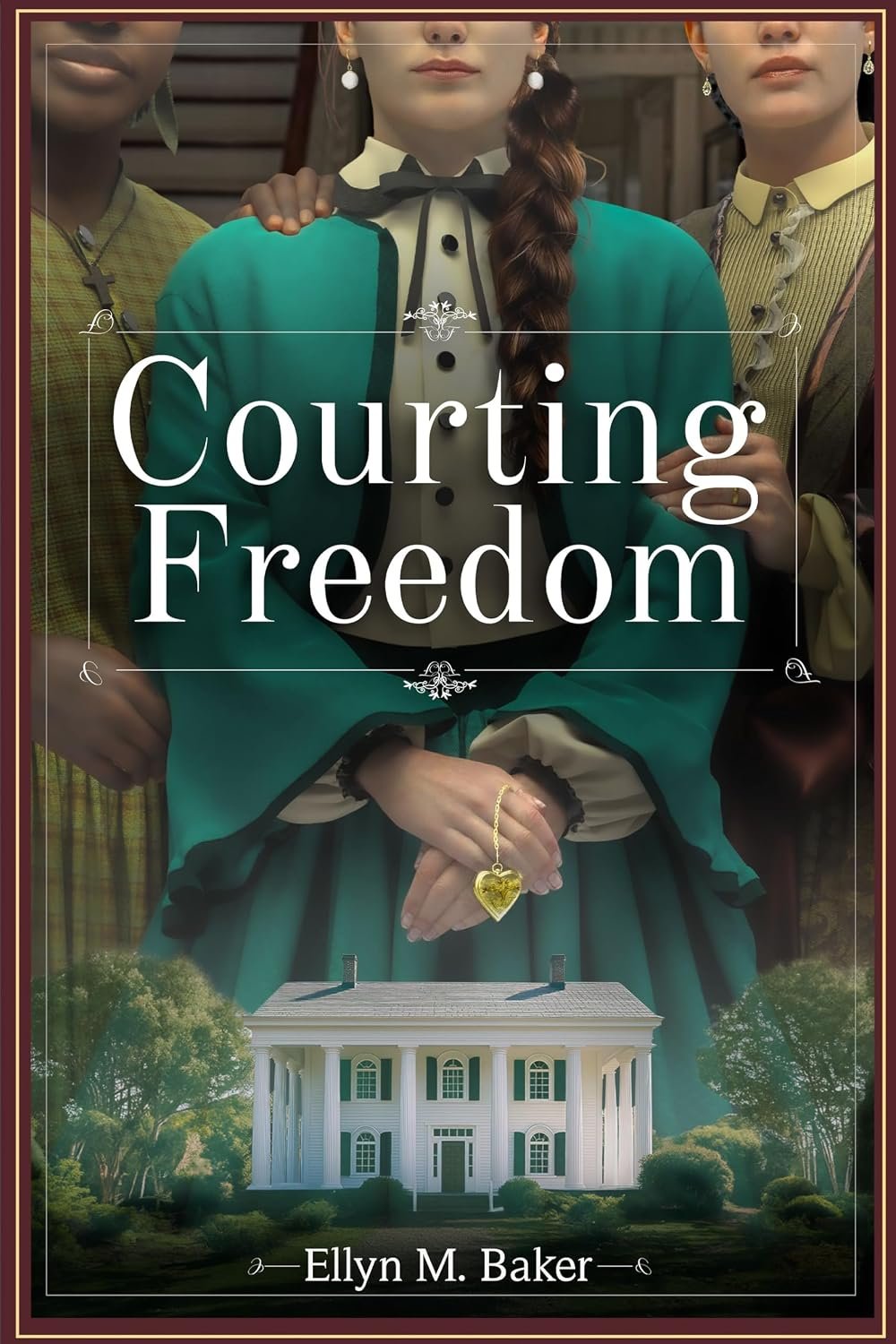
Ellyn M. Baker’s Courting Freedom begins in 1861, as Emilie Prescott and her family leave their Southern life and attempt a new beginning in Gettysburg, Pennsylvania. The setting matters because readers know that the American Civil War will soon transform lives far beyond the places where political decisions are made. The characters stand at the beginning of events whose full consequences are not yet visible to them. This gap between what a historical-fiction reader knows and what a character can foresee creates a distinctive form of suspense.
Gettysburg has become a powerful name in national memory, but the novel’s setup asks readers to imagine it first as somewhere people might choose to live. A household arrives with habits, allegiances and expectations that may no longer fit. Personal decisions unfold in a place that history will make famous. This helps explain the book’s combination of romance and conflict: falling in love is not separate from the atmosphere of impending war; it is one of the ways people discover what they value under pressure.
Emilie Prescott Between Two Futures
The publisher synopsis describes Emilie as pursued by two eligible bachelors, one she dislikes and the other she finds difficult to resist. The contrast signals a romantic choice but also opens a broader question of autonomy. Marriage in a nineteenth-century setting intersects with class, family expectations and the kinds of future a woman is allowed to imagine. A courtship can function as a negotiation between individual desire and the roles society considers proper. That makes attraction more consequential than a purely private preference.
Readers should be cautious about assigning moral qualities or plot outcomes to either suitor without the full narrative. The description establishes opposing feelings, not the precise character or destiny of the men involved. The stronger point is that Emilie’s decision-making takes place in a world beginning to challenge its political foundations. If the title is taken seriously, freedom is not simply something armies fight for. It is also something people weigh when they consider whom to trust and how to shape their own lives.
A Southern Family Moves North
The Prescott family’s move from the South to Pennsylvania introduces a geographical and moral tension. Crossing a regional boundary does not automatically make a household free of the assumptions and loyalties it brought along. A family may change residence more quickly than it can change its understanding of law, race or social obligation. In a Civil War novel, that tension makes the domestic setting a place where the national conflict is already present before armed confrontation arrives.
This setup invites readers to question easy narratives about regional identity. The people in either region are not interchangeable, and the existence of some characters who resist a prevailing view does not erase the institution of slavery or the human consequences of its defense. Historical fiction has the responsibility to render conflict understandable without creating a false moral equivalence between enslavement and emancipation. The novel’s promise is to bring that atmosphere into contact with particular lives rather than present only broad historical labels.
Voices Beyond the Main Romance
The series description points to multiple perspectives, including people formerly enslaved who follow the Prescotts toward new circumstances. This feature is essential to the book’s advertised scope. If the title invokes freedom, a narrative that considered only the marriage choices of privileged characters would offer an incomplete vision. Enslaved and emancipated people were not background scenery in the Civil War; their lives and actions were central to the conflict and its meaning.
Readers can pay attention to how these characters are granted perspective, goals and choices rather than treated simply as instruments in another family’s moral awakening. The available synopsis does not specify their names, individual histories or final destinations, and this feature does not invent them. Still, their presence changes what the title might mean. A courtship story set near the outbreak of war becomes a wider examination of whose freedom is constrained by convention and whose is denied by violent law.
Love Amid the Language of Duty
The novel’s advertising emphasizes duty, desire and patriotism, terms that can sound noble until characters must decide which obligations conflict. Loyalty to family may not align with loyalty to country; affection may cross a divide that political allegiance tries to enforce. Military service can be framed as honor by one character and as a threat by another. Historical fiction becomes most interesting when those words are not simple labels but competing claims people must evaluate under circumstances they cannot control.
The romantic material offers a human-scale testing ground for such contradictions. A person might admire courage while disagreeing with the cause for which it is displayed. Desire might persist where practical judgment urges caution. Baker’s premise suggests that intimate and political commitments are continually shaping each other. Readers should look for where the text distinguishes principled responsibility from inherited custom. The answer may emerge less from declarations than from the consequences of choices made when a safer path is unavailable.
The War’s Approach as Narrative Pressure
A novel beginning in 1861 can use the audience’s awareness of later events to create dramatic irony. Characters discuss possibilities without knowing how severe the coming conflict will become. A move intended as fresh opportunity may place them in a different kind of uncertainty. Historical dates are therefore not just scenic decoration; they determine the urgency with which decisions must be made. People who postpone reckoning with an injustice may discover that history has narrowed their room to avoid it.
Yet a historical novel should not be judged only by how many famous events it incorporates. The value of a domestic narrative can lie in showing how war changes meals, friendships, prospects and ordinary confidence about tomorrow. Public events become personal through disruption. The reader can approach Courting Freedom expecting a prewar atmosphere in which emotional commitments and political positions carry greater weight than characters may initially realize, without assuming any unverified battle scene or final resolution.
Audience and Historical Responsibility
Readers who favor historical romance, family sagas and multiperspective Civil War fiction will find clear reasons to consider the first Cause Love & War novel. Its premise offers courtship and movement between regions alongside emancipation and the gathering violence of war. Those interests can coexist, though their treatment should be assessed carefully. A romance situated amid slavery cannot ethically reduce the suffering of enslaved people to an attractive period backdrop. Historical imagination should make the scale of those stakes harder, not easier, to dismiss.
A useful way to read is to examine whose decisions receive the most attention and whose lives are altered by choices they did not control. The phrase ‘court freedom’ may suggest that freedom must be pursued; the story’s historical context reminds readers that it has also been denied, demanded and defended at immense cost. Holding both levels in view allows romantic tension to deepen rather than displace the novel’s historical questions.
The Meaning of Courting Freedom
Baker’s title joins an intimate word, courting, to a public and moral ideal, freedom. That pairing defines the book’s central promise. Emilie must imagine a personal future while living amid a national crisis that forces people to declare where they stand. Others confront restrictions that extend far beyond the romantic possibilities available to her. The story’s advertised multi-voice structure could allow those strands to question one another, making a more demanding portrait of the period than a single love triangle would produce.
The material available publicly establishes the opening circumstances, not every character arc or outcome. What remains clear is the invitation to see freedom as something contested in homes as well as on battlefields. Readers drawn to emotional historical fiction may find that the book’s most searching questions concern responsibility: what one owes to family, to a loved person, to a country and to people denied the choices others take for granted. Those questions give the first volume its enduring historical resonance.
About the book.
Set in 1861, the first Cause Love & War novel follows Emilie Prescott and her family from the South toward Gettysburg, with competing suitors and perspectives on emancipation and war.
Independent editorial book feature. Research-based original commentary from public author, publisher, retailer or bibliographic sources; not a firsthand complete-book review. A cover placeholder will be resolved by the publishing automation.
Found a book worth opening?
Books worth discovering. Authors worth knowing.
Return to the Journal →