
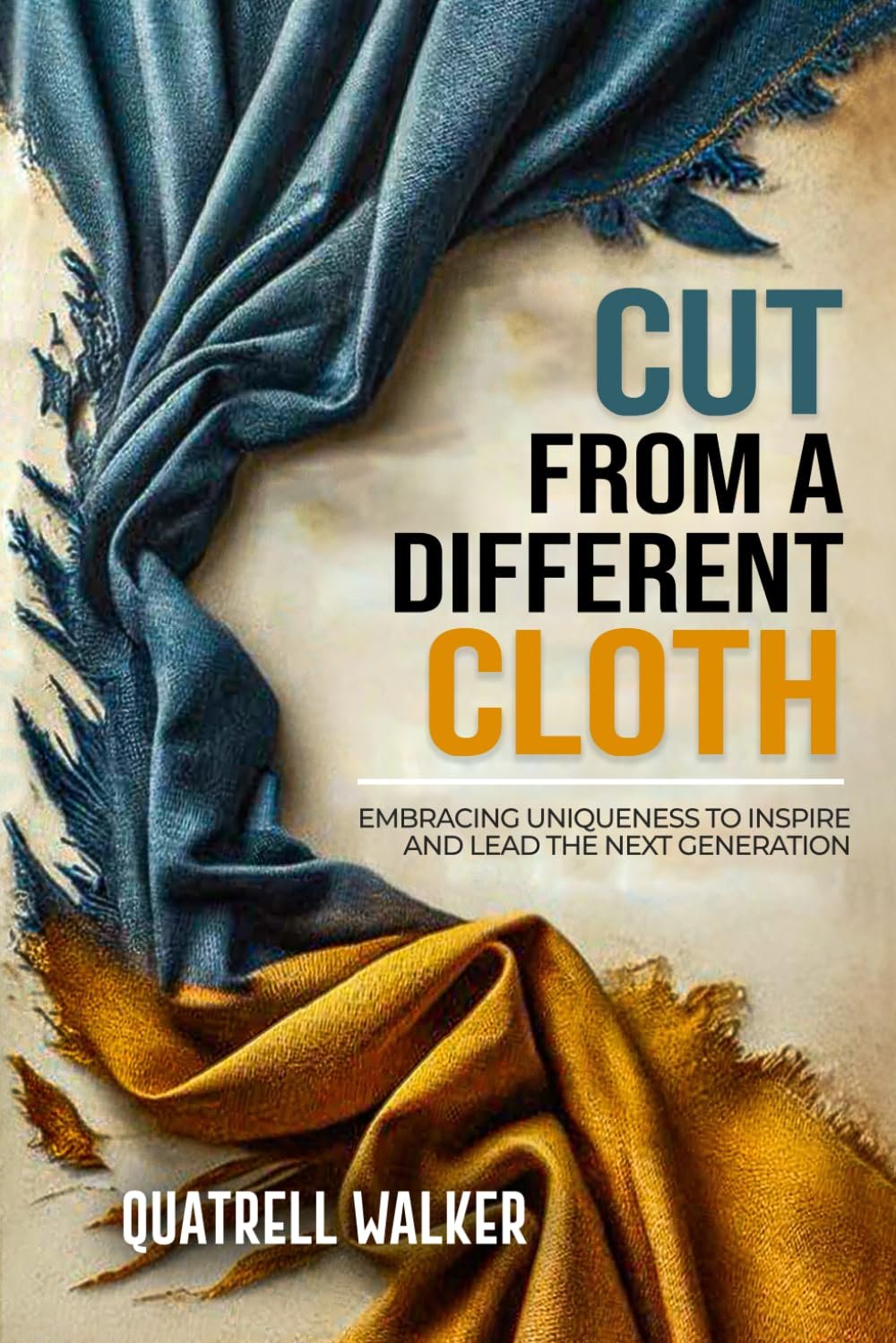
Cut From A Different Cloth: Embracing Uniqueness To Inspire and Lead The Next Generation
A practical invitation to treat difference as a strength, with modest goals, resilient habits and responsibility to people who follow.
Books worth discovering. Authors worth knowing.
Difference is often discussed as a personal advantage only after someone has already succeeded. Before that point, standing apart can feel lonely, risky or simply inconvenient. Quatrell Walker's Cut From A Different Cloth addresses the less glamorous work of figuring out what distinguishes a person, building confidence around it and using that understanding to shape a meaningful direction. The public book description frames the subject as an achievable practice rather than an inborn gift. The title sounds like a declaration; the material described underneath it is concerned with the habits that make such a declaration useful.
An editorial introduction to the book and its published premise, not a full-book review.
A guide built around direction, not a single breakthrough The published account of *Cut From A Different Cloth* describes a guide to identifying long-range goals and taking practical steps toward them. That emphasis matters because ambitions can be both motivating and paralyzing. An inspiring destination does not automatically tell someone what to do tomorrow morning. By linking a large vision with smaller wins, Walker offers a recognizable starting structure: a reader can pay attention to progress that is visible now without pretending the entire path has become clear. Nothing in the available description suggests a guaranteed system or a universal timetable, and the book is better introduced without either promise.
The language of uniqueness changes the usual question posed by self-improvement books. Instead of asking only how a person can imitate a successful example, the title asks what should remain distinct even as that person learns from others. This is an editorial reading of its stated premise, not a quotation from its chapters.
Small victories and the problem of momentum One of the topics specifically named in the public synopsis is recognizing short-term victories. Progress rarely feels dramatic while it is occurring. A conversation handled differently, a task completed despite uncertainty or a promise kept to oneself can be too modest to command attention. The value of naming such changes lies not in treating each as a triumph of equal importance, but in making a developing pattern easier to see. The synopsis suggests that Walker's approach considers these incremental signs alongside long-term ambitions, rather than making patience and action competing ideas.
A book centered on next-generation leadership also invites a second way of looking at small wins. A young person observing a mentor may learn more from how that mentor handles an ordinary setback than from a speech about grand achievement. Consistency is visible. So are apology, revision and follow-through. The stated themes do not establish that Walker provides these specific examples, but they offer a useful lens for anyone weighing the book's relevance to classrooms, mentorship or personal development.
Risk without the mythology of recklessness The official description mentions calculated risks and moving outside one's comfort zone. The word calculated does essential work. Risk can be glamorized as a heroic leap, particularly in motivational language, while the less cinematic tasks of preparation and judgment receive little attention. Framing risk as something considered allows a reader to ask what could be lost, what could be gained and whose lives might be affected. A decision that is brave for one person may be unnecessarily disruptive for another. This distinction keeps the invitation to grow from becoming a demand to gamble.
The same principle applies to failure. Walker's summary characterizes setbacks as potential steps in a process of improvement, a hopeful interpretation rather than a claim that difficulties are automatically valuable. Some losses teach a clear lesson; others require rest, assistance or a new plan. Readers can approach the material most constructively by looking for methods that allow reflection, rather than expecting every obstacle to yield a tidy moral. Resilience is not demonstrated only by pushing forward.
Support systems and the shape of leadership Another explicitly described thread is leaning on a support system. That makes the phrase *cut from a different cloth* less isolated than it might initially sound. Individuality does not require an audience of one. Someone can pursue an unconventional direction while seeking advice from people with different experiences. Support can offer encouragement, challenge a flawed assumption or provide a practical resource. The book's public positioning places growth in relation to other people as well as to internal confidence, a useful corrective to the idea that accomplishment is achieved by willpower alone.
The subtitle extends this outward movement: embracing uniqueness is presented as a means to inspire and lead the next generation. The emphasis is not merely on possessing confidence but on what confidence enables someone to give. A person who knows why they make particular choices may become better able to explain those choices without requiring everyone else to imitate them. That is a plausible leadership application of the public premise, not a report of a case study inside the book.
Gratitude, confidence and transitions The book description names gratitude and confidence alongside adaptation to change. These qualities are sometimes placed in separate self-help categories, yet they can complement one another. Gratitude helps a person recognize existing resources and relationships. Confidence makes it possible to attempt something not yet secured. Adaptation is the bridge between them: circumstances change, and what worked at one stage may no longer work at the next. A useful growth guide can invite readers to hold these ideas together without assuming that a positive attitude removes external constraints.
The phrase 'trust the process' appears in Walker's public description. Taken carelessly, it can sound like an instruction to accept whatever happens. Taken thoughtfully, it suggests the importance of evaluating progress over time rather than judging a whole effort by a single day. Readers might ask what indicators they need to track, whom they trust to offer honest feedback and when perseverance should give way to a change of tactics.
Who may find the book relevant The material is positioned for people seeking direction, moving through challenges or wanting to rekindle enthusiasm for a goal. Its connection to youth inspiration also makes it potentially interesting to teachers, community mentors and leaders interested in the example they set. Those readers should consider whether they want motivational framing, practical prompts or detailed evidence-based instruction. The public listing establishes Walker's topics but does not provide a table of contents or enough chapter-level material to assess how extensively each subject is developed. That boundary is important for any honest recommendation.
At roughly 94 pages in a retailer's paperback listing, the work appears designed to be approachable rather than encyclopedic; edition details should still be checked before purchase. The appeal of the premise lies in moving the reader away from a false choice between being original and being disciplined. Distinctiveness need not oppose routine, and goals need not erase identity. The question the book raises most clearly is not how to be unlike everyone else at every moment. It is how to recognize one's strengths, act on them consistently and make that example useful to others.
About the book.
A goal-setting guide emphasizing short-term victories, calculated risk, support systems, gratitude and resilience.
Non-sponsored Book Feature based on the queue record and cited public materials; this is not a full-book review. Interpretive observations are distinguished from the publicly documented synopsis. Verify all copy before publication. Source research: primary reference and second reference.
Found a book worth opening?
Books worth discovering. Authors worth knowing.
Return to the Journal →