
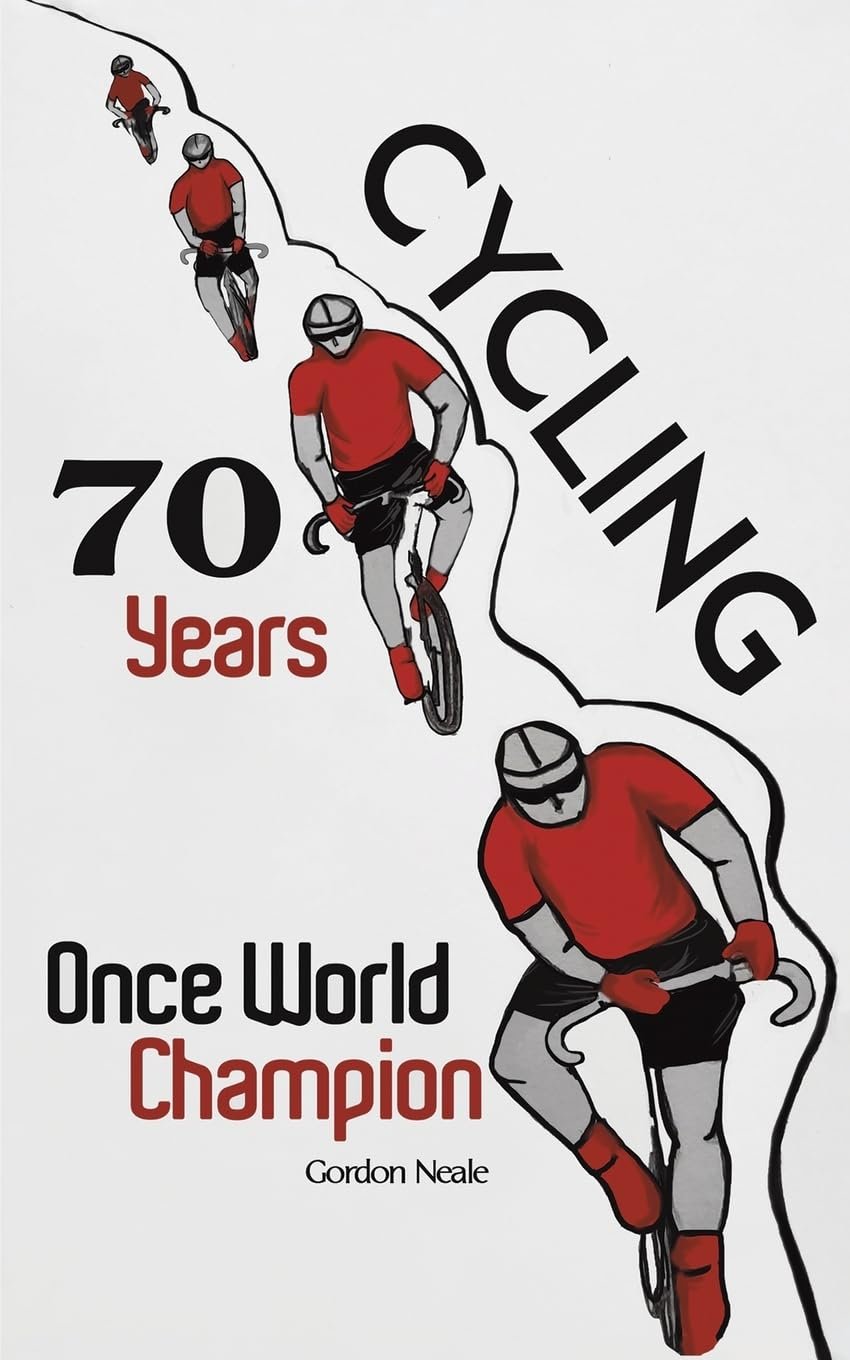
Cycling 70 Years: Once World Champion
Gordon Neale recounts decades of cycling across Europe and beyond, from early French races to a senior world title in Russia.
Books worth discovering. Authors worth knowing.
Gordon Neale recounts decades of cycling across Europe and beyond, from early French races to a senior world title in Russia.
Gordon Neale’s Cycling 70 Years: Once World Champion begins from an exceptional span of lived experience.
A Lifetime Measured in Miles
Gordon Neale’s Cycling 70 Years: Once World Champion begins from an exceptional span of lived experience. He recounts decades moving through competitive cycling, club culture, international travel and professional work beyond the sport. His own book website and independent reviewers identify racing in France, Spain and Britain, later journeys to South Africa and Russia, and a senior world championship as landmarks along the way. But the title is not only a claim about longevity or a single victory. It suggests how cycling can become a structure for remembering places and people. A ride gives a traveler a route, a pace and an unusually close view of landscape. Over seventy years, those routes accumulate into something resembling a private atlas. Readers do not need to understand gear ratios or specialist race classifications to recognize the memoir’s human premise: a person repeatedly returns to an activity that has shaped friendships, work, travel and identity across radically changing periods of life.
Following Tom Simpson to France
Neale’s published outline describes traveling in the footsteps of British rider Tom Simpson to Saint-Brieuc in Brittany around 1960. The period matters because competitive cycling was becoming a serious international pursuit for young riders prepared to leave familiar surroundings. France was not merely a tourist destination; it offered clubs, races and routines that demanded physical and social adaptation. Neale’s recollections are rooted in the people he met and the infrastructure of cycling at the time. His book website lists early French racing in detail and refers to surviving race programs that helped reconstruct the chronology. Such evidence is significant in a memoir composed decades after the events. Memory can preserve vivid impressions while misplacing dates, and a careful writer benefits from documents that anchor recollections. The reader receives not only an adventure story but the opportunity to see how a sporting life is reconstructed from both remembered experience and the fragments of paper that survived it.
Club Life and a Changing Sport
The author’s account includes years with amateur clubs and a variety of road-racing contexts. For readers new to competitive cycling, the club is an important part of the story. It provides training partners, rivalries, practical expertise and a network through which riders learn the unwritten habits of the sport. A race result records a time or position, but it cannot capture the conversations during travel or the responsibilities people assume for one another. Neale’s memoir reportedly contains plenty of names and local references, which independent reviewers regard as both a strength of authenticity and a challenge for readers unfamiliar with the scene. That tension is worth stating. The density of remembered detail may delight enthusiasts looking for a record of their era while slowing someone seeking a streamlined narrative. The book’s achievement as testimony is different from the promise of a tightly edited history; it offers the proximity and particularity of one participant’s many experiences.
From European Roads to Distant Competitions
Descriptions of Cycling 70 Years extend beyond familiar European training routes. Neale writes of riding and racing in South Africa during the pre-Mandela era and of taking a senior world championship in Russia. Those journeys connect sport with distinct historical settings, but a feature should not pretend the cycling memoir is a comprehensive account of either country’s politics. It is one traveler’s perspective, filtered through competitions, people met and movement between venues. That limited viewpoint can still be illuminating. A race may be measured by universal rules, yet every location supplies a different set of customs, material conditions and personal encounters. The memoir’s geographical range also complicates the idea of a sporting career as a straight ascent toward a trophy. Decades of participation include changing fitness, shifting priorities and opportunities that arise through travel. The eventual title of champion is striking, but its meaning depends on the broad life that precedes it.
Mallorca, Work and the Business of Cycling
Neale’s story includes a financial-services career and the organization of cycling training camps in Mallorca. The combination is revealing because it shows that athletic identity need not disappear when professional responsibilities change. Rather than treating the years beyond peak racing as an empty epilogue, the memoir describes building opportunities for other riders and turning accumulated knowledge into shared experiences. Mallorca’s climate and roads made it an attractive environment for training, and Neale’s author biography emphasizes his involvement in camps there over many years. Organizing them would have required skills very different from pedaling fast: schedules, relationships, logistical planning and the patience to help groups with varied abilities. The description suggests a life in which cycling became both an occupation’s companion and a means of connecting communities. Readers who have watched a hobby transform into an organizing principle for travel or work may recognize a familiar trajectory on a far larger scale.
A Pilgrimage on Two Wheels
Among the unusual episodes described by the book website is a four-day cycling pilgrimage from Albufeira in Portugal to Fátima. The destination is famous as a pilgrimage site, and the route introduces a different register from competitive racing. A pilgrimage may still involve physical difficulty, but its meaning is not exhausted by arriving fastest. Neale presents the journey humorously, with attention to characters and a distinctive ceremony at its conclusion. The available accounts do not establish every stop or anecdote, so this feature leaves them to the original book. The episode is important as evidence of the memoir’s range. For someone who has raced through landscapes, cycling can also become an occasion for social connection, personal reflection or playful adventure. The same machine enables serious competition and unhurried discovery. That versatility helps explain why the author’s relationship with cycling persisted for so many decades without being confined to the pursuit of results.
Memory, Editing and the Honest Record
Independent assessments of Cycling 70 Years are not uniformly celebratory. BookLife praised the wealth of historical cycling material while criticizing aspects of editing and organization in an early edition. Self-Publishing Review likewise recognized the memoir’s spirit and memorable detail while identifying tangents and uneven prose. Those assessments matter because a responsible feature should not erase criticism merely to sound encouraging. Neale himself acknowledges on his website that the book was initially written largely from memory and that the original edition needed better proofreading. He reports a reproofed reprint made available in July 2025, although some sellers may still carry older copies. That edition distinction is useful for prospective readers. A memoir’s authenticity and a book’s editorial finish are separate considerations, and different readers will weigh them differently. What remains distinctive is the author’s effort to preserve experiences that might otherwise survive only in scattered programs, photographs and stories told among cyclists.
An Open Road Beyond the Podium
Cycling 70 Years: Once World Champion will appeal most obviously to riders, cycling historians and readers interested in European sporting culture, but its geographic and personal breadth reaches further. Neale’s memories touch on ambition, travel, work, aging and the changing form of a lifelong passion. The most persuasive reason to explore the book is not that every anecdote will be familiar or every page perfectly shaped. It is the possibility of hearing a participant explain what it felt like to move through decades of sport and society on two wheels. Readers who enjoy precise historical record should be aware of the memoir’s memory-based method and edition history; readers who welcome conversational reminiscence may find that part of its charm. This research-based feature is grounded in the author’s website and independent reviews, not a claim of firsthand full-text criticism. The book offers a long road, an unusually broad cast of encounters and a reminder that the most important journeys rarely end at the finish line.
About the book.
Cycling memoir, sports history and European travel. Gordon Neale recounts decades of cycling across Europe and beyond, from early French races to a senior world title in Russia.
Editorial book feature, not paid sponsorship. Independent research-based commentary based on publicly available book details; not a claim of first-hand full-text review. The designated cover placeholder will be resolved by the owner’s publishing automation.
Found a book worth opening?
Books worth discovering. Authors worth knowing.
Return to the Journal →