
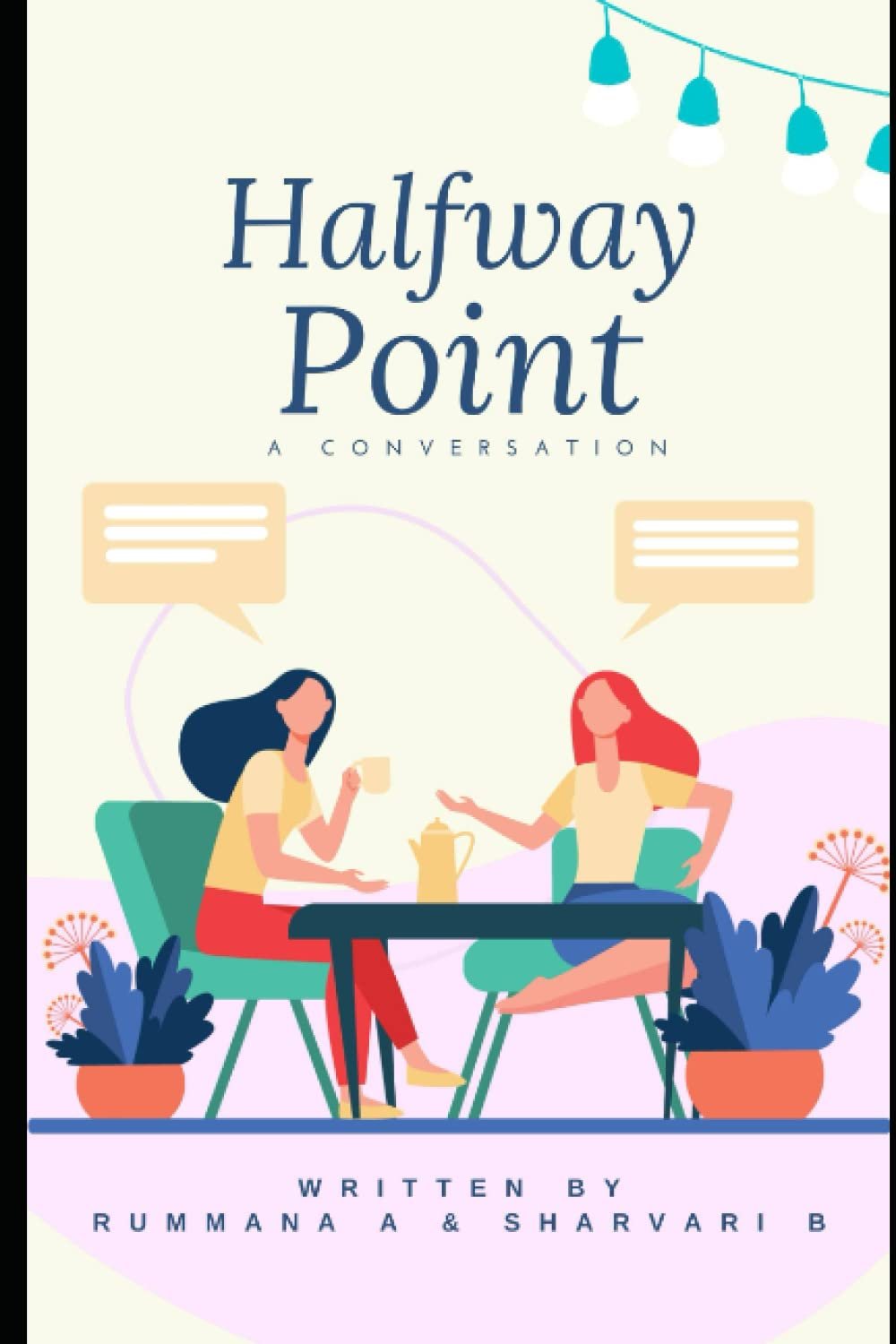
Halfway Point
Two longtime friends turn a milestone birthday into frank questions about middle age, friendship and the futures they still hope to make.
Books worth discovering. Authors worth knowing.
Two longtime friends turn a milestone birthday into frank questions about middle age, friendship and the futures they still hope to make.
R.
The Milestone Nobody Can Rehearse
There is a particular kind of conversation that tends to arrive around a milestone birthday. It begins innocently, with practical observations about work, health, family and plans for the coming week. Then an unexpected question interrupts the ordinary sequence: how did the years pass so quickly, and what should happen with the ones still ahead? *Halfway Point*, credited to Rummana A and Sharvari B, grows out of precisely that unease. In a published interview the two writers trace its beginning to a major birthday, a shift in how they were talking about middle age, and the recognition that a long friendship could make difficult introspection less lonely. The premise is not a dramatic event. It is the decision to take familiar conversations seriously enough to preserve them.
The authors’ interview makes their method especially interesting. Instead of dividing a subject into chapters and assigning one writer the work of explanation, they exchanged questions at the end of the day. Each friend responded, and the exchange created new questions in turn. That is a structure worth pausing over. A person’s instinctive answer often changes when it has to meet another person’s different experience. A question about whether life has been successful, for instance, is not simply a search for an objective tally. It may reveal what someone once valued, what she now regrets, or which ambitions have quietly become less important. The dialogue format allows such contradictions to remain visible rather than being polished away.
Two Voices, One Unfinished Conversation
Friendship is a central part of the book’s documented origin. The interview does not describe an impersonal co-writing arrangement; it describes women who have known each other long enough to recognize habits, strengths and blind spots. Even so, the writers say that discussing their bucket lists and imagining what a detective might learn by interviewing their neighbors disclosed unexpected things about one another. That small admission makes the project distinctive. Intimacy does not automatically mean complete knowledge. People become familiar with a friend’s routines while still carrying private hopes, unspoken fears or changing understandings of themselves. A genuine conversation is capable of reopening those spaces.
The questions also offer a welcome alternative to the relentless advice culture around midlife. Many books treat forty as a deadline for reinvention or a last opportunity to optimize work, finances and fitness. *Halfway Point* is described more modestly, as two people reconsidering the past and wondering about the future. That does not mean the subject lacks urgency. Time remains finite; choices still have consequences. But urgency need not produce a ten-step manifesto. It can prompt better listening, a clearer admission of uncertainty, and the ability to say that a previously desirable goal no longer fits. Readers may find the book’s central invitation in the act of asking, not in obtaining a single perfect answer.
The Value of Asking About Ordinary Life
The authors have said that their exchanges became more introspective, at times even grim, as they thought about mortality and the changes of middle age. Their response was neither to deny that seriousness nor to settle permanently into it. Humor, curiosity and playful prompts appear alongside the harder material, judging by their account of the writing process. This balance matters because reflection is sustainable only when it leaves space for the absurd details of daily existence. A funny question about what the neighbors would say can tell us something essential about reputation. A bucket list can reveal the tension between the adventures we imagine and the responsibilities we actually choose.
A reader need not share the writers’ age to recognize the mechanism. Every life contains moments when an old identity becomes inadequate: a first child leaving home, a changed career, a relationship ending, a parent growing frail, or simply discovering that an imagined future no longer inspires excitement. The book’s conversation-based format offers a practical model for such transitions. Ask what has altered. Ask which assumptions are still useful. Ask whose approval has mattered more than it should. These are questions prompted by the documented subject of *Halfway Point*, not a claim that each appears verbatim on its pages. The distinction preserves the integrity of a feature based on an interview rather than a full-text reading.
Writing as a Form of Friendship
The collaborators also describe learning how much a routine helps a shared project. If either writer worked alone, ideas might stall or get postponed; a second person supplied momentum and accountability. The daily exchange of questions became a small creative discipline. For readers curious about collaborative writing, that origin story makes the book more than an account of aging. It is evidence of how a relationship can become a literary form. Each person contributes not only material but a reason for the other person to keep thinking. The finished work, in that sense, is shaped by a conversation that neither individual could have produced in isolation.
It would be a mistake to assume that the book delivers universal answers about happiness or purpose. The writers explicitly present their views as personal, according to the interview, and describe the final version as a cleaned-up presentation of what they already thought and discussed. That honesty is a virtue. Readers approach reflective nonfiction from different families, economic circumstances and cultural expectations; a book about midlife need not pretend those differences disappear. Its value may instead lie in making readers more willing to host a similar conversation in their own lives, whether with an old friend, a sibling, a partner or themselves through a journal.
The Questions That Travel Home
One of the gentler pleasures of a book like this is that it can continue after the reading has stopped. Consider asking a longtime friend what ambitions have become less important since you first met. Consider exchanging honest descriptions of a day you would choose if work and obligation briefly disappeared. Consider discussing whether you would rather be admired by many people or understood by a few. None of these activities requires a correct answer. They create a way to notice how people are changing while there is still time to know those changes. The authors’ own surprise at what they learned about each other suggests how fruitful this can be.
The title *Halfway Point* itself is best understood as a metaphor, not an actuarial prediction. No person can know how much life remains. But an imagined midpoint can still supply perspective: what would deserve more attention if the future were not infinitely expandable? The concept can feel severe until it becomes practical. A conversation today can repair a distance that might otherwise grow. A creative project can begin without waiting for a more convenient season. A friend can discover that another friend is not quite the person she thought she knew. That is an inviting understanding of midlife rather than a frightening one.
For readers who enjoy personal essays, dialogue-led reflections and writing about friendship, Rummana A and Sharvari B’s project offers a grounded starting point. The available interview confirms a distinctive process, a specific life-stage catalyst and an unusually collaborative voice. It does not justify inventing episodes or claiming firsthand familiarity with every chapter. What can be said with confidence is enough: *Halfway Point* makes the ordinary practice of talking honestly with someone who knows you into a subject worthy of a book. In an age that prizes public reinvention, it also honors the quieter possibility of being understood while you are still figuring yourself out.
About the book.
A conversational, searching book about two friends asking each other questions after a milestone birthday, including bucket lists, mortality, and what it means to reach midlife.
Editorial book feature, not paid sponsorship. Independent research-based commentary using publicly available descriptions and author material, not a claim of first-hand full-text review. The cover placeholder will be resolved by the owner’s publishing automation.
Found a book worth opening?
Books worth discovering. Authors worth knowing.
Return to the Journal →