
The Love of Time
An intergenerational meeting opens a time-travelling story about what a life can hold.
Books worth discovering. Authors worth knowing.
An intergenerational meeting opens a time-travelling story about what a life can hold.
Research-based literary perspective on a verified edition.
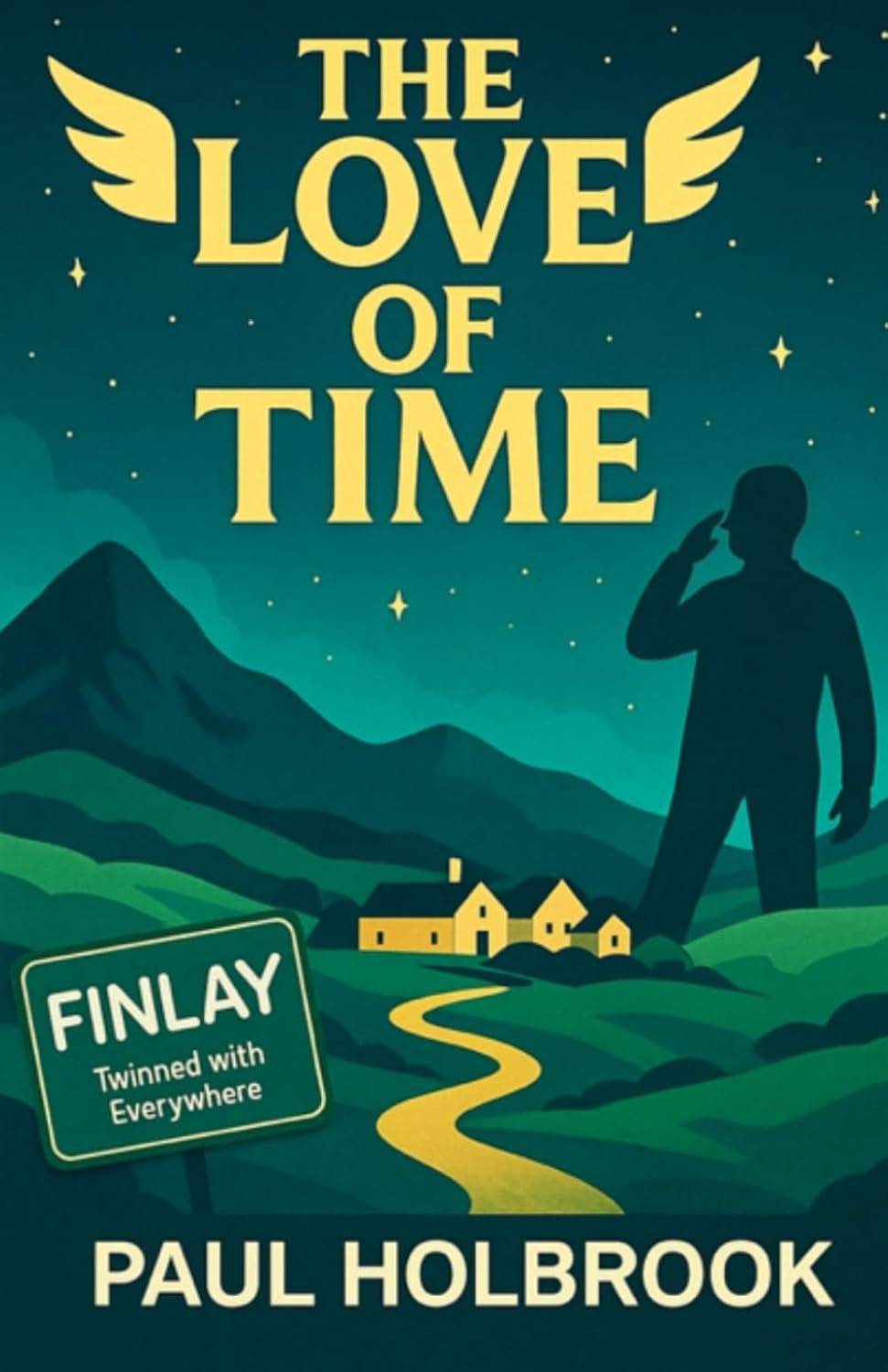
What if the most startling person in a small retirement community were someone who had already lived through a thousand years? Paul Holbrook’s The Love of Time begins with Sophie Pratman volunteering in a Highland retirement village, where an elderly resident named Amelia Hawke confounds ordinary expectations. Amelia claims an age measured in centuries and presents the possibility of time travel and borrowed lives. The publisher’s description leaves room for doubt: is Sophie speaking to an extraordinary witness of history or to an old woman whose stories cannot be believed literally? That uncertainty is a generous opening for a novel advertised as mixing dark humour, fantasy, history and the endurance of love.
A fantastic claim in an ordinary setting
The retirement village matters because it is a place where time has a visible social presence. People encounter the accumulated effects of ageing, memory, companionship and loss there in a way that hurried public life often conceals. Setting an improbable claim within such an environment makes the premise feel especially pointed. We are accustomed to hearing older people tell stories about worlds that younger listeners cannot imagine. Amelia’s extraordinary assertion pushes that familiar gap toward fantasy: what if the distance between generations were not a few decades but an entire millennium?
Sophie’s volunteer role gives the encounter an ethical dimension. A volunteer is there to offer company and assistance, not to verify a historical miracle. Listening well may require curiosity without immediate judgement, while safeguarding another person’s dignity may require resisting easy assumptions. The source description does not tell us how Sophie resolves these concerns, and it would be wrong to assign her reactions beyond the confusion it reports. The basic situation nevertheless invites readers to think about the difference between believing a story and taking its teller seriously. Sometimes an act of attention comes before certainty.
Time travel as more than a mechanical puzzle
Many time-travel stories invite questions about paradoxes, alternate histories and the rules governing movement between eras. Holbrook’s description emphasizes something different: the lives one might experience, borrow or carry, and the way love survives across them. This does not mean the novel has no mechanics; the available materials simply do not establish their detail. Its advertised emotional centre concerns what a very long life might do to memory and desire. A person with centuries of experience could acquire extraordinary knowledge, but she might also accumulate losses that resist tidy explanation.
The familiar fantasy of gaining more time assumes that added years would solve the problem of scarcity. Yet a story about a thousand-year existence can reverse that assumption. What if a nearly inexhaustible span makes each farewell harder to comprehend? What if the challenge is not living long enough to meet someone, but learning how to value those encounters without making them instruments of a search? These are interpretive questions opened by the description’s emphasis on love and death, not an invented catalogue of Amelia’s experiences.
Humour as a form of perspective
The public synopsis calls attention to dark humour and gives Amelia a self-mocking way of describing herself. That combination is a useful reminder that serious subjects do not demand unrelieved solemnity. Mortality can be frightening, but the conventions of fantasy permit readers to approach it indirectly, through absurdity, surprise and a character who appears untroubled by the need to sound respectable. Comedy can make room for ambiguity. A person who jokes about her own story may be telling the truth, obscuring it or simply refusing to perform certainty for an audience.
Humour is particularly effective across generations when it unsettles expectations about who is knowledgeable and who is naïve. Sophie might seem positioned to help an elderly resident navigate contemporary life; Amelia’s supposed history makes that division radically uncertain. The premise allows the younger and older characters to meet as fellow interpreters of an unusual situation, rather than merely as giver and receiver of care. Whether the dialogue sustains that promise is for readers to discover, but the setup carries a refreshing potential for two-way learning.
Love measured against history
The description explicitly blends the transcendence of love with journeys through centuries and worlds. This creates a different emotional scale from a romance limited to one season or location. Social customs change; ideas about work, marriage, identity and freedom may change with them. If someone carries attachments across such transformations, the meaning of devotion cannot remain entirely static. A historical fantasy can use these contrasts to ask how much of love belongs to the person and how much to the assumptions of the period in which that person lives.
It is also worth resisting the assumption that endurance proves the purity of an attachment. Longing can sustain a person, but it can become a way of avoiding the present. The phrase “love of time” holds that ambiguity beautifully. It might refer to devotion surviving time, to affection for the strange gift of being alive, or to the act of learning to let time pass. The public materials do not authorize a definitive reading. They do, however, invite readers to think about whether the most meaningful form of lasting love could involve change rather than an impossible preservation of the past.
The reader’s place beside Sophie
An effective fantastic narrative often works through a viewpoint character who must decide how much to accept. Sophie’s initial confusion can provide a bridge for readers who are not yet prepared to enter Amelia’s world. The story’s promise is not necessarily that every mystery will be resolved at once. In fact, premature certainty could drain the premise of its charm. A listener can be intrigued by what is impossible, skeptical about what sounds contradictory and moved by the human feeling underneath both responses.
This balance also helps distinguish fantasy from a mere collection of unusual events. The miraculous is most interesting when it changes how someone regards ordinary life. A retirement village is full of unremarked histories; an apparently impossible biography may teach Sophie to look more closely at the lives around her. That is an editorial possibility, not a reported plot conclusion. Readers can test it by asking whether the novel’s time-travelling elements deepen its present-day relationships rather than simply providing spectacular excursions.
Who may want to read it
The Love of Time is likely to appeal to readers who enjoy speculative premises with an intimate human frame: time travel, memory, a dash of mystery and humour that makes space for difficult feelings. Those drawn to stories about ageing and companionship may find the retirement-village setting especially appealing, while historical-fantasy readers may enjoy the advertised journeys through eras and lives. A reader expecting a strictly rules-driven science-fiction account of temporal mechanics should examine a sample before deciding; the description places love, mortality and character ahead of a technical explanation. It may also interest book clubs prepared to discuss whether listening requires belief and how a relationship changes when one person’s experience seems impossibly vast.
Holbrook is credited as author on the verified listing, and its public description supplies the central situation without establishing the full journey. This is therefore a sponsored, research-based introduction rather than a personal verdict. Its most appealing promise is a simple, unsettling invitation: allow an apparently ordinary conversation to rearrange everything you thought you knew about the length and shape of a life.
About the book.
An intergenerational meeting opens a time-travelling story about what a life can hold. The purchase link preserves the original listing in the queue.
The book is designated as a sponsored feature in the MarketAnyBook queue. This article is an original research-based introduction, not a firsthand review; editorial interpretation is identified as such. Sources comprise publicly available publisher, retailer or bibliographic descriptions and the verified queue and cover; detailed interior content has not been independently examined.
Found a book worth opening?
Books worth discovering. Authors worth knowing.
Return to the Journal →