
Drafting Differences
A love story about two writers can make the act of composition part of the romance. Ginette Guy Mayer’s Drafting Differences brings together Sherry Evans, a.
Books worth discovering. Authors worth knowing.
A love story about two writers can make the act of composition part of the romance. Ginette Guy Mayer’s Drafting Differences brings together Sherry Evans, a.
Evidence-conscious literary criticism, not a claim of firsthand full-text reading.
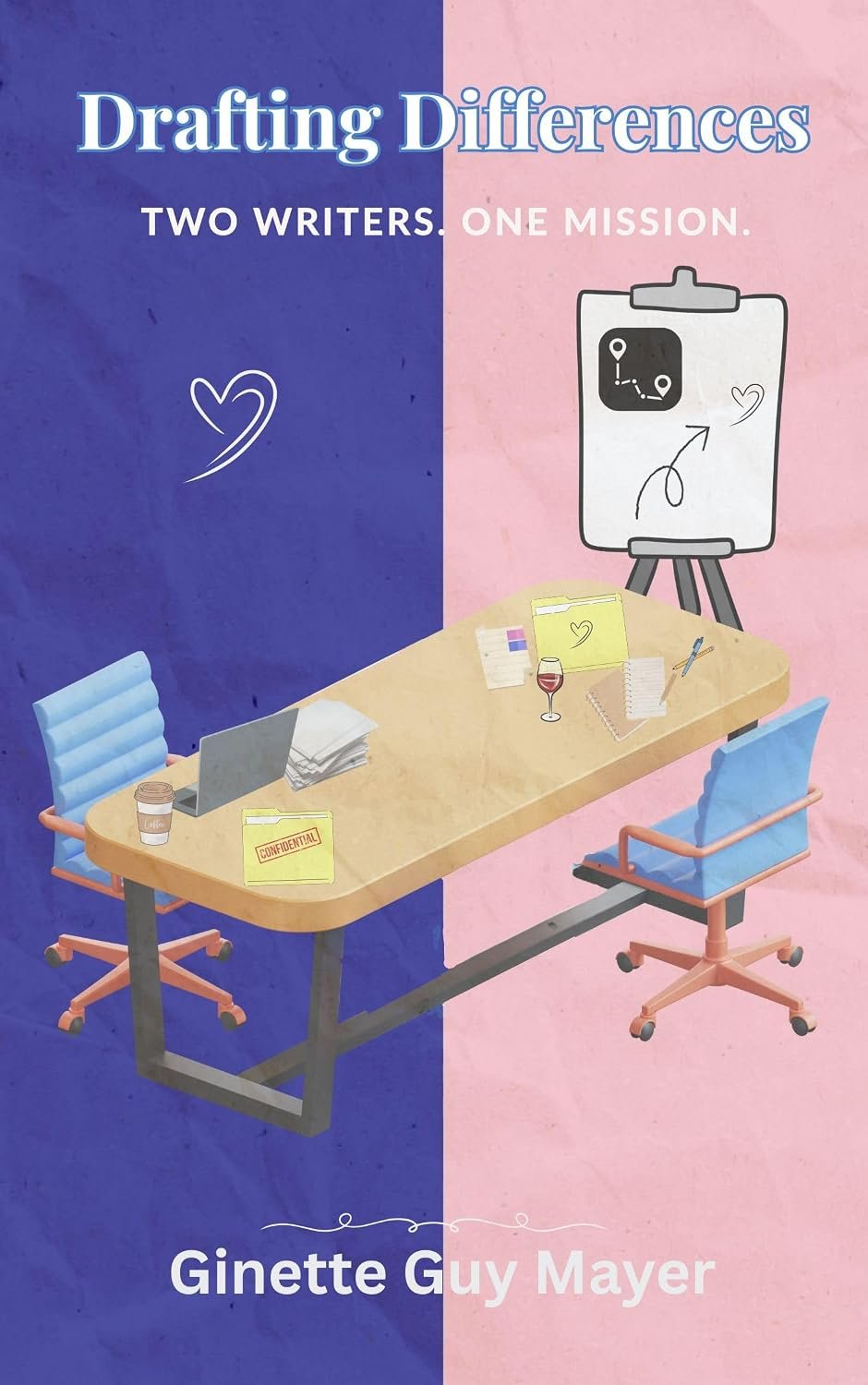
A love story about two writers can make the act of composition part of the romance. Ginette Guy Mayer’s Drafting Differences brings together Sherry Evans, a bestselling romance novelist whose working life depends on control, and Peter Cook, a thriller writer drawn to chaos and dramatic openings. Their literary agent arranges a collaboration; a writing retreat turns professional disagreement into close-quarters negotiation. The premise is neatly self-aware: two people must learn how to make a shared story while discovering they cannot fully outline what is happening between them.
Two genres at the same desk The published synopsis defines Sherry through careful outlines and the expectation of happy endings, Peter through improvisation and explosive beginnings. That opposition has an obvious comic surface, but it also represents two different responses to uncertainty. Sherry makes plans in order to manage it; Peter appears to turn uncertainty into creative fuel. Neither approach is automatically superior. Their partnership can become compelling if it makes room for mutual revision rather than merely forcing one temperament to yield to the other.
Making the characters professional writers allows the book to stage arguments about form inside ordinary dialogue. A scene involving a deadline can also become a scene about emotional risk; disagreement over a plot may reveal personal fears about trust. Yet metafictional cleverness can grow overly neat. If every piece of writing advice doubles as a romantic lesson, the characters risk feeling like demonstrations rather than people. The best test of this material is whether their personalities survive the conceit instead of serving it.
Collaboration as intimate work The book’s description locates much of the emerging closeness in an enforced retreat, where late-night brainstorming and arguments change the working relationship. Forced proximity is a familiar romance device, but a professional collaboration gives it a distinctive reason to exist. Writers must reveal imperfect ideas before they are ready; they have to accept criticism without retreating into wounded pride. A shared manuscript creates a space in which vulnerability can be practical before it becomes emotional.
A romance built on that arrangement has to take the labour seriously. Creative partnerships involve questions of credit, authority and compromise. Who gets to decide when a scene is finished? What happens when a collaborator’s instinct threatens the very qualities the other values? Although the summary does not document particular negotiations, those are the kinds of pressures that would make the working relationship credible rather than decorative. A writing retreat can be a charming setting; it should also produce genuine creative stakes.
Later-life affection without condescension The book explicitly identifies itself as a later-in-life second-chance romance. That matters. Stories about mature protagonists can offer emotional experience without assuming that age makes people less capable of surprise, desire or foolishness. They may also make the stakes of trust sharper: habits have had years to harden and a professional reputation may feel too substantial to risk. The most generous second-chance romances allow adults to change without insisting that their earlier selves were failures.
The supplied synopsis introduces further professional pressures—online controversy, publishing politics and an unexpected screen deal—that threaten the relationship. Those elements appear to move the conflict beyond the retreat into questions of public identity and private loyalty. The danger for the book would be to overburden a modest, character-led romance with contrived industry crises. Its opportunity is to show that love becomes more consequential when the outside world has something to lose from the partnership.
When a profession becomes a metaphor The image of writers editing one another’s ideas is particularly well suited to an adult romance because it avoids pretending that people meet without previous drafts of themselves. Both Sherry and Peter arrive with habits, ambitions and reputations. To collaborate, they may have to decide which principles are essential and which are merely defensive routines. That distinction matters in love too. Compromise is not the dissolution of personality; a strong partnership should make both people more recognizably themselves rather than creating a convenient blend.
The agent’s decision to pair them also places the collaboration inside a commercial setting. Books are artworks and products, with all the awkwardness that double identity creates. A professional deadline can undermine the fantasy of unlimited time to discover feelings, while publicity can make a personal conflict seem like a marketable story. The reported social-media controversy and film-deal pressure therefore offer more than decorative contemporary details. They could test whether the pair values honest private work more highly than a public narrative built around success.
The value of a mature lead Later-life romance has room for consequences that youthful love stories often postpone. Professional identity can be difficult to change after years of investment; personal independence may be a genuine achievement rather than a barrier to be removed. The synopsis presents Sherry’s desire for control with comic affection, but it would be reductive if the story treated her discipline as a defect to be corrected by Peter’s spontaneity. His preference for chaos might be creatively liberating, yet it could also place burdens on a collaborator. The most balanced version of this romance would allow each approach both its virtues and its costs.
This is also why the metaphor of rewriting has limits. A person is not a manuscript over which a partner should claim editorial rights. The appealing version of change is mutual and chosen. A novel about authors should be especially alert to whose voice receives the final word—and whether partnership means learning to listen rather than learning to win.
For readers of an earned happy ending This is an appealing premise for readers who enjoy mature romantic leads, creative workplaces, verbal sparring and a slower-burn emotional arc. The public descriptions position it as a closed-door romance, a useful expectation for anyone choosing between degrees of explicitness. Readers drawn to fast-moving action or a large-scale plot may find its professional and interpersonal concerns more intimate than they prefer.
Our appraisal relies on the documented synopsis, not on a full reading of the manuscript. Drafting Differences offers a tidy thematic question: can two people accustomed to having the final word learn to write something neither could control alone? The author has given herself a promising structure, and the book’s success would depend on allowing the answer to feel discovered rather than drafted in advance.
About the book.
The title, contributors, routing category, original retailer link and unique Drive image file were checked against the live queue. The review is based on publicly available evidence and original editorial analysis.
This is an unsponsored editorial book review. This research-based critical review interprets the verified book listing and available external descriptions; it does not claim a complete reading.
Found a book worth opening?
Books worth discovering. Authors worth knowing.
Return to the Journal →