
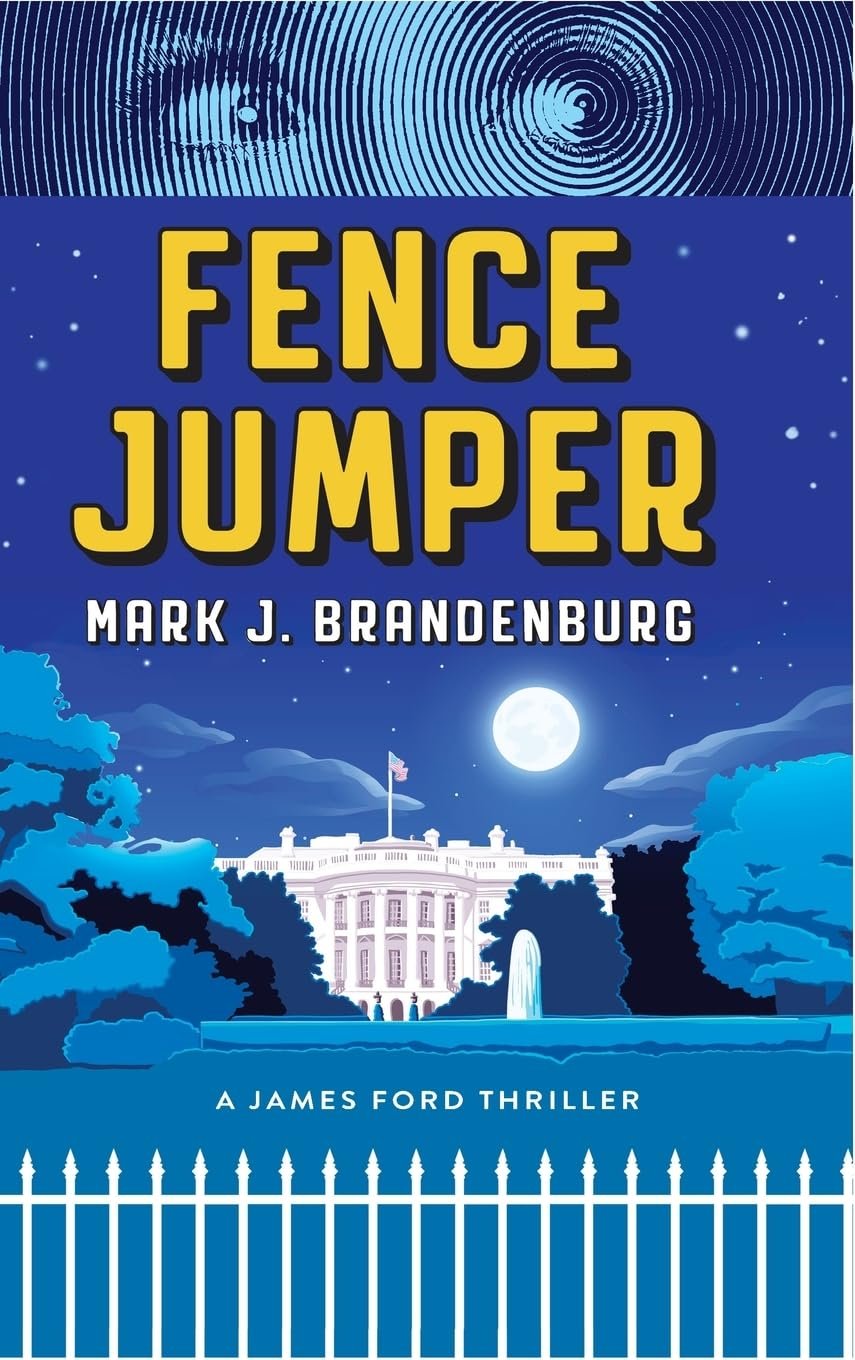
Fence Jumper: A James Ford Thriller
A suspended Secret Service agent encounters a senator’s allegedly kidnapped wife in Mark J. Brandenburg’s satirical political thriller.
Books worth discovering. Authors worth knowing.
A suspended Secret Service agent encounters a senator’s allegedly kidnapped wife in Mark J. Brandenburg’s satirical political thriller.
Original editorial introduction, grounded in the verified book edition and public descriptions.
An apparently kidnapped woman becomes the person who explains the danger rather than merely suffering it. That reversal gives Mark J. Brandenburg's Fence Jumper: A James Ford Thriller its central charge. The published synopsis identifies James Ford as a Secret Service agent suspended after an international sex scandal. He encounters the wife of a senator seeking the presidential nomination, and she claims her own husband intends to have her killed. From there, the pair confront political intrigue and increasingly dangerous adversaries. The setup combines an unreliable public reputation, a desperate private allegation, and the spectacle of people competing for national power.
A compromised protector
A Secret Service agent is associated with discipline, trust, and the protection of public officials. Ford begins the story under a cloud, suspended because of his involvement in a scandal. That detail immediately complicates the conventional thriller hero. The reader knows he has lost institutional standing, and the people he might need to convince could have reasons to distrust him. The synopsis does not specify the exact details of his misconduct or the agency's internal proceedings, so there is no basis to invent either. What the premise establishes is the tension between professional experience and diminished credibility.
A hero with a damaged reputation can be effective because he cannot simply rely on official authority to solve a crisis. If he hears a claim about a senator's wife facing lethal danger, he must decide what to believe and how to act when his own position is uncertain. Those stakes create narrative pressure beyond personal redemption. It is possible for someone who has behaved badly to recognize a threat accurately; it is also possible for a person desperate to restore status to misjudge a situation. The source leaves those questions open, allowing readers to follow the conflict rather than accept a predetermined verdict.
The woman at the center of a political lie
The published description says the senator's wife has been presented as kidnapped but tells Ford that her husband plans to kill her. That reversal raises questions about who controls a public story. In a campaign, private events can become instruments of persuasion, and a frightening account may benefit someone other than the person placed in danger. The book's setup therefore seems interested not only in violence but in the machinery of image and reputation. Readers might consider how the difference between what a nation is told and what individuals know can generate suspense.
The wife should not be described as powerless or deceptive beyond what the synopsis verifies. She provides the crucial allegation that draws Ford into the affair, making her an initiating figure in the mystery. Her credibility and her reasons are matters for the book to develop. The same is true of the senator: the promotional summary reports his alleged plan and places him among the political forces involved, but a feature should not invent new crimes or courtroom outcomes. Respecting the limit of the description preserves the story's ambiguity and lets its eventual revelations carry their own weight.
Conspiracy with a satirical edge
Retail and publisher descriptions refer to conniving senators, murderous Russian agents, and the wider maneuvering of Washington's elite. These are genre elements, not evidence about actual public officials or real-world espionage operations. The author explicitly positions the book as a political thriller with humor and satire. That blend matters because a purely grim conspiracy can make everyone in a story seem similarly sinister. Satire creates another way to examine powerful figures: exposing vanity, absurdity, performance, and the gap between public dignity and private behavior.
Humor can make the machinery of power appear both ridiculous and dangerous. The reader may laugh at someone's self-importance while still recognizing the consequences of the choices being made. A thriller featuring compromised political actors is especially suited to that double response. The source materials do not identify particular jokes or comedic scenes, so the claim should remain about the book's advertised tone. But readers can expect a premise that does not treat the solemn language of official Washington as beyond question. The question is how quickly a clever public story can conceal a genuinely lethal one.
Trust inside a fast-moving plot
When two people enter a danger they cannot address through ordinary channels, their ability to trust each other becomes crucial. Ford and the senator's wife are described as an unlikely duo, and that phrase carries useful tension. One has professional experience but a scandal-shadowed record; the other appears to possess insider knowledge but faces an extraordinary threat. Neither can assume the world will accept the story they tell. The synopsis makes it plausible that they must investigate while being pursued, although no particular chase, clue, or escape sequence should be invented here.
A political thriller can generate suspense from information as much as from physical pursuit. Which documents or testimonies would convince others? How can a person assess a warning when the potential conspirators have greater public influence? Who is safest to approach when institutions may be compromised? These are critical questions suggested by the setup rather than a list of events known to take place in the novel. They help explain why the premise is distinctive: the protagonist's tarnished legitimacy and the woman's contested status make the search for truth inseparable from the struggle to be believed.
Who is likely to enjoy Fence Jumper?
Fence Jumper is aimed at readers who like political conspiracy thrillers but welcome irreverence alongside danger. Its publicly documented ingredients include a suspended Secret Service agent, a senator's threatened wife, a presidential race, Russian operatives, and a Washington power structure presented with satirical intent. Readers who prefer purely procedural realism should know that the description foregrounds escapism and humor as part of the experience. Others may appreciate a protagonist who is already damaged before the main crisis begins. Content-specific warnings or promises about the book's final plot twists cannot be established from promotional descriptions alone. The secure recommendation is for audiences interested in intrigue where public reputations may be as carefully constructed as the alleged conspiracy.
What lies behind the performance?
The most persuasive thriller questions often concern not merely whether the protagonist survives but whether the institutions surrounding him deserve trust. Ford's fall from favor, the senator's public ambitions, and the woman's alarming testimony place that question at the heart of the story's opening. Brandenburg's advertised use of satire suggests the novel intends to examine Washington with a mischievous eye, even as lethal danger raises the stakes. This original feature has relied on verified bibliographic and publisher descriptions, not on an invented firsthand reading. The resulting invitation is straightforward: follow a compromised agent into a story where truth may be less politically useful than the fiction people are determined to sell.
About the book.
A suspended Secret Service agent encounters a senator’s allegedly kidnapped wife in Mark J. Brandenburg’s satirical political thriller. Public bibliographic details have been distinguished from editorial interpretation.
Independent editorial feature: this is a source-based introduction, not a firsthand review of the complete book. Bibliographic descriptions and author or publisher statements are interpreted with clear source limits. The original purchase URL remains unchanged; WordPress cover media is added later by the owner’s publisher.
Found a book worth opening?
Books worth discovering. Authors worth knowing.
Return to the Journal →