
from Busy to Productive
Jaime Sauret offers a practical way to turn overloaded days into intentional work built on time, energy and focus.
Books worth discovering. Authors worth knowing.
The problem with being busy is that activity can hide the absence of progress.
S.
The Difference Between Motion and Progress
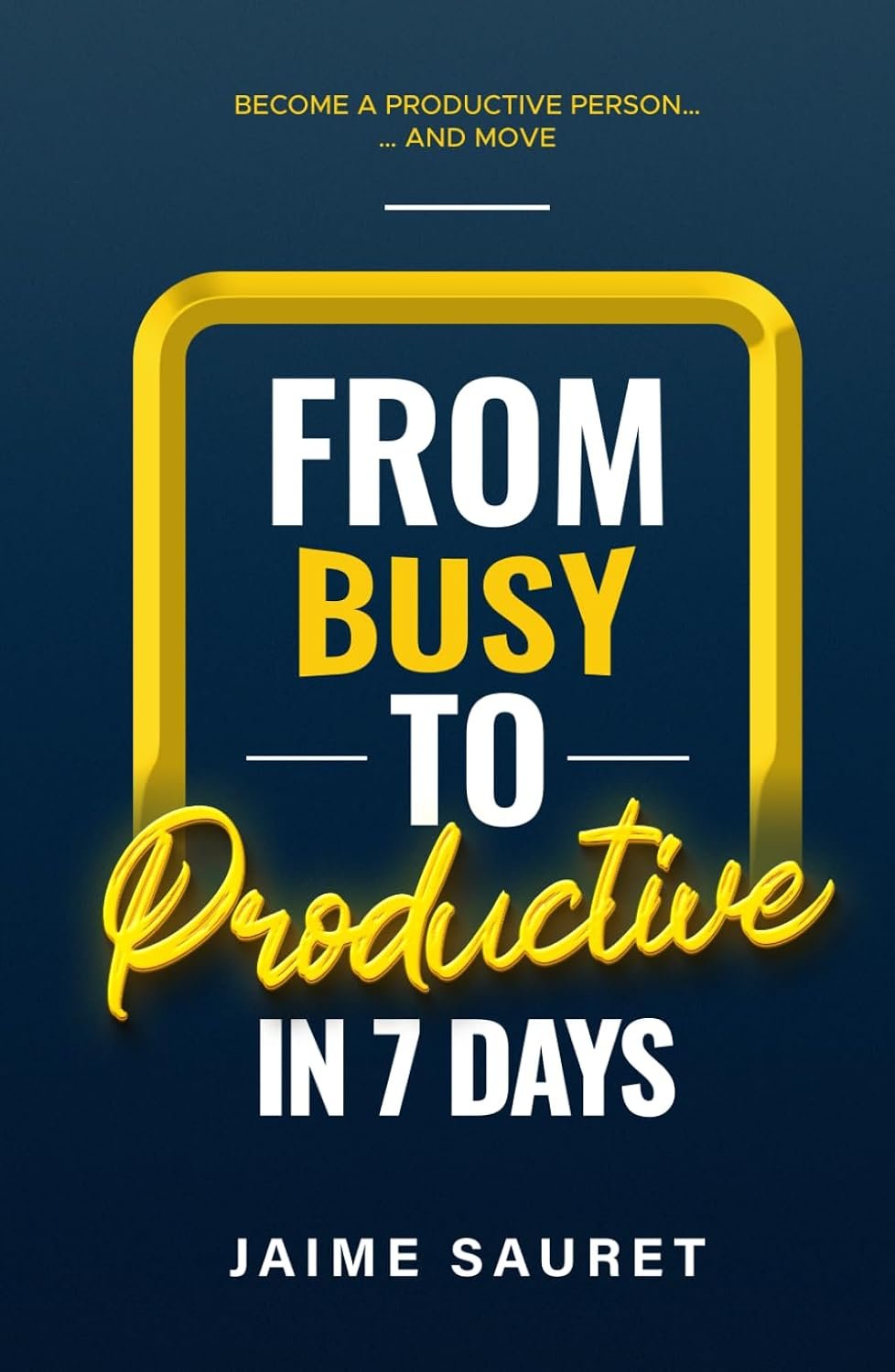
Jaime Sauret’s from Busy to Productive: in 7 days addresses an experience recognizable across many jobs: an exhausting day can end with little sense of having accomplished what mattered. Meetings, messages, urgent requests and a growing list of small tasks can create the feeling of constant activity. Sauret’s project begins by questioning whether activity is the right measure of a successful day. The title promises a short practical framework for regaining some control over attention, time and energy.
The strongest appeal lies in making productivity a question of choices rather than an identity reserved for unusually disciplined people. A person may be hardworking and still be pulled into work that does not align with important priorities. The problem is not always motivation; it can be the organization of obligations, the absence of protected focus and expectations that make every request seem equally urgent. The book invites readers to become more intentional about that pattern.
Time Is a Resource, Not a Trophy
Sauret emphasizes managing time instead of simply filling it. That involves deciding in advance what needs a place on the calendar and recognizing that not every incoming task deserves an immediate answer. A to-do list can be reassuring while remaining ineffective if it treats a minor errand and an important project as equivalent entries. Productive planning asks a more discriminating question: which action would create the most meaningful movement, given the hours genuinely available?
The author has publicly recommended planning days and reserving calendar time for essential work. Readers can translate this into a modest experiment: choose one priority for tomorrow, assign it a realistic slot and note what interrupts that plan. The exercise is not a guarantee that interruptions will vanish. Some workers have little authority over their schedules, and family obligations can take priority unexpectedly. The deeper aim is learning where choice exists and using it deliberately rather than waiting for an imaginary empty day.
Energy Sets the Terms of Attention
The book’s public description treats energy as a core part of productivity. That is important because time alone is a poor predictor of what a person can accomplish. Two uninterrupted hours after a night of poor sleep may not equal two hours when someone is rested. A practical method should pay attention to the rhythms of concentration, physical limits and recovery. This makes breaks a part of effective work rather than evidence that commitment has failed.
Sauret’s advice to recharge during the day can be read as permission to abandon an unhealthy equation between relentless effort and worth. A person can protect demanding work for periods when concentration is stronger and reserve easier administrative tasks for times of lower energy. But energy is not endlessly adjustable through personal technique. Disability, illness, caregiving and working conditions all matter. The book’s framework is most useful when adapted to real circumstances, not imposed as a universal standard of optimization.
Focus in an Economy of Interruptions
Digital communication creates the illusion that availability is the same as usefulness. Someone can reply quickly to every message while leaving the task that required deep thought untouched. Sauret recommends resisting multitasking and removing distractions so attention can remain with the chosen priority. The advice sounds simple, but the difficulty lies in the social expectations surrounding instant response. Focus is both an individual habit and a boundary negotiated with other people.
One workable way to test the idea is to create a short period during which notifications are muted, the necessary documents are ready and the next action is clearly defined. Afterwards, notice not only what was completed but how often the mind tried to switch tasks. Such experiments help expose hidden friction. The goal is not a flawless concentration streak or a new reason for guilt. It is greater awareness of conditions that support meaningful progress, and the willingness to adjust those conditions where possible.
The Seven-Day Frame as an Invitation
A seven-day title creates urgency, but it should not be mistaken for a claim that a lifetime of habits can be transformed permanently in one week. A brief timeframe works best as a beginning: seven opportunities to observe, test and revise the way one works. Sauret’s stated emphasis on easy-to-implement principles makes this a reasonable reading. The point is to move from abstract aspiration to small actions that can produce evidence of what helps and what does not.
A reader might use the week to examine commitments, protect one important task each day, experiment with recovery breaks and review distractions. The exact sequence of exercises should come from the book rather than be invented in a feature. What matters about the framing is its accessibility. Instead of requiring a radical new lifestyle, it suggests that a person can learn something useful by treating an ordinary week as an opportunity to redesign a few decisions.
Growth Beyond a Better Checklist
Sauret’s workshop materials also refer to growth alongside time, energy and focus. Growth broadens productivity beyond completing today’s tasks. If people improve only their ability to process demands, they may become faster at work they never chose and remain no closer to a meaningful goal. A growth perspective asks what skills, relationships or projects deserve investment so the next month or year can differ from the last. Productive work should create capacity, not simply consume it.
This question is particularly relevant for people who feel that professional demands have crowded out personal ambitions. Learning, creative practice, family life and health may be important without appearing in an employer’s performance dashboard. A healthy method leaves room to consider them. Readers can evaluate the book by asking whether it helps define success in their own terms and whether the suggested tools make those priorities more visible in actual schedules.
Practical Advice Without Magical Thinking
Productivity writing can sometimes imply that every obstacle can be solved by individual willpower. Sauret’s publicly available advice is more useful when read as a set of tools than as an accusation against those who struggle. Calendars, reduced distraction and deliberate rest can improve working conditions; they cannot eliminate understaffing, impossible deadlines or financial insecurity. A person may become more organized while still needing structural support or a different allocation of responsibility. Recognizing that distinction preserves the dignity of work.
A reader might begin with the least burdensome change rather than overhaul every routine at once. Choose a useful practice, test it for several days and measure whether it frees attention for something worthwhile. Keep what works and discard what creates unnecessary strain. This is not skepticism about self-improvement; it is a way of making improvement honest. Small sustainable changes are more persuasive than claims of permanent reinvention after an especially motivated Monday.
Who Will Benefit from the Approach
The book is aimed at people who are tired of finishing a day exhausted and uncertain where their effort went. Workers in meeting-heavy roles, students juggling deadlines and people pursuing personal projects around paid employment may recognize the pattern immediately. Its practical framing suits readers who want a manageable entry point rather than an elaborate philosophy of achievement. The author’s experience running Busy to Productive workshops reinforces the book’s emphasis on usable techniques, though readers should still evaluate outcomes for themselves.
The most enduring idea is that a full schedule and a purposeful day are not interchangeable. A life can be crowded with obligations and still leave little space for what matters most. Sauret asks readers to reclaim some capacity to choose, to protect energy as carefully as time and to treat attention as something valuable. Even if no seven-day plan transforms every difficulty, that shift from constant motion toward deliberate progress is a substantial reason to consider the book.
About the book.
A seven-day productivity guide centered on purposeful time use, protecting energy, reducing distraction, and building a sustainable personal routine.
Independent editorial book feature. Research-based original commentary from public author, publisher, retailer or bibliographic sources; not a firsthand complete-book review. A cover placeholder will be resolved by the publishing automation.
Found a book worth opening?
Books worth discovering. Authors worth knowing.
Return to the Journal →