
Get Better
An ambitious coaching framework connecting biology, purpose, and daily life.
Books worth discovering. Authors worth knowing.
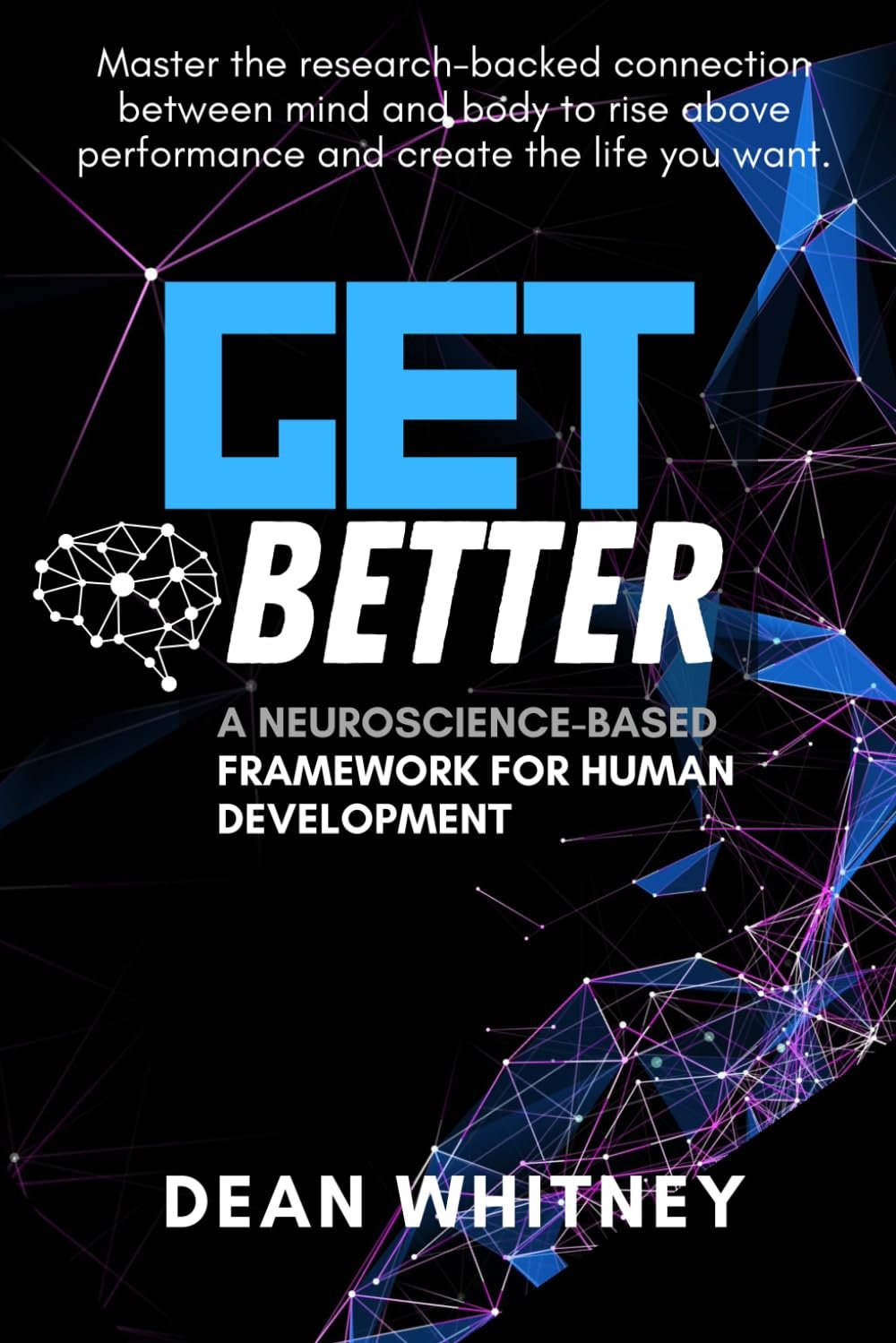
Dean Whitney’s Get Better proposes what its subtitle calls a neuroscience-based framework for human development.
An original critical assessment, grounded in verified public book descriptions.
Dean Whitney’s Get Better proposes what its subtitle calls a neuroscience-based framework for human development.
An ambitious attempt to organize change
Dean Whitney’s Get Better proposes what its subtitle calls a neuroscience-based framework for human development. On the author’s official site, it distinguishes the “Human” side of biological drives from the “Being” associated with purpose, and offers tools for examining calling, health, connection and resources. Its premise is not simply that people should set bigger goals. It suggests that the felt quality of a life can be studied through interacting habits, commitments and bodily responses. Such a broad synthesis may appeal to readers weary of self-help systems focused on a single behavior. The difficulty, inevitably, is proof. A compelling diagram can organize reflection without necessarily demonstrating a scientific mechanism; the book’s neuroscience language deserves the same scrutiny as any other empirical claim.
A useful distinction with a slippery edge
The contrast between Human and Being is rhetorically effective because it helps readers separate short-term reactions from considered values. Someone may intend to change yet repeatedly act according to older habits; naming the conflict can make it less mysterious. But the conceptual division can also mislead if biology is cast as merely an obstacle and deeper purpose as a wholly separate, superior self. Human motivation is not so conveniently partitioned. The advertised framework is therefore best read as a coaching model that draws on neuroscience language rather than as a settled description of the brain. The intellectual responsibility lies in distinguishing metaphor, psychological practice and well-supported scientific finding. That distinction does not make self-reflection less useful; it makes its claims more honest.
The four drivers and the difficulty of balance
Calling, health, connection and resources are sensible lenses through which to consider a life. They draw attention to the fact that success in one domain can coexist with serious deprivation in another. A weekly schedule full of productive work may still leave a person disconnected; satisfying relationships may be strained by inadequate resources. Whitney’s system reportedly includes a 168-hour planning framework and a named Transformation Management System. These devices promise to convert aspiration into more deliberate allocation of time. Their usefulness depends on whether they allow for unpredictability, care obligations, disability and inequality, rather than assuming every reader begins with equal freedom to redesign the week. A serious review should inspect examples and the author’s treatment of constraints before endorsing its universal reach.
Measurement can illuminate or narrow
A proposed “Life Quality Score” is especially interesting because numbers can make vague concerns discussable. A repeated self-assessment may reveal patterns that memory obscures. Yet the act of scoring introduces a false precision if a complicated life is treated as a single objective quantity. It also risks encouraging constant self-surveillance, the opposite of the contentment the system aims to support. The strongest version of the idea would use measurement as a prompt for conversation and revision, not as a moral ranking of human worth. The official material describes what is measured and how it is organized at a broad level; it does not establish that the score has been independently validated. Readers deserve that distinction when a book borrows authority from science.
Who might use the framework well?
Get Better is likely to suit readers comfortable with workbooks, reflective exercises and structured coaching approaches, especially those interested in translating personal values into concrete routines. It may be less suitable to readers looking for a clinically validated intervention or a brief primer on neuroscience. Its most valuable promise is integrative: the reminder that time, relationships, bodily experience and purpose cannot be responsibly treated as disconnected projects. Its largest critical vulnerability is the breadth of its scientific and transformational claims. With those caveats clear, it may offer a useful vocabulary for purposeful self-examination, but prospective readers should judge its methods by the evidence and practical flexibility in the book rather than by the authority of its subtitle alone.
A framework should survive a bad week
Systems of personal development often look most persuasive when applied to a highly motivated person with spare time and predictable circumstances. Their real test is messier. What does a 168-hour plan offer someone caring for a relative, recovering from illness or working irregular shifts? Can a scoring model register the value of rest that has no measurable output? Whitney’s broad categories suggest the possibility of balance, but the answers depend on the details of the program. A thoughtful reader should test the framework against ordinary disruption rather than adopting its diagrams as universal law. The advertised aim of lasting transformation is worth taking seriously only if the system accommodates fluctuation and failure without turning them into evidence of personal inadequacy.
The seduction of the scientific label
Neuroscience can illuminate habits, emotion and bodily response, but its vocabulary can also make coaching propositions sound more conclusive than the research allows. The book’s distinction between biology and purpose may be a useful teaching metaphor even if its categories are not standard scientific constructs. Similarly, an “objective” view of subjective experience is a claim that requires a careful definition of objective. A checklist can make reflection consistent while remaining grounded in personal judgments. None of this forbids readers from using the framework. It encourages them to use it intelligently: ask which claims are supported by studies, which are practical heuristics and which are philosophical choices. That habit may be one of the most constructive ways to read a book about getting better, because it protects improvement from becoming simple submission to a persuasive authority.
The value of an imperfect map
A framework is a map, not the territory. It gives readers a way to describe where they are and imagine a direction, but it cannot contain the full complexity of a human life. Whitney’s system may be most useful when readers treat its categories as prompts for noticing neglected commitments and recurring conflicts. The danger comes when the map’s labels begin to sound like the only legitimate vocabulary for experience. A person might flourish without a clearly articulated calling, or experience a meaningful life through relationships that do not fit a tidy scorecard. The book’s promise of integration deserves consideration, but its greatest test is whether it expands the reader’s judgment rather than replacing it.
About the book.
This review examines the documented premise and its critical implications; literary execution cannot be completely assessed without a full text.
Non-sponsored editorial review according to the MarketAnyBook queue. Based on publicly accessible descriptions and bibliographic evidence; it is not a claim of full-book firsthand reading. Assessments of unverified interior craft are withheld.
Found a book worth opening?
Books worth discovering. Authors worth knowing.
Return to the Journal →