
Goodnight Moon Base
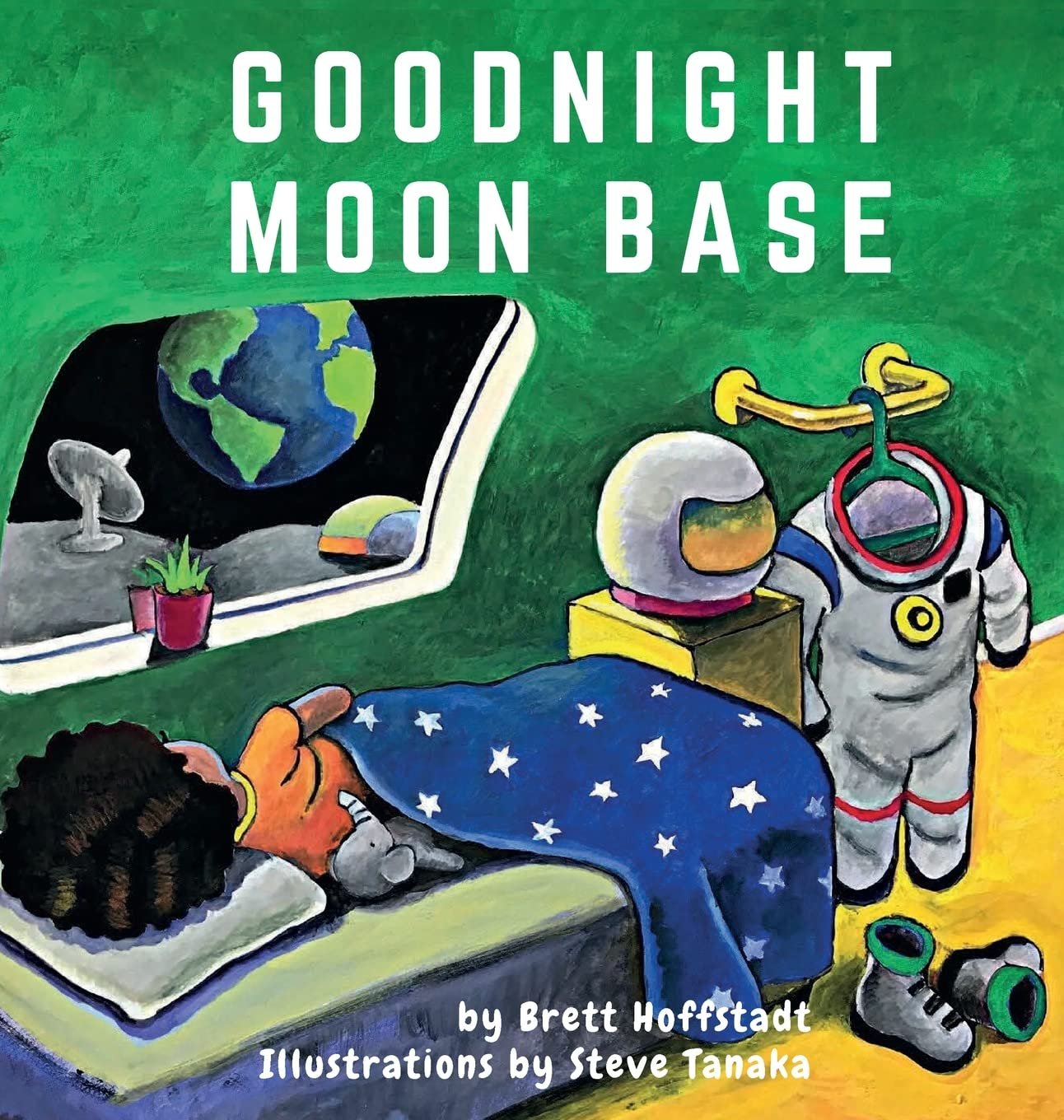
Goodnight Moon Base imagines a bedtime journey in the setting of a lunar settlement, inviting young listeners to treat space exploration as something they can dream about before going to sleep…
Books worth discovering. Authors worth knowing.
Goodnight Moon Base imagines a bedtime journey in the setting of a lunar settlement, inviting young listeners to treat space exploration as something they can dream about before going to sleep. Written by Brett Hoffstadt and illustrated by Steve Tanaka, the book belongs to a distinctive kind of science-oriented picture book: not a technical manual for…
Considered reviews, grounded in the book’s documented promise.
Goodnight Moon Base imagines a bedtime journey in the setting of a lunar settlement, inviting young listeners to treat space exploration as something they can dream about before going to sleep. Written by Brett Hoffstadt and illustrated by Steve Tanaka, the book belongs to a distinctive kind of science-oriented picture book: not a technical manual for children but an invitation to feel at home, imaginatively, in a future that has not yet arrived.
A familiar ritual in an unfamiliar setting
The bedtime book is one of children's literature's most stable forms. Repetition, a quietening rhythm and the naming of familiar objects tell the reader that the world is safe enough to leave behind for a night. Moving that form to the moon changes what counts as ordinary. A habitat, spacecraft or distant landscape may take the place of the things of home. The result can normalize scientific possibility without explaining engineering through dense prose. What matters critically is whether wonder and comfort support one another or whether excitement makes the ritual too restless.
The future as domestic imagination
Many space books for young readers focus on achievement: rockets launch, astronauts accomplish tasks, humans conquer distance. Hoffstadt's central idea is gentler. A moon base need not always be a frontier to be won; it can be somewhere people live, rest and say goodnight. That shift matters. The future becomes habitable rather than merely spectacular, and children are invited to consider the ordinary needs of people in extraordinary settings. The publisher's positioning makes this aspiration clear; a detailed reading would be needed to evaluate how each spread accomplishes it.
Art carries the science
Steve Tanaka's role as illustrator is crucial because spatial relationships are unusually difficult to communicate to a very young audience through explanation alone. Images can show scale, equipment and a sense of place while leaving room for a child to ask questions. The moon base must feel wondrous but not incoherent. There is a productive balance between accuracy and invitation: images can suggest engineering constraints without turning every page into a diagram. The full visual sequence was not inspected for this review, so judgments about actual compositional quality remain provisional.
A hopeful book without false certainty
Hoffstadt's aerospace background gives context for the project, but it is not proof that every visual claim is scientific prediction. A moon settlement is a scenario, not a promise about when human history will arrive there. That distinction need not diminish a child's experience. Stories may motivate curiosity precisely because they offer imaginable futures whose difficult work has yet to be done. This book should be approached as imaginative STEM encouragement, not as a factual forecast.
The read-aloud test
The National Space Society has published an appreciative review of the book and identifies it as a short children's work. Yet the most honest critical standard for a bedtime title remains how it sounds in the mouth and behaves in the child's attention. Is it pleasant to revisit? Can a grown-up read it without stumbling? Does it create a small feeling of closure? Its space premise is appealing, but a full text-and-image assessment would be required before making those claims about execution.
Who will value this book
For young children fascinated by rockets, astronomy and the reassuring rituals of bedtime, the premise is an attractive bridge between imagination and STEM curiosity. It also offers families a chance to discuss what people would need in order to live beyond Earth. This review is evidence-bound; full-page art and complete read-aloud rhythm were not independently assessed.
Scope of this assessment
This is a research-based editorial review drawn from identified bibliographic, author and publisher sources. It considers the work’s documented premise and the critical questions it invites, without claiming a complete firsthand reading. No unverified scene, character action or ending is asserted.
About the book.
An evidence-bounded critical introduction to science-fiction-themed picture book and bedtime rhyme. Published descriptions support the stated premise; interpretations are identified as editorial analysis, not confirmed plot details.
This review concerns a book marked sponsored in the current MarketAnyBook queue. Sponsorship is disclosed, and all observations remain research-based.
Found a book worth opening?
Books worth discovering. Authors worth knowing.
Return to the Journal →