
Hidden Freedom
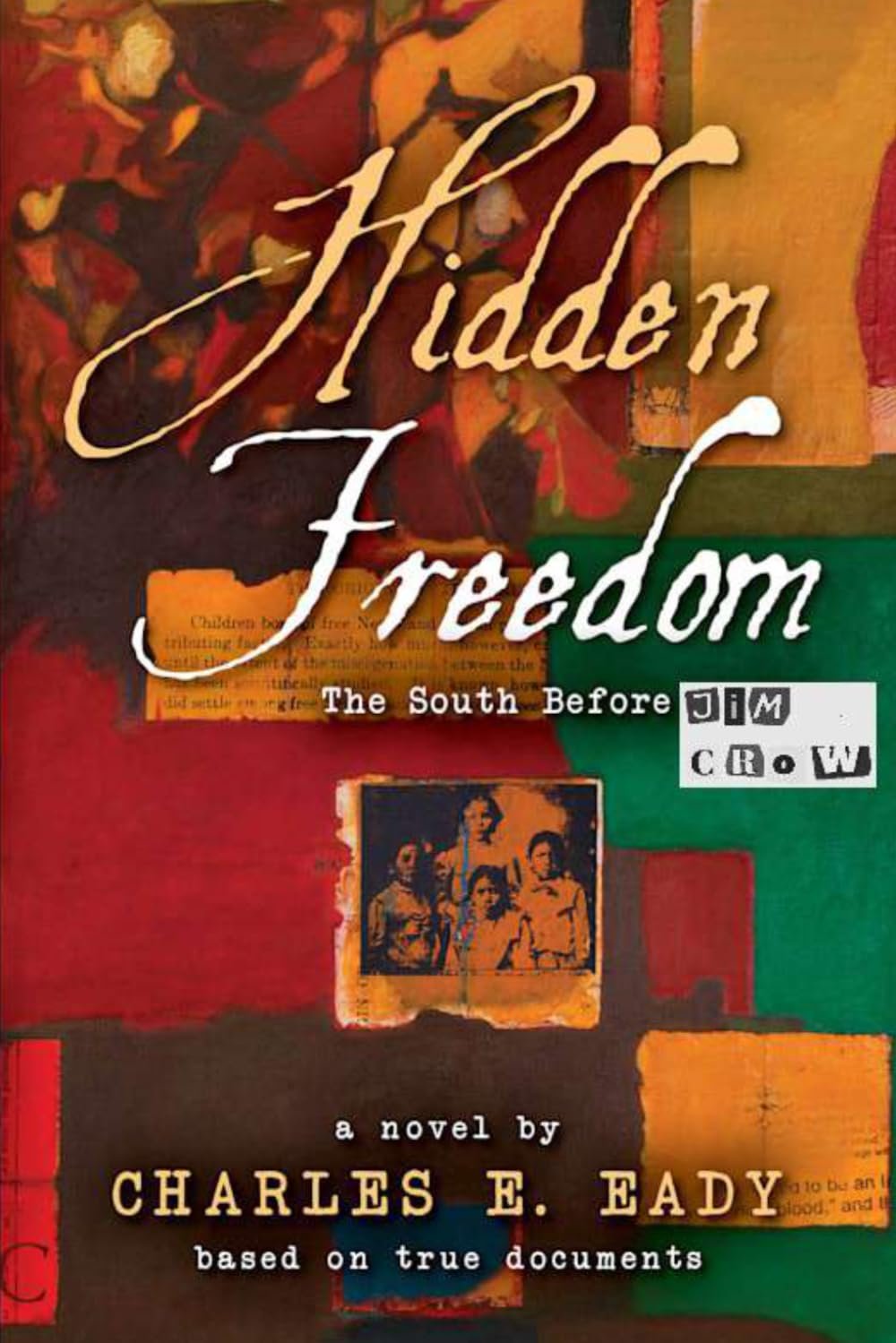
Hidden Freedom contests a familiar flattening of the American South by examining the lives and aspirations of free Black people who lived there and the records that can still recover their agency…
Books worth discovering. Authors worth knowing.
Hidden Freedom contests a familiar flattening of the American South by examining the lives and aspirations of free Black people who lived there and the records that can still recover their agency. Charles E. Eady's book presents itself as an intervention in historical memory, drawing attention to documents that conventional summaries may neglect. That…
Considered reviews, grounded in the book’s documented promise.
Hidden Freedom contests a familiar flattening of the American South by examining the lives and aspirations of free Black people who lived there and the records that can still recover their agency. Charles E. Eady's book presents itself as an intervention in historical memory, drawing attention to documents that conventional summaries may neglect. That is potentially important work. It also demands an unusually exacting standard: when a history book challenges established narratives, the strength of its evidence and the care with which it interprets that evidence matter more than the forcefulness of its cover claim.
Who appears in the archive?
Historical narratives can become distorted not only because events are misreported but because some lives leave a richer documentary trail than others. Government documents, property transactions, petitions and private correspondence record certain actions while omitting motives and silencing people who lacked institutional access. Eady's stated focus on free Black Southerners broadens the questions historians might ask about autonomy, property, education and civic participation. Yet the reviewer must also recognize that an archive is not a transparent window. Every document was produced within a set of power relationships, and its language may conceal as much as it reveals.
The risk of correcting one simplification with another
The phrase the South before it was racist, associated with the work in an art exhibition, is provocative and historically difficult. Racial exploitation and slavery existed long before later systems of formal segregation; the history of free Black people complicates any single narrative without eliminating the violence of those structures. A responsible account can insist on recovering Black achievement while refusing to make that recovery evidence of a racially innocent society. The necessary question is whether Eady distinguishes local variations, legal categories and historical periods with sufficient care. A short sales description cannot answer that.
A painter’s investment in recovery
Eady is also identified with visual art inspired by the research, including a portrait and story involving a woman determined to learn to read. This suggests a distinctive relationship between documentation and imagination. Historical art can make neglected lives emotionally legible, but it must clarify where a recorded fact ends and reconstructive storytelling begins. The ethical challenge is especially sharp when the subjects cannot correct the modern interpreter. Readers should attend closely to references, dates and the provenance of documentary claims rather than relying solely on a compelling anecdote.
History is richer when agency survives
A narrow narrative of oppression can inadvertently deny agency to people whose freedom was constrained. A narrow counternarrative of achievement can minimize the constraints themselves. The richest history must hold both truths together. Free Black Southerners created lives, institutions and strategies within a racial order that remained profoundly unequal. Eady’s subject is worth recovering precisely because historical complexity resists easy morality plays. A first-hand review of the complete book would need to assess not just how many examples it collects but whether their interpretation supports the larger conclusion.
The reader’s obligation
This is the kind of book that should send readers toward primary sources and scholarly conversations, not away from them. Claims presented as neglected truths require verifiable citations and a willingness to engage historians who read the same records differently. A fair reviewer should be open to new evidence and alert to rhetorical overreach. The available summary establishes the subject and intent, not enough of the apparatus or argument to award it scholarly authority.
An archive is a collection of choices
To say a document was rarely seen is not yet to prove that historians ignored it. Access, cataloguing, survival and scholarly circulation are different matters. A serious reader should ask whether each record is reproduced accurately, dated, contextualized and compared with relevant scholarship. Hidden Freedom's promise of archival recovery is therefore both an attraction and a responsibility. The more surprising the interpretation, the more generously it should show its supporting work. That transparency lets readers appreciate a discovery without needing to trust the author's confidence alone.
The conceptual trouble with freedom
Free Black people in the American South did not occupy a single stable legal or social position across colonies, states and decades. Freedom could be formally recognized yet severely restricted, exercised through property or literacy while threatened by discriminatory laws and violence. A book that recovers their experiences must attend to that complexity. The title Hidden Freedom suggests agency within constraint; its argument will be strongest when it never makes freedom a synonym for equality. The available promotional description highlights examples of striving, but the full book must show whether the surrounding restrictions are examined with equal precision.
History and the desire for a better past
Readers may understandably wish to find lost stories of success, cooperation or dignity amid an overwhelmingly brutal history. Those stories matter. But the need for encouraging examples can tempt a writer to draw conclusions larger than the evidence supports. Good historical prose takes pride in complexity rather than a feel-good correction. Eady's subject would gain force from explaining contradictions: how a particular individual achieved relative independence; what that accomplishment required; and which neighbors faced a very different reality. Such work honors lives better than a claim that the wider society was simpler or kinder than it actually was.
The necessary patience of reconsideration
Readers need not choose between honoring free Black agency and recognizing Southern racism. Both belong in the same historical field. The most valuable version of Eady's project would push beyond that false choice, restoring individuals to accounts previously dominated by systems while still explaining those systems accurately. The work deserves an open but rigorous reading: assess its documents, distinguish fact from inference and invite further research rather than treating any provocative framing as the final word.
Who will value this book
Suitable for readers interested in African American Southern history, archival recovery and the politics of historical interpretation. It is best read critically alongside established scholarship. This is a research-based assessment of the documented project, not independent validation of every archival or historiographical claim.
Scope of this assessment
This is a research-based editorial review drawn from identified bibliographic, author and publisher sources. It considers the work’s documented premise and the critical questions it invites, without claiming a complete firsthand reading. No unverified scene, character action or ending is asserted.
About the book.
An evidence-bounded critical introduction to revisionist Southern history and archival nonfiction. Published descriptions support the stated premise; interpretations are identified as editorial analysis, not confirmed plot details.
This is an unsponsored, research-based editorial review, not a claim to firsthand reading of the complete book. Historical assertions in promotional synopsis have not been independently checked against the book’s primary documents; requires scholarly editorial review.
Found a book worth opening?
Books worth discovering. Authors worth knowing.
Return to the Journal →