
Where Trees Fall: 1
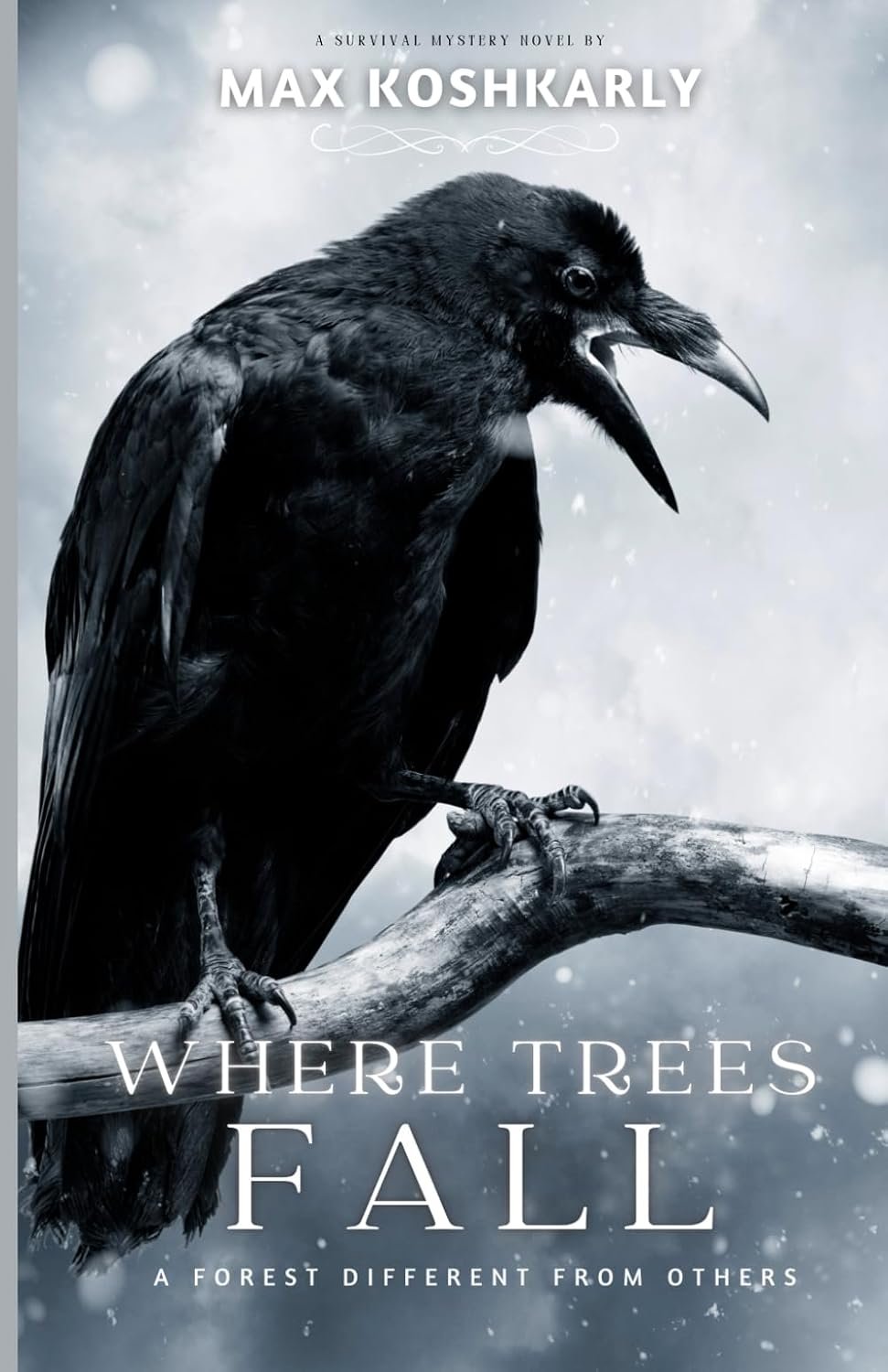
Where Trees Fall takes Alice and Emily into a mysterious forest after a severe storm, leaving them to navigate the unfamiliar wilderness through trust, ingenuity and mutual effort. The forest…
Books worth discovering. Authors worth knowing.
Where Trees Fall takes Alice and Emily into a mysterious forest after a severe storm, leaving them to navigate the unfamiliar wilderness through trust, ingenuity and mutual effort. The forest carries a double promise: it is a concrete survival problem and a space where ordinary expectations may no longer hold. Maksud Koshkarly's story draws upon the…
Considered reviews, grounded in the book’s documented promise.
Where Trees Fall takes Alice and Emily into a mysterious forest after a severe storm, leaving them to navigate the unfamiliar wilderness through trust, ingenuity and mutual effort. The forest carries a double promise: it is a concrete survival problem and a space where ordinary expectations may no longer hold. Maksud Koshkarly's story draws upon the familiar fairy-tale tradition of being lost in the woods, but the published description suggests a darker atmosphere combining surrealism, mystery and horror.
The forest does not simply hide the route
In folklore, woods often mark a region beyond settled social rules. People can lose not only direction but also confidence in what their senses tell them. The account of Alice and Emily's journey builds on that inherited symbolism while introducing storms, animals and secrets. Such ingredients offer many forms of danger, yet the more durable suspense may come from uncertainty about the forest's logic. Does a practical choice still produce a predictable result? The public synopsis invites that question without settling how the story answers it.
Two people against an environment
The pairing of Alice and Emily prevents the story from becoming purely solitary endurance. Survival depends on whether trust can survive fear, fatigue and incompatible judgments. In fiction, companionship is most convincing when people are not always generous or correct. The stated themes of honesty, loyalty and friendship could emerge through practical disagreements about risk and responsibility. They could also flatten into lessons if stated too directly. A full reading is needed to distinguish the novel's treatment from the synopsis's uplifting vocabulary.
A storm as the boundary between worlds
An opening disaster is an efficient way to sever the protagonists from recognizable security. The danger of that method is that external spectacle substitutes for a felt transition. The reader needs to understand what Alice and Emily have lost, even if the book withholds parts of their history. A storm can be the mechanism of displacement; it should not necessarily be the whole meaning of it. The strongest survival stories let environmental obstacles reveal character rather than treating each hazard as another box to tick.
The tension between horror and reassurance
The available descriptions include language of friendship and resilience alongside a haunting forest that may never fully release those who enter. That combination is more interesting than either uncomplicated adventure or continuous terror. A story can allow characters to support one another without making the world safe. It can also use a disturbing landscape to expose the limits of control. The novel's tone and resolution cannot be certified from the publisher statement, but the premise supports a genuinely ambivalent reading.
The forest as a keeper of memory
A frightening place in folklore often seems to know more about its visitors than they know about themselves. Koshkarly's synopsis refers to hidden secrets and a place that may not wholly release those who encounter it. Such language suggests that escape might not be equivalent to leaving. A journey can change the way survivors remember danger, friendship or their own capacity to act. This psychological dimension would distinguish the story from a conventional obstacle course. The title also invites a quiet unease: trees falling may imply damage to a system that once appeared permanent. Those are thematic possibilities, not verified revelations of the plot.
Adventure and uncertainty about age
The named heroines and moral emphasis might lead some readers to assume a children's adventure, while descriptions of horror and surrealism point in a darker direction. Marketing records are not consistent enough to settle the intended age bracket. That matters. The same scene can be thrilling or overwhelming depending on a reader's expectations, and a recommendation should not smuggle in an unverified suitability claim. Prospective readers are better served by a description of the documented atmosphere: mysterious, threatening and oriented toward survival with another person. A definitive age recommendation would require inspection of language, violence and resolution.
Trust must have a dramatic price
If the story is about friendship, every danger need not function as a lesson, but the characters' decisions should still affect their relationship. Trust becomes meaningful when somebody has a reason to withhold it. Loyalty matters when it conflicts with fear or practical advantage. The synopsis names these values, yet the reviewer should ask whether the narrative allows them to be tested rather than merely rewarded. That is where the difference lies between a book that says friendship is important and one that makes readers feel the difficult work of remaining a friend.
A mystery whose consequence can endure
The most affecting forest stories leave a trace after the path is found. Alice and Emily's ordeal may matter less for which trail proves safe than for how they learn to rely on one another under conditions of limited knowledge. The description explicitly foregrounds mutual trust, and that choice makes the horror elements potentially richer. Fear sharpens attention; it can also isolate. A narrative that allows companionship to survive uncertainty would justify its emotional claims. The stronger critical standard is therefore not the number of creatures or hazards the characters encounter, but how the experience changes what it means for them to be together.
Who will value this book
For readers who like mysterious forests, survival narratives and emotionally charged speculative adventure, the setup is attractive. It may also suit those who enjoy young protagonists building trust under pressure, though the exact intended age range is not verified. This assessment draws on published synopses and does not invent the ending. The promise of the forest lies in its emotional disturbance as much as in its physical hazards; the strongest full review would investigate that intersection with close attention to the characters’ language and choices. The source material is clear about the premise but does not settle narrative technique or reader age.
Scope of this assessment
This is a research-based editorial review drawn from identified bibliographic, author and publisher sources. It considers the work’s documented premise and the critical questions it invites, without claiming a complete firsthand reading. No unverified scene, character action or ending is asserted.
About the book.
An evidence-bounded critical introduction to surreal forest adventure and psychological fantasy. Published descriptions support the stated premise; interpretations are identified as editorial analysis, not confirmed plot details.
This is an unsponsored, research-based editorial review, not a claim to firsthand reading of the complete book.
Found a book worth opening?
Books worth discovering. Authors worth knowing.
Return to the Journal →