
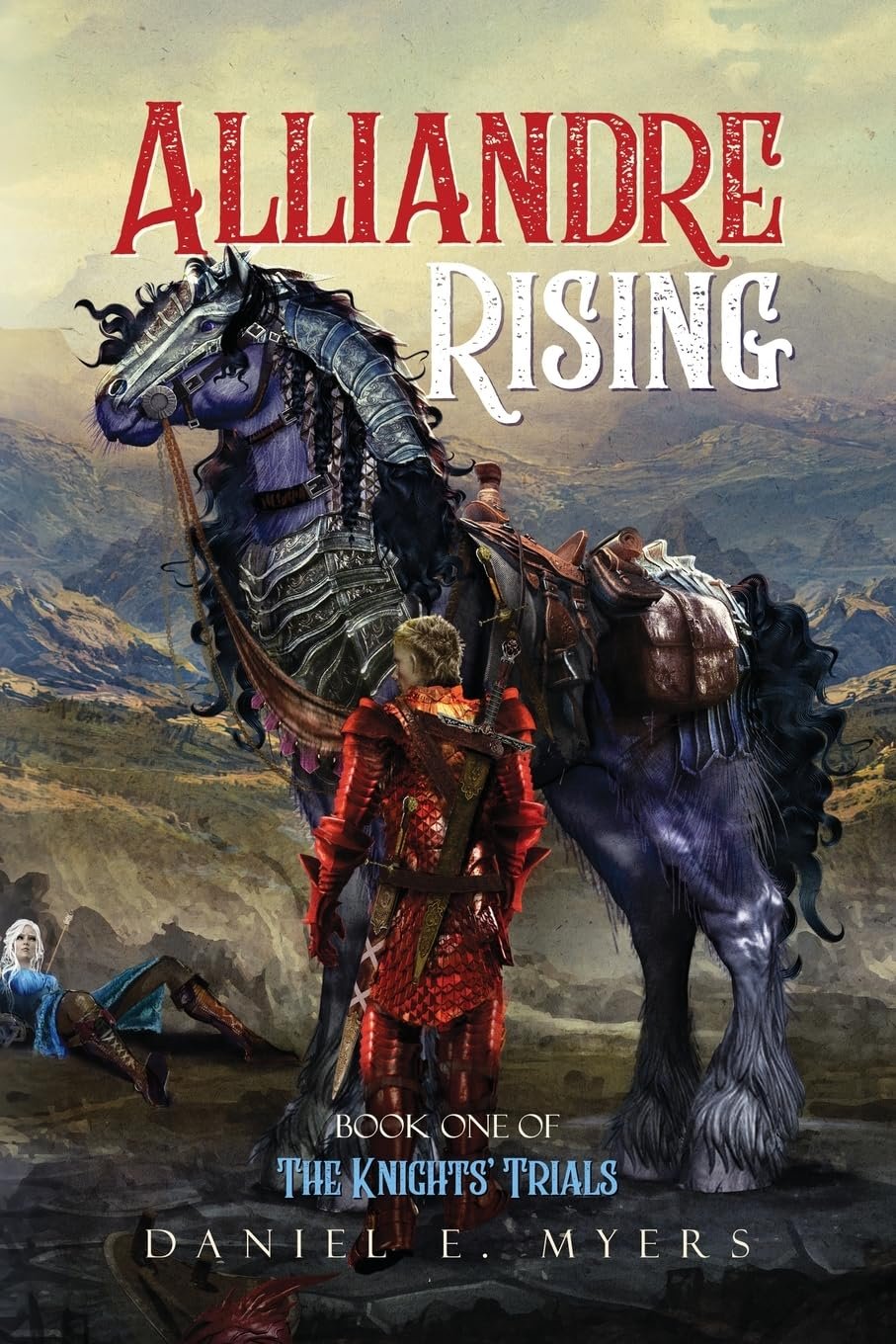
Alliandre Rising
A young knight faces rivalry, pride and the expectations of a magical world as the Knights’ Trials move toward a decisive contest.
Books worth discovering. Authors worth knowing.
A young knight faces rivalry, pride and the expectations of a magical world as the Knights’ Trials move toward a decisive contest.
D.
The Road Toward a Knight’s Defining Choice
A fantasy tournament is never merely a contest of weapons when the people competing carry rivalries, aspirations and obligations into the arena. Alliandre Rising, the first book in Daniel E Myers’s Knights’ Trials, uses that potential for moral complication in a world of knights, aelf magic and social rules about which kinds of power deserve respect. The official synopsis sets Alliandre on a path toward a Grand Melee, while his companion Sivle pursues magical advancement and the Silver Aelf Ariandel becomes an unexpected force in their relationships. Their stories provide several ways of thinking about knighthood: as formal achievement, personal discipline and the difficult business of recognizing another person’s worth.
The central questions are not limited to which competitor will prevail. A character can win an encounter and lose something important through the manner of the victory. Another can fail publicly and still reveal courage or ingenuity. The author-provided outline highlights humiliation, scorn and acceptance alongside training and battle. This creates a promising foundation for readers who enjoy epic settings but want decisions to matter as much as spectacle. The book’s reported premise is unusually specific, so a spoiler-conscious feature can discuss its tensions without claiming knowledge of what happens after the final moment described in the publisher’s setup.
Alliandre and the Weight of Honor
In the official description, Alliandre’s most consequential confrontation is tied to Sir Rodney, a rival whose insult against Marion provokes anger. The Grand Melee becomes more than a stage for testing skill because Alliandre’s emotional response threatens to eclipse his discipline. When he gains a position of overwhelming advantage, the question shifts from whether he is strong to what strength requires of him. A knight’s reputation may depend on restraint as much as on victories. A tournament can reward boldness, but honor is tested in the moment when an opponent is vulnerable and the crowd is watching.
The outline stops at a stark image of Alliandre with power over his rival’s life. It would be irresponsible to supply the next action or its aftermath without a verified text. What can be said is that the narrative deliberately places the audience at the edge of a moral decision. Readers who like tournaments as tests of character may appreciate that emphasis. The confrontation also makes pride a credible antagonist. Sir Rodney’s provocation matters because it reaches beyond sport into loyalties that Alliandre values, and his response forces the ideal of the honorable knight to meet ordinary human fury.
Sivle’s Unwelcome Kind of Magic
Alliandre’s companion Sivle Si Evila Drol Revo offers a different route through the same world. He is a half-aelf former priest and an active mage attempting to impress the Mage’s Council with a war-mage spell. According to the official summary, this institution prefers nurturing and harvest magic over martial innovation. The disagreement is intriguing because both positions could reflect legitimate concerns. A council that has seen magic used destructively may fear its militarization; a young mage might believe refusing to develop defensive power leaves people exposed. The premise does not settle the argument, but it gives Sivle’s ambitions more complexity than a simple quest for a stronger spell.
The published outline suggests that Sivle encounters public humiliation and reveals a capacity others regard with disapproval. Such treatment raises questions about gatekeeping. Institutions often claim to recognize merit while setting cultural boundaries that make certain kinds of talent unwelcome. In fantasy, magical rules can render these pressures visible and dramatic. Sivle’s challenge is not only to master a technique. He has to decide how far to pursue recognition from an establishment that may never accept his work on his own terms, and whether personal loyalty can help him withstand criticism.
Ariandel and the Cost of Judgment
Ariandel, a Silver Aelf mage, hopes to excel in her craft and participate in the comórtas pósta, a selection associated with the next Great Aelf King. The author’s account describes a young adult whose skepticism toward her new acquaintances slowly softens as she witnesses friendship and acceptance offered in the face of belittlement. Her development, as outlined, is not a straight line. An episode involving Sivle’s humiliation and her own untimely gloating closes a possible avenue of further instruction. What makes that incident interesting is not simply embarrassment; it is the way a quick judgment can destroy a relationship one has only begun to understand.
This interpersonal layer matters in a fantasy filled with titles and ceremonial institutions. An impressive magical gift cannot automatically produce discernment. Characters may learn technical skills more readily than humility, and the ability to recognize another person’s talent can be tested before the talent becomes socially fashionable. The Silver Aelf’s ambitions also invite an inquiry into how individual desires intersect with the expectations attached to rank. A reader need not know every custom of the fictional society to understand the central human problem: what happens when a person mistakes familiarity with rules for wisdom about people?
A World Shaped by Competing Traditions
The presence of an organized Mage’s Council, religious histories, aelf social structures and formal knightly competition indicates an invented world governed by institutions as much as monsters or spells. Fantasy readers who appreciate social texture may find these details as compelling as combat. Institutions carry memory and establish shared norms, but they also enforce blind spots. A nurturing spell may be celebrated because it fits a community’s ideal image of magic, while an equally disciplined wartime application may be rejected because of its associations. The difference between safety and conformity is one of the genre’s enduring questions.
An author can use a tournament or a council hearing to turn abstract ideas into visible action. Alliandre’s honor becomes a decision made under scrutiny; Sivle’s status becomes a humiliating public judgment; Ariandel’s capacity for empathy becomes a choice in how she treats someone other people have dismissed. These threads appear capable of converging because they share a concern with the collision between personal conduct and public reputation. A fuller assessment of how they ultimately interweave would require reading the novel, but the official premise explains why the first volume is framed as a trial in more than one sense.
For Readers Who Want Consequences
The book will likely interest readers of chivalric epic fantasy who enjoy layered alliances, institutions with competing values and characters whose strengths are imperfect. The author presents several points of identification. Some readers may recognize Alliandre’s anger at an insult against someone he cares for. Others will respond to Sivle’s frustration when work he values is dismissed. Ariandel’s uncertainty offers another entry: the discomfort of realizing that a first impression was unfair. None of these perspectives guarantees a simple hero or villain, and that complexity may be a reason to enter the series.
Alliandre Rising is labeled as the first Knights’ Trials volume, so it also serves as an invitation into a longer fantasy world. Beginning a series means learning its language and institutions while discovering which loyalties will survive pressure. The official summary makes clear that the characters’ defining tests concern pride, acceptance and ambition as much as swordsmanship or magic. That is a sound reason to explore the novel. The spectacle of the Grand Melee may attract attention, but the questions surrounding the decisive blow promise the deeper journey.
About the book.
The official book presentation follows Alliandre toward a martial contest, the complicated training and aspirations of mage Sivle, and Ariandel, a Silver Aelf mage whose ambitions test relationships and judgments.
Editorial book feature, not paid sponsorship. Independent research-based commentary using publicly available descriptions and author material, not a claim of first-hand full-text review. The cover placeholder will be resolved by the owner’s publishing automation.
Found a book worth opening?
Books worth discovering. Authors worth knowing.
Return to the Journal →